Single Agent or Multi-Agent? A Decision Guide for Enterprise Teams
By Delos team — 2026-11-20
Every enterprise team building with AI agents hits the same fork: one capable agent that does everything, or a team of specialised agents coordinated by an orchestrator? The honest answer is that most teams should start with one, and move to several only when a specific constraint forces them to. This guide gives you five questions to decide, the real trade-offs, and a rollout path.

Every enterprise team building with AI agents hits the same fork: one capable agent that does everything, or a team of specialised agents coordinated by an orchestrator? The honest answer is that most teams should start with one, and move to several only when a specific constraint forces them to. This guide gives you five questions to decide, the real trade-offs, and a rollout path.
Why this choice matters more than the model you pick
Architecture decides cost, latency, debuggability and how much risk you can contain. Anthropic's engineering guidance on building agents recommends finding the simplest solution possible and only adding complexity when it demonstrably improves outcomes. The cost of ignoring that advice is visible in the market: Gartner predicts that over 40% of agentic AI projects will be cancelled by the end of 2027, citing escalating costs, unclear business value and inadequate risk controls. Over-engineered architectures feed all three.
What each architecture looks like
Single agent
One agent, one prompt, one set of tools and permissions. It plans, calls tools and answers. It is simple to build, cheap to run and easy to debug because there is one trace to read. Typical fits: an assistant that summarises meetings and drafts follow-ups, or a support agent answering from one knowledge base.
Multi-agent (orchestrated)
An orchestrator receives the goal, splits it, routes sub-tasks to specialist agents (data retrieval, writing, approval), checks their output and merges the result. Each specialist has a narrow prompt and only the tools it needs.
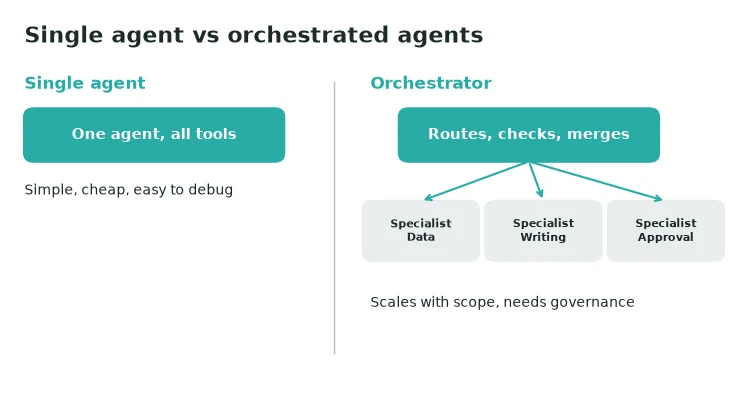
Single agent vs orchestrated agents
Five questions to decide
1. Do the tasks need different tools or permissions? If one step reads payroll data and another posts to a public channel, separate agents let you give each the minimum access. That is a security argument, not a performance one.
2. Can steps run in parallel? Independent sub-tasks (checking ten suppliers, reviewing ten contracts) finish faster when several agents work at once.
3. Does one prompt exceed the context window? When instructions and documents no longer fit, or quality drops as the prompt grows, specialists with focused context help.
4. Do different risk levels need separate controls? A drafting step can run freely while a payment or customer-facing step needs human approval. Splitting them makes the approval point explicit and auditable.
5. Do different teams own different parts of the process? Finance owns reconciliation, legal owns review. Separate agents map to separate owners, which keeps accountability clear.
Rule of thumb: zero or one yes, stay with a single agent. Two or more, design a multi-agent setup around exactly those constraints.
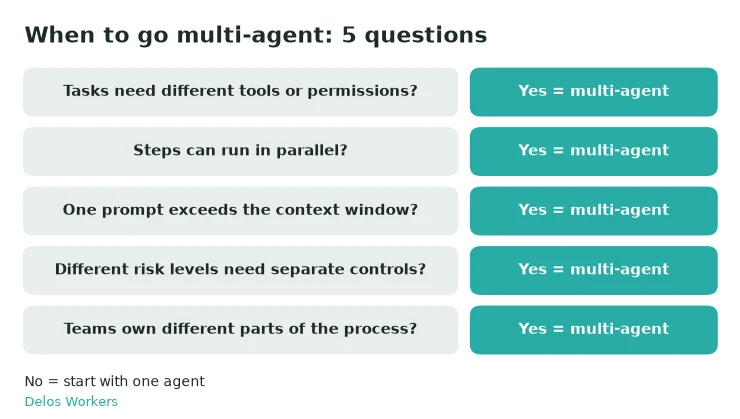
When to go multi-agent: 5 questions
The real trade-offs
Cost and latency
Multi-agent setups multiply model calls. In Anthropic's write-up of its multi-agent research system, agents used roughly 4x more tokens than a chat, and multi-agent systems roughly 15x more; the same article reports the multi-agent setup beat a single agent by 90.2% on its internal research evaluation. Better results can justify the bill, but only for high-value tasks. These are figures from one vendor's own system, so treat them as an order of magnitude, not a benchmark for your use case.
Debugging and reliability
Every handoff is a place where context is lost or an error is amplified. With one agent you read one trace; with five you need tracing across all of them, plus tests for each handoff.
Governance
Multi-agent can reduce risk (least privilege per agent) or increase it (more surfaces, more places to log). It only reduces risk if permissions, logging and approval gates are designed in from day one. See our guide on writing an acceptable-use policy employees follow.
Three enterprise examples
- Meeting follow-ups (single agent): one agent summarises, extracts actions and drafts emails from one transcript. No parallelism, one permission set. Stay simple.
- Employee onboarding (multi-agent): separate agents for IT access, HR paperwork and training schedule, because each touches a different system and owner. See our 30-day employee onboarding checklist.
- Month-end close across entities (multi-agent): parallel reconciliation per entity, an orchestrator consolidating, and a human approval gate before posting.
A rollout path that avoids the 40% trap
1. Start with one agent on one narrow, measurable workflow.
2. Log every tool call and decision from day one.
3. When a specific constraint from the five questions appears, extract that step into a specialist, not the whole system.
4. Add an orchestrator only when you have two or more specialists to coordinate.
5. Keep a human approval point on every irreversible action.
Most stalled projects skip step 1. Read why pilots stall before production.
Conclusion
The question is not 'which architecture is more advanced' but 'which constraint am I solving'. One agent until a permission, parallelism, context, risk or ownership constraint says otherwise. Delos Workers are built as specialised AI colleagues you can combine step by step, with permissions and memory per worker, so you can grow from one to several without rebuilding.
FAQ
Is multi-agent always better?
No. It adds cost, latency and debugging effort; use it when a specific constraint requires it.
How many agents should I start with?
One, on one workflow.
Who approves agent actions?
A named human owner for every irreversible action.