Employee Onboarding With AI Agents: A 30-Day Checklist for HR Teams
By Delos — 2026-11-18
A practical 30-day onboarding checklist: let AI agents handle logistics and follow-through, while your people keep welcome, culture and feedback human.

Most onboarding fails quietly. The laptop arrives on day 3, the access requests sit in a queue, and the new hire spends the first week asking where things are. Brandon Hall Group research, widely cited, found that a strong onboarding process can improve new-hire retention by 82% and productivity by over 70%. The gap between a strong and a weak process is rarely strategy. It is logistics and follow-through, which is exactly what AI agents are good at.
Why onboarding breaks (and where AI agents help)
Three failure patterns show up again and again. First, handoffs: HR, IT, facilities and the manager each own one piece, and nobody owns the whole timeline. Second, repetitive questions: 'How do I book leave? Where is the expense policy?' are answered dozens of times a month. Third, silence: after day 5, nobody checks in until the first review. An AI agent connected to your HR tools, mailbox and calendar can own the timeline, answer the repetitive questions from your own documents, and trigger the check-ins. Your people keep what only people can do: welcome, context, trust.
The 30-day checklist
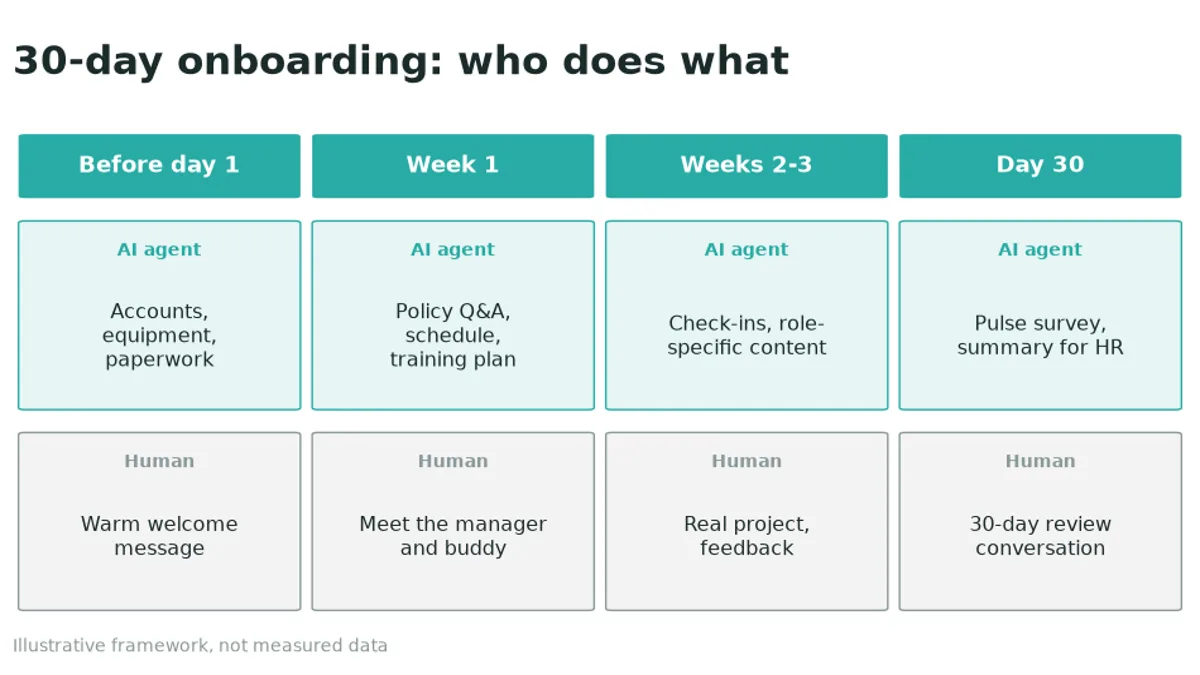
Before day 1: pre-boarding
- Send the signed-contract checklist and collect missing documents (ID, bank details, mutual insurance forms).
- Open accounts: email, calendar, messaging, the tools the role needs. Request access through your normal approval flow.
- Order and track equipment, with a delivery date before day 1.
- Draft the week-1 calendar: welcome meeting, manager one-to-one, buddy coffee, security and compliance training.
- Human: the manager sends a short, personal welcome message.
Week 1: orientation
- Day 1: the agent sends a one-page 'first day' brief (where to go, who to meet, which tools to open).
- Give the new hire an assistant that answers policy questions (leave, expenses, remote work) from your approved HR documents, with a link to the source each time.
- Schedule the mandatory training and track completion; remind the new hire and the manager if something is late.
- Human: the manager walks through the team's goals and introduces the buddy. This cannot be delegated.
Weeks 2 and 3: ramp-up
- The agent assembles a role-specific reading and training plan from existing documentation.
- Automated check-ins on day 5, 10 and 15: two or three questions, answers summarised for the manager and HR.
- Flag blockers early: missing access, unanswered requests, training not started.
- Human: the new hire takes on a real, small project with a clear owner and quick feedback.
Day 30: review
- The agent runs a short pulse survey and prepares a one-page summary: completed tasks, training status, sentiment, open issues.
- Human: the manager and the new hire hold the 30-day conversation, based on that summary. Agree on goals for days 30 to 90.
What to automate, and what to keep human
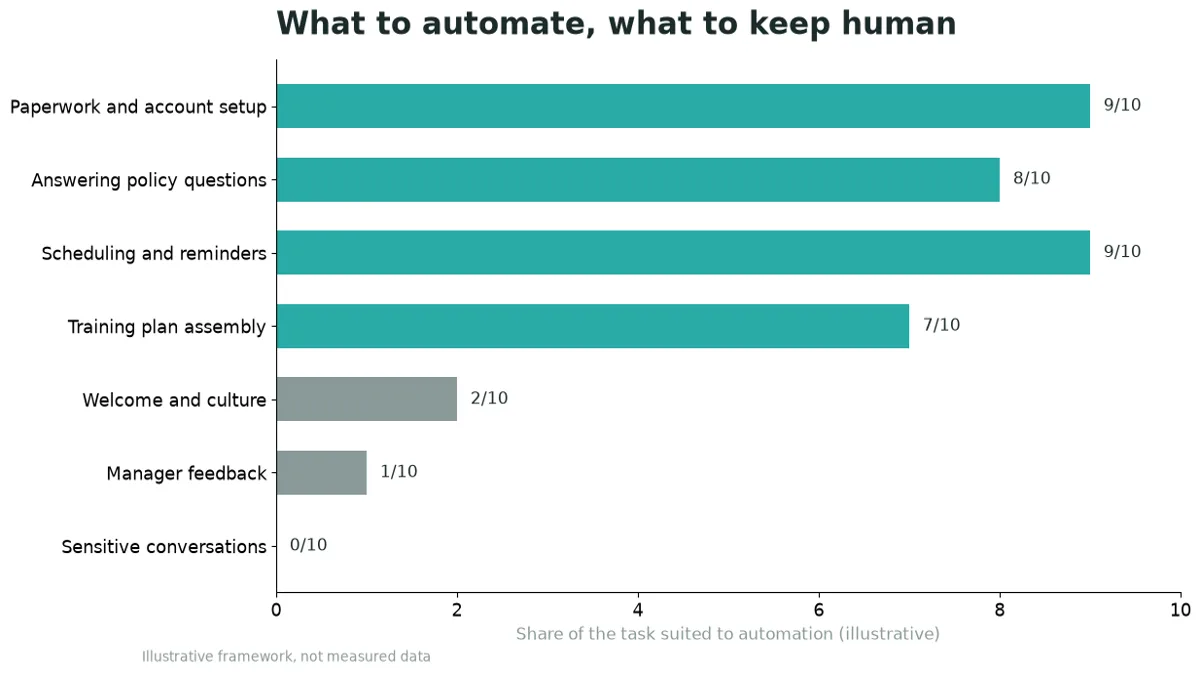
A simple rule: automate what is repetitive, rule-based and time-bound; keep human what is relational, contextual or sensitive. Paperwork, account setup, reminders and policy questions sit on the first side. Welcome, culture, feedback and any difficult conversation sit on the second. The scores in the chart are an illustrative framework, not measured data.
Guardrails HR should set before launch
- Data access. The agent should see only what the onboarding needs. Salary, health and disciplinary files are out of scope.
- Sources. Policy answers must come from approved documents and cite them. If the answer is not in the documents, the agent says so and routes the question to HR.
- Legal framing. Tools used for recruitment, performance or other employment decisions can fall under the high-risk category of the EU AI Act (Annex III, employment). Onboarding logistics is usually lower risk, but keep a human decision-maker on anything that affects a person's job, and document the setup. Personal data is also covered by the GDPR.
- Transparency. Tell new hires they are talking to an AI assistant, and give them an easy way to reach a person.
A realistic first month for your team
You do not need to automate all 30 days at once. Start with two high-volume steps: pre-boarding paperwork and the policy Q&A assistant. Measure time-to-first-login, number of HR tickets in week 1 and the new hire's own score at day 30. Then add check-ins and the day-30 summary. For the governance side, see our guide on an acceptable use policy. For another example of agents handling document-heavy work with human checkpoints, read our piece on clinical trial document review.
Key takeaways
- Onboarding fails on logistics and follow-through, which agents handle well.
- Split the 30 days into pre-boarding, week 1, weeks 2-3 and day 30, with one agent task and one human task each.
- Keep welcome, culture and feedback human.
- Set data, source and transparency guardrails before launch.