Why AI Pilots Stall Before Production: 6 Breaking Points and How to Fix Them
By Delos team — 2026-11-19
Most AI pilots impress in a demo and die in the handover. Here are the six places they break, and what to do about each.

The pilot worked. The demo got applause. Six months later, nothing runs in production. That pattern is the norm: S&P Global Market Intelligence's 2025 survey found companies scrapped on average 46% of AI proofs of concept before they reached production, and 42% abandoned most of their AI initiatives. MIT's NANDA initiative reported that about 95% of generative AI pilots had no measurable P&L impact. The cause is rarely the model. It is everything around it.
The pilot trap: why a demo is not a deployment
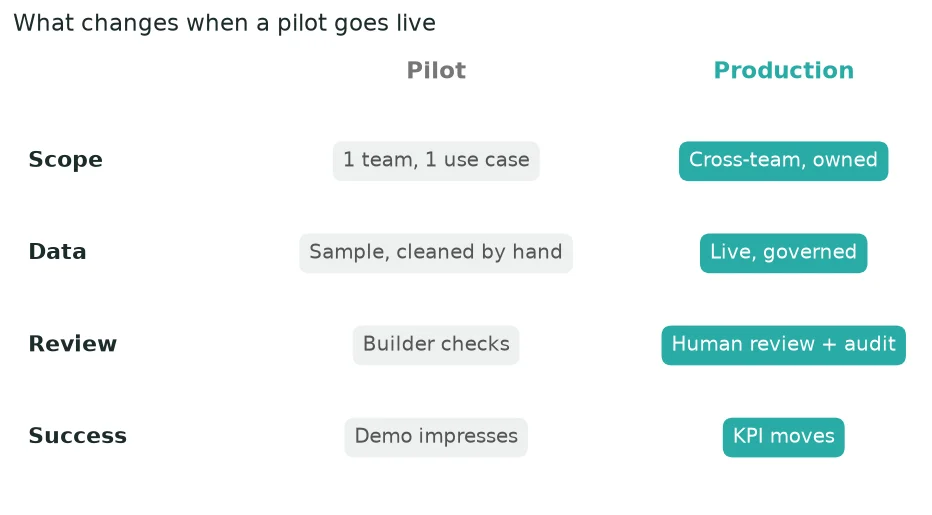
A pilot is built to prove that something is possible: one team, a cleaned sample of data, a builder who checks the output personally. Production has to prove that something is reliable: many teams, live data, no hand-holding. The two are different products. Treat the pilot as a rehearsal with a known end date, not as a smaller version of the real thing.
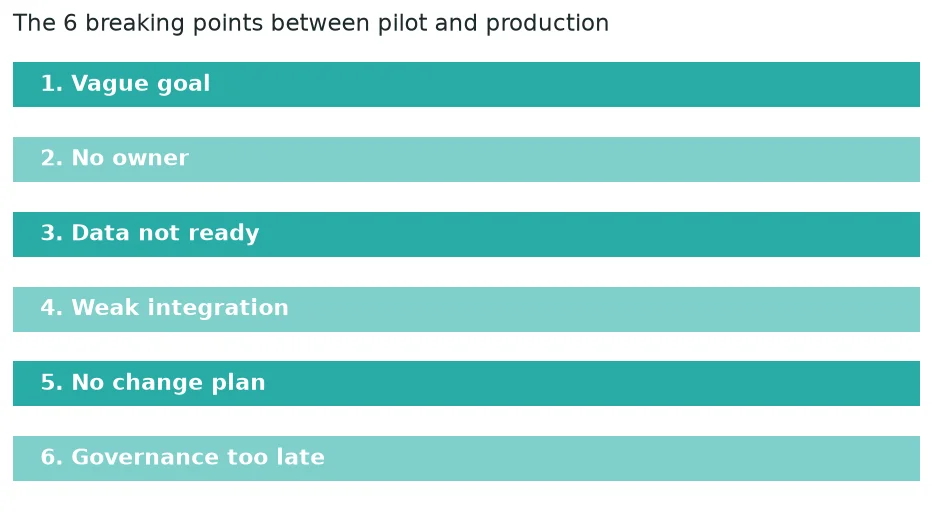
The 6 breaking points between pilot and production
1. A vague goal. 'Explore AI for finance' is not a goal. 'Cut invoice exceptions from 12% to 6% in two quarters' is. Without a metric, nobody can decide to scale or stop.
2. No business owner. Pilots run by IT or an innovation lab lose their sponsor when the budget cycle turns. Name one business owner who is measured on the result.
3. Data that was never ready. Pilots run on a curated extract. Production meets duplicates, missing fields and access rights. Audit the real data source before the pilot, not after.
4. Weak integration. Industry research cited in 2026 coverage says 78% of enterprises struggle to connect AI to legacy systems. If the agent cannot read from and write to the tools your team uses daily, people will copy-paste, then stop.
5. No change plan. A tool nobody was trained on is a tool nobody uses. Budget time for training, for rewriting the process, and for the manager who must change how work is assigned.
6. Governance arriving last. Security, legal and compliance reviews at the end turn into a veto. Bring them in at week one and agree the rules: what data the agent may touch, what a human must approve, what gets logged. Our guide on an AI acceptable use policy is a good starting point.
What production-ready actually means
Before going live, check four things: a named owner, a baseline number measured before the pilot, an audit trail of what the agent did, and a human review step for anything with financial, legal or customer impact. If one is missing, you are still in pilot, whatever the slide says.
A 90-day playbook to move from pilot to production
Days 1-15: pick one workflow with a measurable cost, assign the owner, record the baseline. Days 16-45: run the pilot on real, uncleaned data with the real tools connected. Days 46-60: hold a go/no-go review against the metric; stopping is a valid result. Days 61-90: roll out to a second team, train users, and set up monitoring and a monthly review.
Use case: onboarding that survived the handover
An HR team piloted an AI agent to answer new-hire questions. It scaled only after they connected it to the HRIS, set a human check on contract-related answers and measured time-to-first-productive-day. See our 30-day onboarding checklist for the full approach. The same logic applies to finance close and to intercompany reconciliation, covered in our multi-entity close article.
How Delos workers help
Delos workers are AI colleagues with a role, a memory and access to more than 3,000 tools, so integration is part of the setup rather than a later project. Roles, permissions and human validation steps are defined from day one, which removes breaking points 4 and 6 early.
Key takeaways
- Define one metric and one owner before writing a line of prompt.
- Pilot on real data and real tools.
- Bring governance in at week one.
- Plan the change, not just the build.
- Decide to scale or stop at day 60.
For broader adoption context, see McKinsey's State of AI.
FAQ
Why do AI pilots fail?
Mostly for organisational reasons: unclear goals, no owner, poor data, weak integration, no change management, late governance.
How long should an AI pilot last?
30 to 60 days on real data, with a go/no-go review against a metric set beforehand.
What percentage of AI pilots reach production?
Estimates vary by study and definition: S&P Global found 46% of proofs of concept scrapped on average; MIT NANDA reported about 95% of generative AI pilots without measurable P&L impact.