AI Acceptable Use Policy: A One-Page Template Your Employees Will Actually Follow
By Delos — 2026-11-16
Most companies have no AI policy, and employees use AI anyway. Here is a one-page template built around data tiers, approved tools and clear escalation.

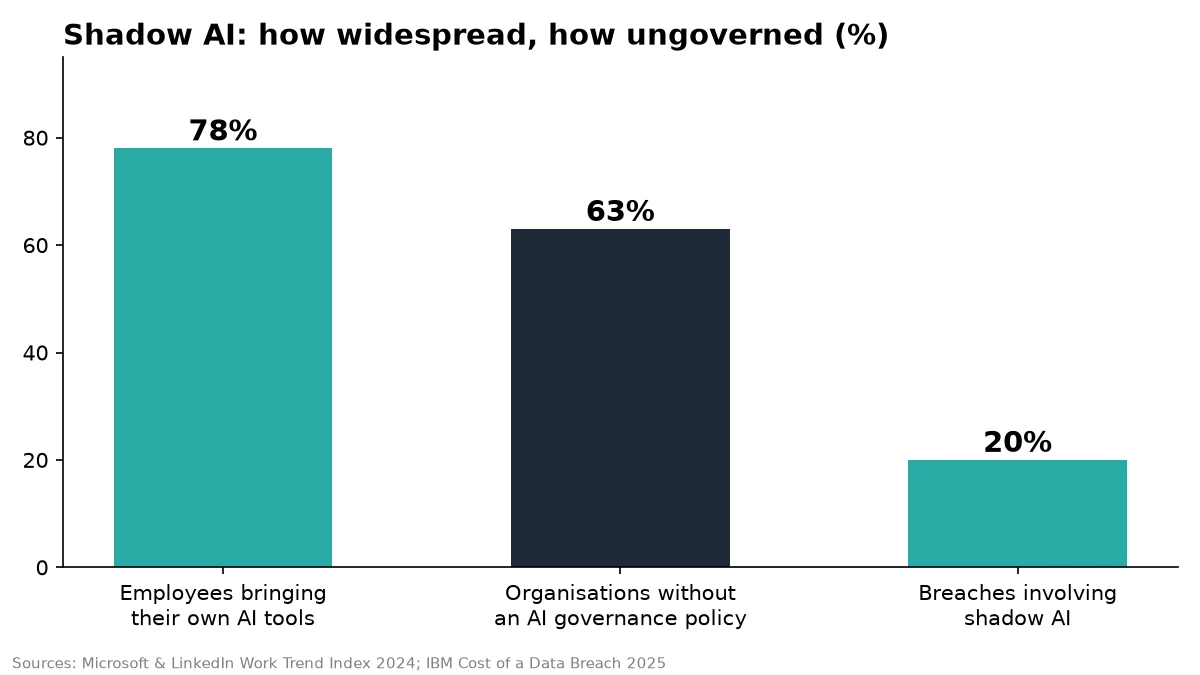
Your employees are already using AI. Microsoft and LinkedIn’s 2024 Work Trend Index found that 78% of AI users bring their own tools to work, and IBM’s 2025 Cost of a Data Breach report found 63% of organisations still have no AI governance policy. The gap between those two numbers is where sensitive data leaks. A policy is the cheapest control you can deploy, if people read it.
An AI acceptable use policy should answer a practical question before an employee pastes something into a chat window: can I use this tool with this information, for this task? It is not a substitute for access controls or contracts. It is the shared rule that makes those controls understandable.
Why most AI policies fail
Policies fail for three reasons: they are 20 pages long, they ban everything so people route around them, and they never say which tool to use instead. A banned tool with no approved alternative is just shadow AI with extra guilt.
Write for the moment of use, not the annual compliance exercise. Replace vague instructions such as “use AI responsibly” with a data tier, an approved destination and a named contact. The policy should help someone finish their work safely, rather than force them to guess what the security team meant.
What it costs to wait
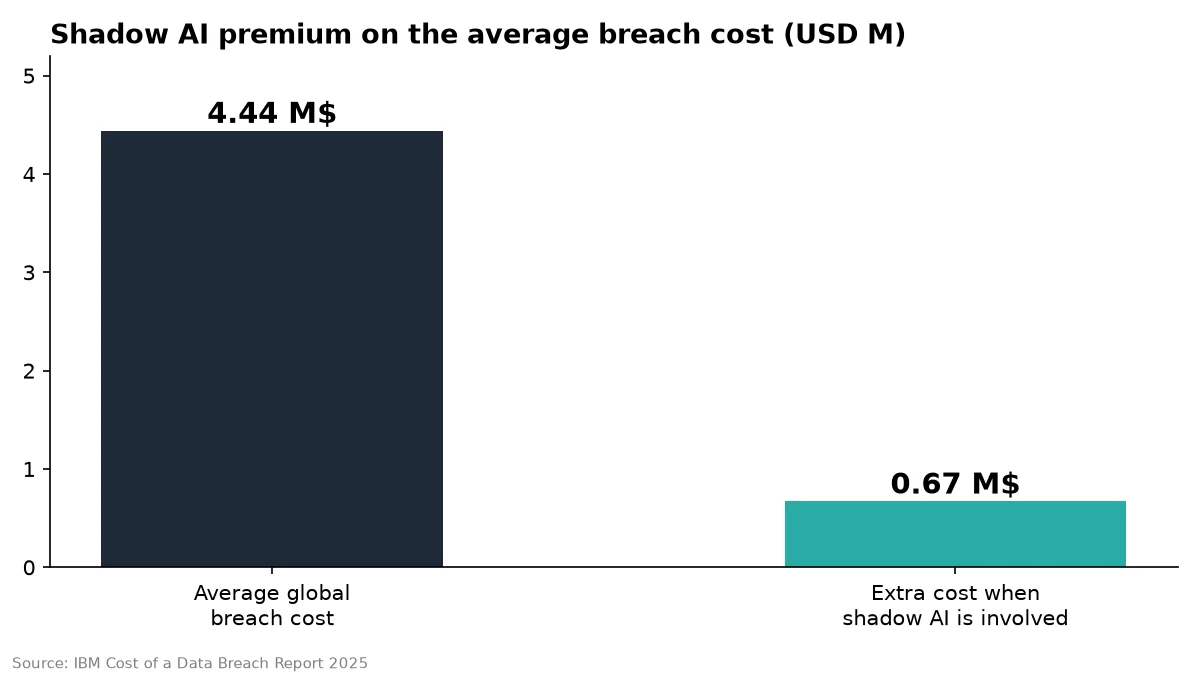
IBM reports a global average breach cost of $4.44 million in 2025, and found that breaches involving shadow AI added roughly $670,000 to that figure, with about one in five organisations reporting such a breach. These are findings from the report, not a forecast of what every company will lose.
Those are the numbers to put in front of a steering committee. See our guides on detecting shadow AI and the governance signals to watch. Use them to identify where people already need an approved alternative, rather than treating the policy as a blanket ban.
The one-page template
Six blocks, each one short enough to fit on a slide. Keep the policy itself to one page and put the tool register and team-specific examples in linked supporting material. The employee should find the decision rule without reading an entire security manual.
1. Scope and purpose
Who is covered: employees, contractors and interns. Which tools are covered: chat assistants, copilots, agents and browser extensions. Two sentences: “This policy applies to everyone using AI for company work, including external collaborators. It covers standalone tools and AI features embedded in software, and its purpose is to protect company and customer information while enabling approved uses.”
2. Data tiers
The core of the policy. Green: public or already published content, any approved tool. Amber: internal documents and non-sensitive business data, approved enterprise tools only. Red: customer personal data, credentials, source code secrets, financials before release and health data, never in any external model; only in tools hosted under your contract with no training on your data.
Give three concrete examples per tier, taken from your own teams. For green, consider a published product page, a public job advert and a press release. For amber, consider an internal meeting agenda, a non-sensitive process note and a draft training outline. For red, consider a customer record, an API secret and an unreleased financial statement. Have security validate the examples: a document’s title alone does not determine its tier. If unsure, ask before uploading.
3. Approved tools list
Name the tools, owner and what data tier each is cleared for. Publish it on the intranet and review monthly. If the list is empty, the policy is theatre. Include where to request access and how to propose an alternative, so an employee with a legitimate need has somewhere to go. Approval applies to the configured enterprise account, not automatically to the personal version of the same product.
4. Human review
AI output that reaches a customer, a regulator, a contract or a financial statement must be read and owned by a named person. The employee, not the model, is accountable. Review facts, references and confidential information before release. “The AI wrote it” is not an approval trail; record who checked and accepted the output using your existing workflow.
5. Prohibited uses
Short and specific: no automated decisions on hiring, firing or credit without legal review; no uploading of red-tier data to unapproved tools; no personal accounts for work content; no agents with write access to production systems without IT approval. Where red-tier processing is permitted under the contracted-tool exception, state the approved environment explicitly. Do not leave employees to infer that exception for themselves.
6. Incidents and questions
One mailbox, one Slack or Teams channel, one promise: reporting a mistake within 24 hours is not punished. People hide incidents when they fear blame. Insert your real reporting contacts before publication. Ask the employee to stop the activity, describe the tool and information involved, and let security handle containment. The no-blame promise encourages early disclosure; it does not replace incident response.
Make it stick in 30 days
Week 1: get legal, IT security and one business lead to agree the data tiers. Test them against real tasks. Week 2: publish the approved tool list and a 10-minute briefing with real examples. Week 3: switch on logging and DLP rules for the red tier. Week 4: collect questions, fix the list and set a quarterly review.
Align the policy with the NIST AI Risk Management Framework so audits find familiar language, and map it to the EU AI Act obligations that apply to your use cases. Have legal assess applicability rather than assuming every use has the same obligations.
Where AI workers fit
Policy only works when the compliant path is the easy one. Delos Workers run inside your tenant, with permissions per role, audit trails and no training on your data, so the approved tool is also the best tool. That is how a policy turns from a PDF into a habit. Match the worker’s permissions to its task and keep human approval where your policy requires it. Our enterprise shadow AI governance guide covers the wider operating approach.
Checklist before you publish
- Data tiers with three examples each.
- Approved tool list with owners.
- Named human accountable for every external output.
- One reporting channel with a no-blame promise.
- Quarterly review date in the calendar.
- A 10-minute briefing, not a 20-page PDF.
A good AI policy is short, specific and paired with tools people want to use. Start with the one-page template, test it on one team and iterate.