Predictive Lead Scoring: Stop Chasing the Wrong Leads
By Delos Intelligence — 2026-10-22
Most reps waste time on leads that never close. See how predictive lead scoring lifts conversion by up to 30% and what a modern score actually weighs.
Every sales team has the same quiet problem: reps spend most of their week on leads that were never going to buy. Studies of B2B pipelines routinely find that fewer than 1 in 4 marketing-generated leads are genuinely sales-ready, yet reps treat them as if they were equal. The result is wasted hours, slow follow-up on the few good leads, and a forecast nobody trusts. Predictive lead scoring is the fix that finally works, not because it is new, but because the data and models behind it have caught up.
What predictive lead scoring actually is
Traditional lead scoring is a spreadsheet of hand-set points: +10 for opening an email, +20 for a demo request, and so on. It feels objective but it is really just a team's guesses encoded as numbers. Predictive lead scoring flips this around. Instead of guessing which signals matter, a machine-learning model learns from your own closed-won and closed-lost history which combinations of signals actually precede a sale, and ranks every new lead by probability to convert.
The difference is not cosmetic. A rules-based score tells you a lead did three things you decided were important. A predictive score tells you this lead looks like the 40 deals you closed last quarter, and here is why. That shift, from opinion to evidence, is what moves conversion.
The numbers that justify it
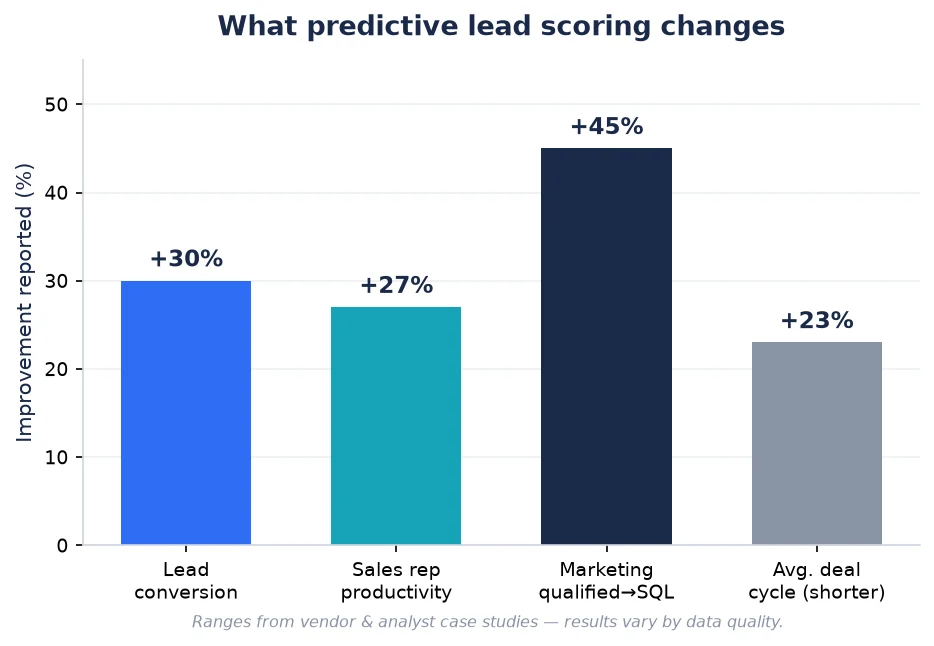
The business case is well documented. Teams that adopt predictive or AI-assisted scoring commonly report conversion-rate improvements in the 20-30% range, meaningful gains in rep productivity because less time is burned on dead leads, and a sharp lift in how many marketing-qualified leads actually become sales-qualified. Forrester and multiple vendor studies have shown that organizations with mature lead-management and scoring practices generate significantly more revenue at lower cost per lead than those relying on manual triage.
What a modern lead score weighs
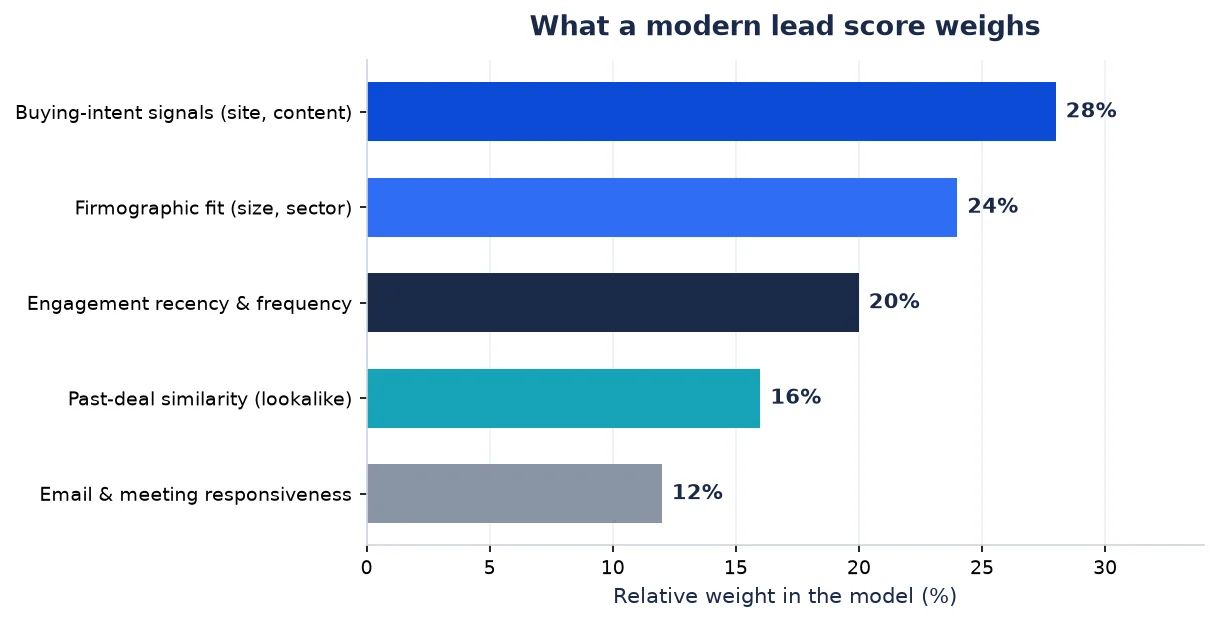
A good predictive model does not look at one magic signal. It blends several families of data and weights them by how predictive they have proven to be on your own history:
- Buying-intent signals — pages visited, content downloaded, pricing-page views, search behavior.
- Firmographic fit — company size, sector, geography, tech stack.
- Engagement recency and frequency — a lead active this week outranks one active two months ago.
- Similarity to past wins — lookalike matching against deals you actually closed.
- Responsiveness — how quickly and how often the lead replies to outreach.
Because the weights are learned, they adapt as your market shifts, instead of staying frozen in a rule nobody has revisited in a year.
Where teams go wrong
Three mistakes sink most scoring projects. First, scoring without acting on it: a score that does not change who gets called first is decoration. Second, scoring on thin data, a model trained on a few dozen deals will overfit and mislead; you need enough closed history for the patterns to be real. Third, treating the score as a verdict rather than a prioritization: a low score is not a rejection, it is a 'nurture, do not call yet' signal.
How to roll it out without a data-science team
You do not need to build a model from scratch. Most teams start by connecting their CRM and marketing automation data, letting a scoring engine learn from existing closed deals, and running the score in shadow mode for a few weeks, comparing what it would have prioritized against what reps actually did. Once the ranking visibly beats gut feel, you wire it into routing: highest-probability leads go to reps immediately with speed-to-lead SLAs, mid-tier leads enter nurture, and the model keeps retraining as new deals close. An AI sales assistant can own this loop end to end, scoring, routing, and flagging when a nurtured lead heats up, so humans spend their time selling instead of sorting.
The payoff is not a vanity metric. It is reps who trust their lead list, a pipeline that reflects reality, and a forecast that finally holds.
Related reading: AI SDR lead qualification, AI-powered churn prediction, and AI customer service in 2026.