AI Customer Service in 2026: What the Numbers Really Say
By Delos Intelligence — 2026-10-17
Agentic AI could resolve 80% of common service issues by 2029, yet 64% of customers resist it. Here's what the 2026 data really says and how to deploy AI support that works.
Few areas of enterprise AI generate as much noise, and as much contradiction, as customer service. Vendors promise fully automated support; customers quietly dread it. Behind the hype, the 2026 data tells a more useful story, and it points to a specific way of deploying AI that actually holds up.
What the numbers actually say
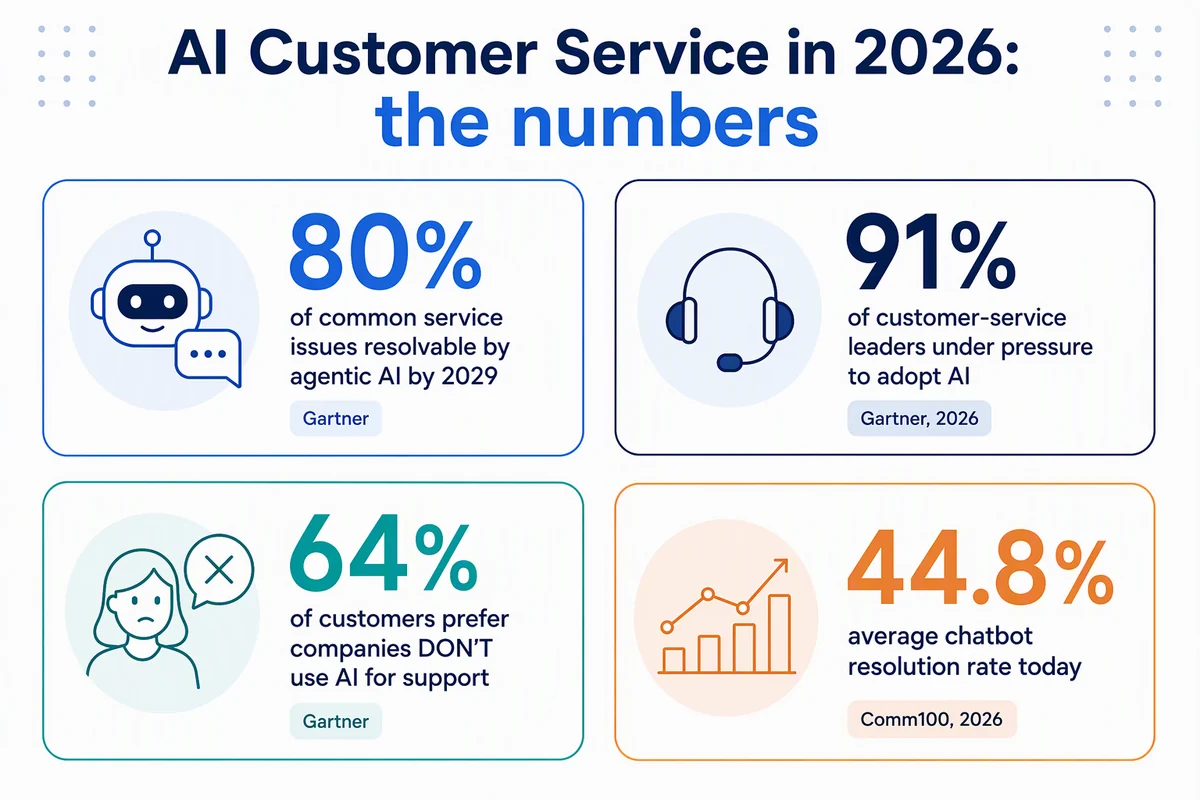
Gartner projects that 80% of common customer-service issues could be resolved autonomously by agentic AI by 2029, a leap from today's reality. In its February 2026 survey of 321 service leaders, Gartner found 91% are under organizational pressure to adopt AI in customer service right now.
Yet the same body of research shows 64% of customers would prefer companies didn't use AI for support at all, and 53% say they'd consider switching to a competitor over a bad AI experience. On the ground, measured results are more modest: Comm100's 2026 chatbot benchmark puts the average chatbot resolution rate at 44.8% across sampled industries. The gap between the 80% ambition and the 44.8% reality is where most of the disappointment, and the opportunity, lives.
Why the pilots stall
Three failure patterns recur. First, teams point AI at everything at once instead of the high-volume, low-risk tickets where it shines. Second, the AI is bolted onto a chatbot but never connected to the real systems (order status, billing, CRM, knowledge base), so it can answer but not act. Our guide to the evolution of AI customer support explores why moving beyond answers matters.
Third, success is measured by deflection rate alone, which rewards deflecting customers rather than resolving their problem, quietly eroding CSAT. Gartner also notes a sobering economic point: more than half of service organizations will double their technology spend by 2028 without an equivalent reduction in headcount. AI support is not automatically cheaper; it is better when designed well.
What good looks like
The teams getting real value treat agentic AI as a capable teammate, not a wall between the customer and a human. The AI handles the repetitive, well-bounded requests end to end, actually resolving them by taking action in connected systems, and hands off cleanly to a person the moment a case gets complex or emotional. McKinsey's operations research provides further context on redesigning customer-care workflows.
Knowledge stays clean and current, because an AI answering from stale documentation fails confidently, which is worse than failing at all. See our practical guide to AI-powered knowledge management for the groundwork behind reliable answers.
For a practical look at agentic customer-service deployments, watch this discussion from TSIA:
Four moves to make it work
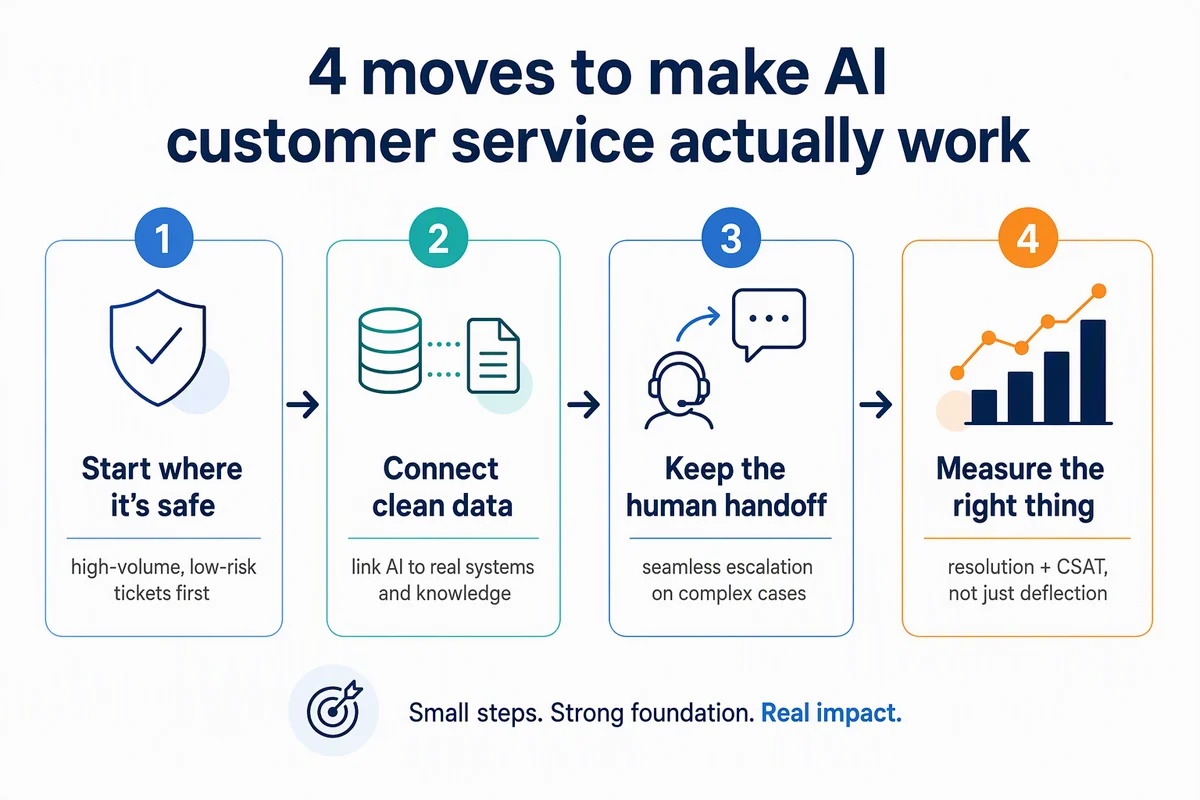
1. Start where it's safe
Automate high-volume, low-risk, repeatable requests first (order tracking, password resets, returns), prove the win, then expand.
2. Connect clean data
Agentic AI is only as good as the systems and knowledge it can reach. Invest in integrations and knowledge hygiene before scaling.
3. Keep the human handoff
Design seamless escalation so customers never feel trapped. The goal is resolution, not containment.
4. Measure the right thing
Track resolution rate and CSAT together, not deflection in isolation. A deflected but unhappy customer is a churn risk, not a win. Test the experience before scaling: our AI agent testing guide explains how to evaluate agents in production-like conditions.
The bottom line
The 80% headline is a destination, not a starting point. In 2026, the enterprises pulling ahead are not the ones automating fastest; they are the ones automating deliberately: safe use cases first, clean data underneath, a human one click away, and the right metric on the dashboard. That is how AI customer service earns trust instead of eroding it.
That is exactly how Delos AI workers are designed to operate in support teams: resolving the repetitive and escalating the rest.