AI-Powered Customer Churn Prediction: How Enterprises Catch At-Risk Accounts 60 Days Earlier
By Laura — 2026-10-06
Most churn is decided long before the cancellation email arrives. Here is how AI turns scattered customer signals into early, actionable warnings that retention teams can act on.
By the time a customer sends the cancellation email, the decision is usually weeks old. Support tickets piled up, product usage quietly dropped, the champion left, and the renewal conversation went cold. The signals were all there, scattered across your CRM, help desk, billing system and product logs. AI-powered churn prediction exists to read those signals together, early enough to actually do something about them.
Why churn is a prediction problem, not a reporting problem
Traditional churn dashboards are rear-view mirrors: they tell you who left last quarter. By then the revenue is gone and the post-mortem is academic. The money is in catching the leading indicators, not the lagging ones. According to Bain & Company, increasing customer retention by just 5% can raise profits by 25% to 95%, because retained customers buy more and cost less to serve.
The problem is that early churn signals are weak, noisy and spread across systems no single team owns. A human CSM covering 80 accounts cannot watch every usage dip, every unanswered ticket and every contract clause at once. A model can.
What the model actually learns
A churn model ingests signals that individually mean little but together form a pattern:
- Product engagement: login frequency, feature breadth, active seats vs. licensed seats, drops in core-workflow usage.
- Support health: ticket volume, escalations, sentiment, time-to-resolution, repeat issues.
- Commercial signals: invoice disputes, downgrade requests, late payments, discount pressure at renewal.
- Relationship signals: champion departure, fewer stakeholders logging in, declining QBR attendance.
The output is a per-account churn probability, refreshed continuously, plus the top factors driving each score. That explainability matters: a CSM will not act on a black-box number, but will act on “usage down 40% and the main admin left 3 weeks ago.”
The real payoff: lead time
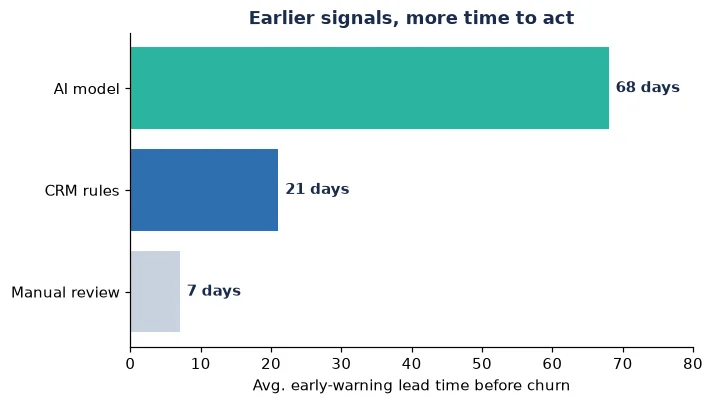
The single most valuable output is time. Rule-based CRM alerts typically fire when a renewal is already weeks away. A well-trained model surfaces risk far earlier, when a save play can still change the outcome.
Enterprise use case
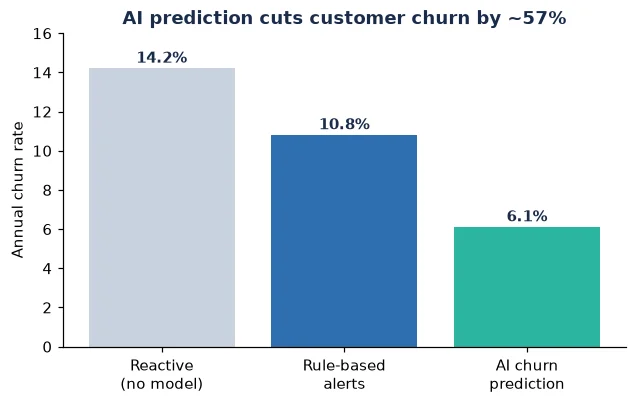
A B2B SaaS company with 4,000 mid-market accounts was losing roughly 14% of logo value a year, discovered mostly at renewal. They deployed a churn model scoring every account weekly and routed any account crossing a risk threshold into a structured save playbook: an executive check-in, a tailored success plan, and in some cases a commercial gesture. Within two renewal cycles, churn on the scored, intervened segment fell by more than half, and CSMs reported spending less time guessing which accounts needed attention and more time running plays that worked.
How to get started without boiling the ocean
- Unify the signals. You cannot predict on data you cannot see. Connect product, support, CRM and billing into one account view first.
- Start with a simple, explainable model. A transparent model your CSMs trust beats a sophisticated one they ignore.
- Wire scores to action. A risk score with no playbook is a dashboard nobody opens. Define what happens at each risk tier.
- Close the loop. Feed save outcomes back into the model so it learns which interventions actually work.
Done well, churn prediction shifts customer success from reactive firefighting to proactive portfolio management. For related reading, see our pieces on AI customer support automation and AI-powered revenue recognition. External frameworks worth reviewing include Harvard Business Review on customer retention economics.
The companies winning at retention are not the ones with the best cancellation surveys. They are the ones who never let the account get that far.