AI SDRs: How Automated Lead Qualification Wins the First Five Minutes
By Delos Intelligence — 2026-10-11
AI SDRs qualify and route inbound leads in minutes, not days. See the speed-to-lead data, the economics vs. human reps, and a 90-day rollout plan.
Most B2B pipelines don't leak because there aren't enough leads. They leak because leads go cold while they wait. A prospect fills in a form at 9:14 a.m., and by the time a rep calls back the next afternoon the moment is gone. That gap is exactly where an AI Sales Development Representative (AI SDR) earns its place: it answers, enriches, qualifies and routes every inbound lead in minutes, around the clock.
The real bottleneck is response time, not lead volume
Decades of research on lead response point to the same conclusion: speed compounds. The classic Lead Response Management study popularized by the Harvard Business Review found that reaching a web lead within five minutes dramatically raises the odds of qualifying it compared with waiting even an hour, and the odds collapse after a day. Buyers also reward whoever shows up first: a large share of deals go to the vendor that responds before anyone else.
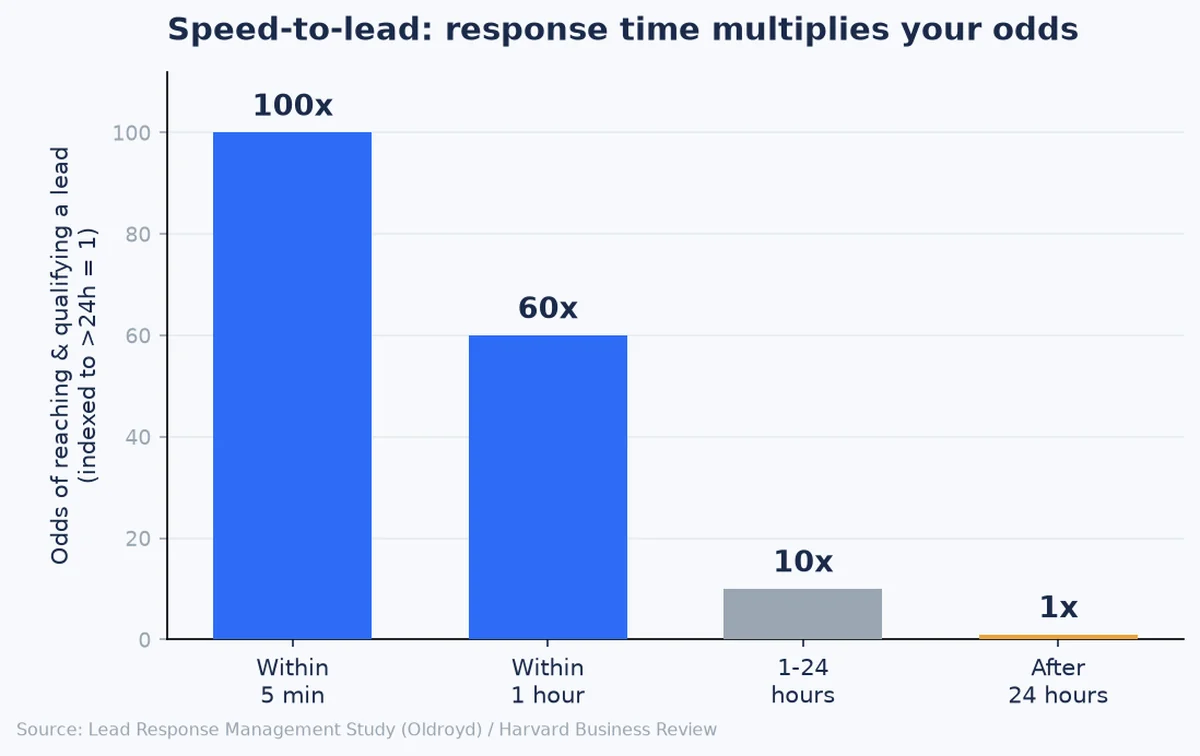
Human teams struggle here for structural reasons, not for lack of effort. Reps sleep, take meetings, and work a queue in series. A lead that lands during a demo, overnight, or over the weekend simply waits. An AI SDR removes the queue entirely: every lead is handled the instant it arrives.
What an AI SDR actually does
Strip away the hype and an AI SDR is a workflow with judgment at each step:
1. Enrich and score
The moment a lead arrives, the agent appends firmographic and behavioral data (company size, sector, role, intent signals) and scores it against your ideal customer profile. No rep has to open five tabs to figure out who this is.
2. Engage in minutes
It replies on the channel the prospect used — web chat, email, or form follow-up — with a contextual, personalized message rather than a generic autoresponder. It asks the two or three qualifying questions a human SDR would ask.
3. Qualify and route
Based on the answers, it books a meeting straight onto the right rep's calendar, routes an enterprise lead to the named account owner, or nurtures a not-yet-ready lead instead of discarding it. Every interaction is logged to the CRM automatically.
AI SDR vs. human SDR: the economics
This is not about replacing sellers — it's about where human time is worth most. Closing, discovery, negotiation and relationship-building stay firmly human. The repetitive top of the funnel — first-touch, triage, chasing no-shows — is where automation changes the unit economics.
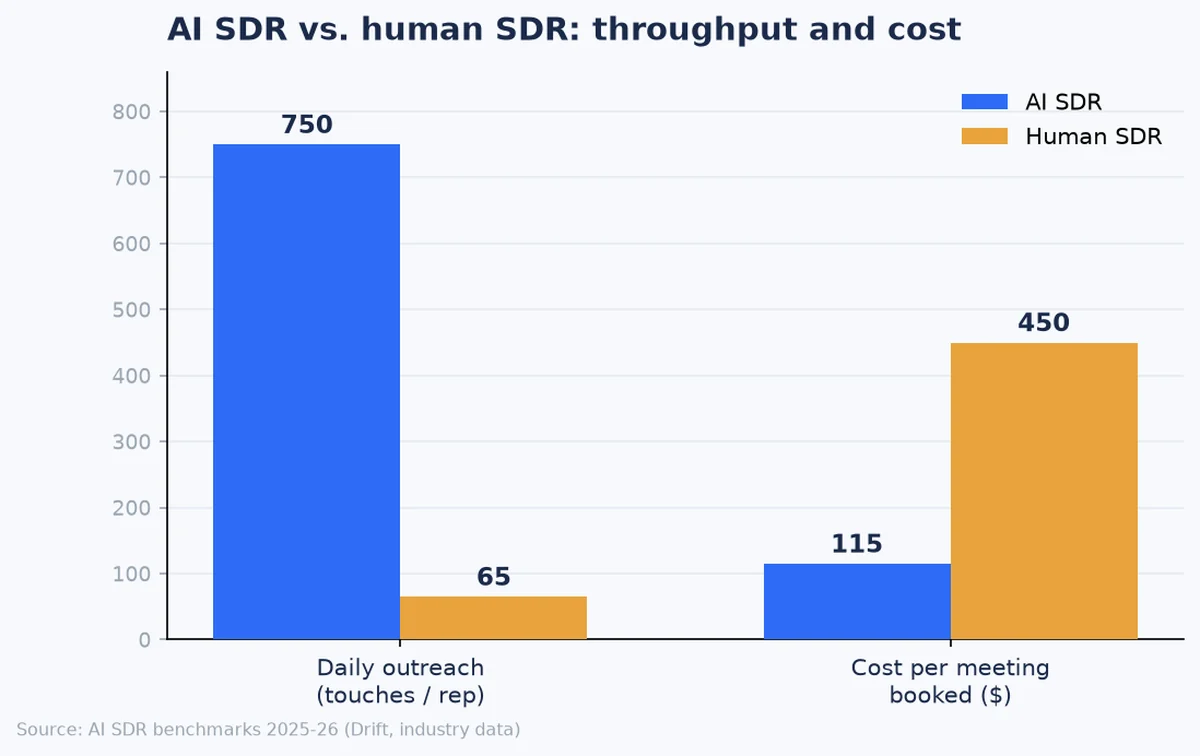
An AI SDR runs hundreds of personalized touches a day at a near-flat cost, while a human rep manages a few dozen. The result isn't just lower cost per booked meeting; it's consistency — every lead gets the same fast, qualified first response regardless of volume spikes. McKinsey estimates a large share of sales activities can be automated with current technology, and lead triage is among the highest-ROI places to start (McKinsey).
Where it goes wrong (and how to avoid it)
AI SDRs fail in predictable ways. Over-automation that feels robotic erodes trust — keep a human handoff one click away. Bad data in means bad qualification out, so your CRM hygiene and enrichment sources matter more than the model. And a hard rule: be transparent that the first responder is an assistant. Buyers forgive a bot that's fast and helpful; they don't forgive being tricked.
A 90-day rollout that works
Start narrow. Days 1–30: point the AI SDR at a single inbound source (say, demo-request forms) and let it enrich, score and route — humans still send the first reply. Days 31–60: let it send first-touch replies and book meetings for one segment, with a rep reviewing transcripts daily. Days 61–90: expand channels and segments, and wire qualification thresholds to your real conversion data. Measure speed-to-first-response, qualified-meeting rate, and rep hours returned — not vanity activity counts.
The bottom line
The first five minutes after a lead raises its hand are the most valuable and the most wasted minutes in B2B sales. An AI SDR is the most direct way to stop wasting them — not by selling for you, but by making sure every interested buyer gets a fast, relevant, qualified first response, and that your human sellers spend their time on the conversations that actually close. For teams drowning in inbound, that shift is the difference between a pipeline that leaks and one that compounds.
Related reading: AI-powered sales enablement, AI marketing automation, and AI customer support agents.