Why Groups Close Slower: Multi-Entity and Intercompany Close With AI Agents
By Delos — 2026-11-15
Adding entities adds days. Where a group's close time goes, and which intercompany steps AI agents can take over without losing control.
Ask a controller at a 15-entity group why the close takes ten days and the answer is rarely 'we are slow'. It is 'we have fifteen ledgers, three ERPs and a spreadsheet that ties them together'. Survey data backs that instinct: entity count is the clearest published driver of close length.
The numbers: entities and systems drive close time
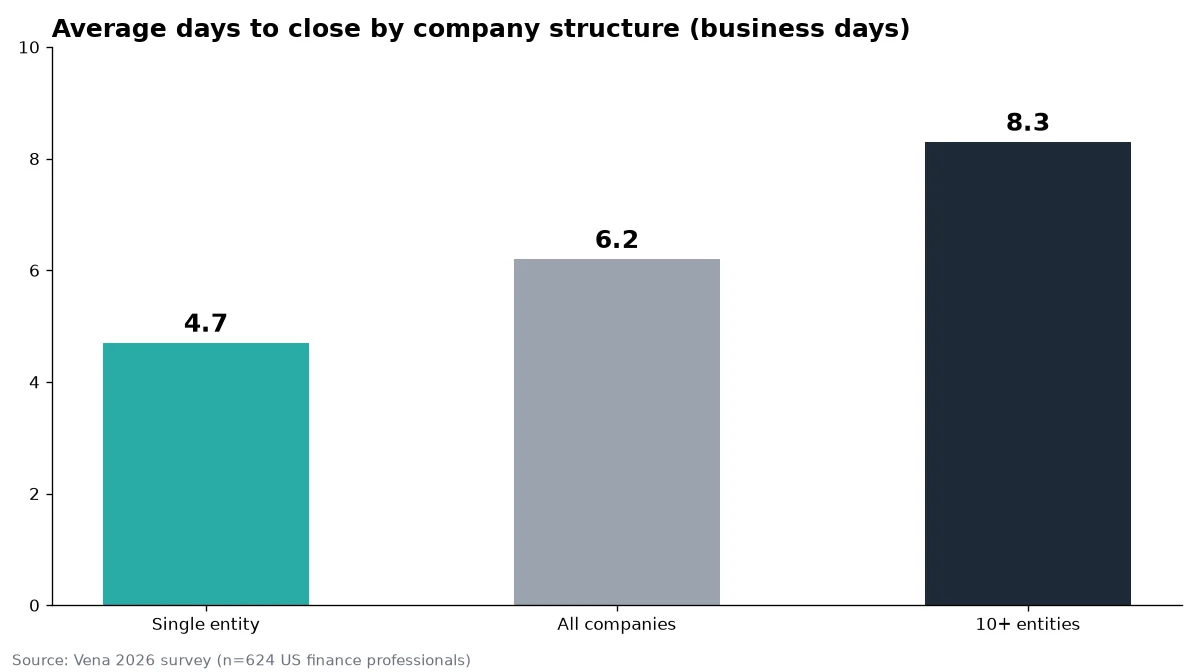
In Vena's 2026 survey of 624 US finance professionals, the average close takes 6.2 business days. Single-entity companies average 4.7. Groups with more than 10 entities average 8.3, a gap of 3.6 days. Sage's 2023 survey of 1,031 finance professionals found US respondents averaged 18 entities and 8 working days.
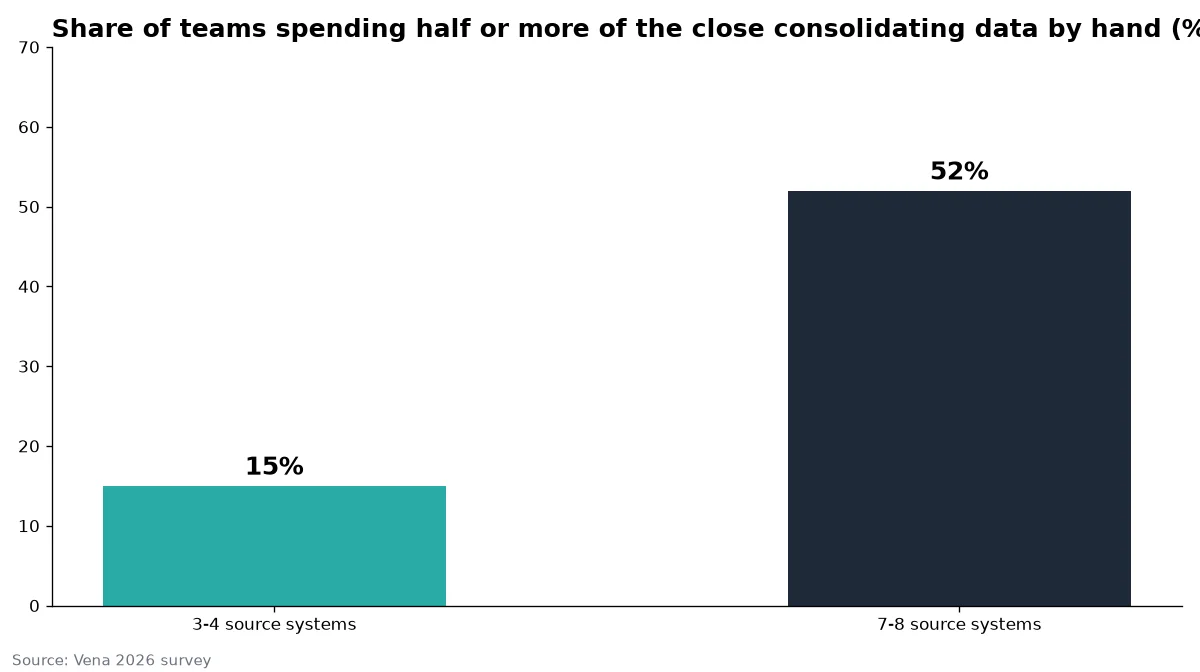
Source systems matter just as much. In the same Vena survey, 52% of teams pulling data from 7 or 8 source systems spend half or more of the close consolidating data manually, against 15% of teams with 3 or 4 systems. Teams that gather close data from email or shared documents average 6.8 business days, against 5.9 for everyone else.
Where a group's close time actually goes
1. Intercompany matching
Every internal sale, loan or recharge must appear on both sides at the same amount, currency and date. Differences are found late, on day 3 or 4, when they block eliminations.
2. Currency translation and eliminations
Rates, translation methods and elimination entries are rule-based but fiddly, and they are redone whenever a late entry lands in a subsidiary.
3. Chasing subsidiaries
Waiting on other teams is the top blocker in the Ledge 2025 survey (56% of teams). In a group the 'other teams' are in other countries and time zones.
4. Mapping charts of accounts
When entities use different charts of accounts, someone maintains the mapping table by hand, in a spreadsheet.
What AI agents can take over
Agents work best on steps that are repetitive, rule-based and easy to review.
- Continuous intercompany matching: compare both sides daily, propose the matching entry and flag differences above your materiality threshold, so day 1 starts with a short exception list instead of a discovery.
- Reminders and status: chase subsidiaries on open items and keep one close tracker updated.
- Drafting elimination and translation entries from your rules, for a human to approve.
- Mapping suggestions: propose account mappings for new accounts and flag anomalies.
- Variance commentary for each entity, drafted for the controller to edit.
Keep human: elimination policy, transfer pricing positions, impairment and any estimate. The rule: the agent prepares, a named accountant approves, every action is logged.
A 4-step rollout for a group
- Measure days to close per entity (business days, books locked), not only for the group.
- Fix data first: one chart-of-accounts mapping, one intercompany partner code, one cut-off calendar.
- Start with intercompany matching on your two largest entity pairs; agent drafts, accountant approves.
- Extend to eliminations and entity commentary once exception rates are stable for two closes.
What to expect
Be careful with promises. Published results are associations, not guarantees: the Hackett Group reports 35% to 57% shorter close cycles for digitally mature finance teams, and about 99% of journal entries automated versus 85% for peers. Your gain will depend on data quality and how many systems feed the close. See our companion checklist for the day-by-day plan.
Conclusion
Groups do not close slower because their people are slower. They close slower because reconciliation work is discovered late. Move it earlier, give agents the matching, and keep accountants on the exceptions. Delos Workers like Jeanne, our accountant worker, are built for that preparation work, under your control.
For related reading, explore continuous close with finance agents and what really works in agentic AI for finance.
Sources: Vena 2026 close survey (n=624); Sage Close the Books 2023 (n=1,031); Ledge 2025 (n=100); The Hackett Group 2025 research; APQC close benchmarks.