Month-End Close in 5 Days: A Practical Checklist for Finance Teams
By Jeanne — 2026-11-02
Half of finance teams need 6+ business days to close the books. Here is the day-by-day checklist, the benchmarks and the automation steps that get you to 5 days.
For most finance teams the close is not an accounting problem, it is a logistics problem. Numbers exist in the ERP from day one; the days disappear chasing journal entries, reconciling spreadsheets and waiting for upstream data. According to 2025 Ledge benchmarks cited by Solvexia, 50% of finance teams need six or more business days to finalize their books, while best-in-class teams close in under three. APQC puts the median at 6.4 calendar days.
Where the days go
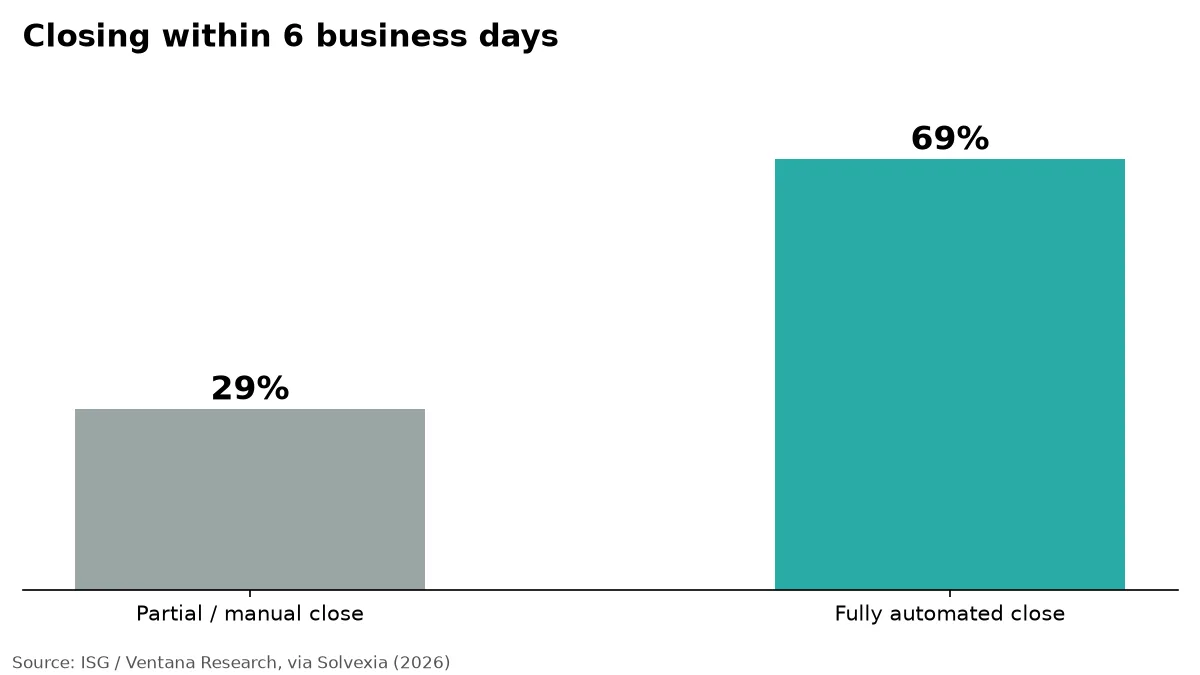
Four friction points explain most overruns: manual data collection from several systems, transaction matching that does not scale with volume, late accruals and intercompany items, and reporting rebuilt by hand in spreadsheets. Dokka reports that most teams still spend five to ten days a month on this. ISG/Ventana Research found that organizations automating substantially all close processes are more than twice as likely to close within six business days than those with partial or manual processes (69% versus 29%).
Benchmarks: how long should a close take?
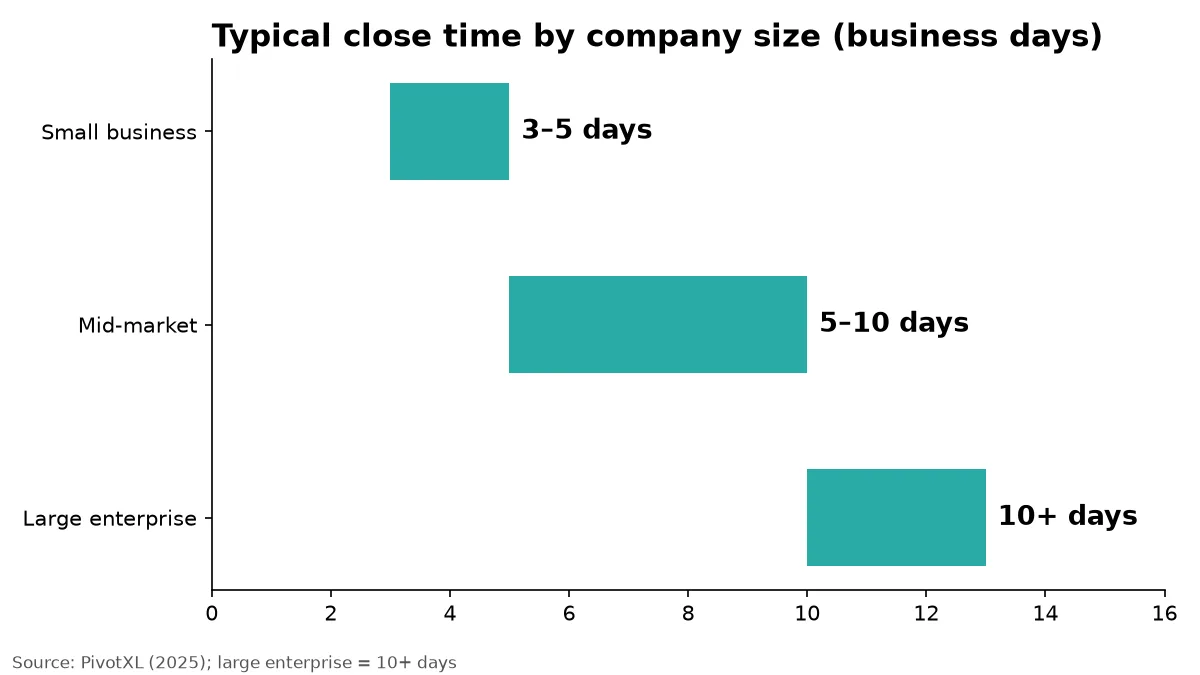
PivotXL's benchmark: small businesses 3 to 5 business days, mid-market 5 to 10, large enterprises 10 or more, with 'best in class' at 5 days or less. Use it as a range, not a target: multi-entity structures and intercompany eliminations legitimately add time. Your real goal is to beat your own last quarter.
The 5-day checklist
Before the close (D-5 to D0)
- Freeze a close calendar with named owners and deadlines for every task.
- Reconcile bank and card accounts daily or weekly instead of once a month.
- Collect recurring accrual inputs (payroll, rent, subscriptions) as templates, not emails.
- Chase open purchase orders and unbilled revenue before month-end, not after.
Day 1: cut-off and accruals
- Lock sub-ledgers (AP, AR) after cut-off, post accruals and reversals from templates.
Day 2: reconciliations
- Match sub-ledger to general ledger; automate matching, keep humans on exceptions. One practitioner reports 50 to 70% less matching time, while stressing that investigating discrepancies still needs human judgment.
Day 3: review and anomalies
- Run journal-entry anomaly checks (unusually large, odd-timed, duplicated entries) and review only flagged items.
Day 4: consolidation and variance analysis
- Consolidate entities, eliminate intercompany, explain variances above a threshold.
Day 5: reporting and sign-off
- Generate reporting packs from the closed ledger, get approvals, archive the audit trail.
What to automate first (and what not to)
Start where the evidence is strongest: account reconciliation, anomaly detection on journal entries, and automated data collection and formatting. The last one is the least glamorous and often the most reliable time saver. Do not promise an 'autonomous close': judgment on discrepancies, estimates and disclosures stays with accountants. Vendor claims such as '10 days to 2' should be read as best case, not as a plan.
A realistic first 90 days
Month 1: map the current close, time each step, pick the three slowest. Month 2: automate reconciliation and data collection for those. Month 3: add anomaly checks, review the calendar, measure again. Track days to close, number of manual journal entries and post-close adjustments.
How AI workers help
A finance worker such as Jeanne at Workers Delos can prepare reconciliations, draft accrual entries from templates, flag anomalies and assemble the reporting pack, leaving the team to approve and explain. Start with one process, measure, then extend.
Conclusion
A 5-day close is reachable when you treat it as a workflow to redesign, not a deadline to survive. Pick your three slowest steps this month.
For related reading, explore continuous close with finance agents and what really works in agentic AI for finance.