Agentic AI in Finance: What Actually Works vs What's Still Hype in 2026
By Delos Intelligence — 2026-10-20
Agentic AI is the top finance priority of 2026 — but most teams haven't shipped it. Here is an honest split between the use cases that work today and the ones still overselling.
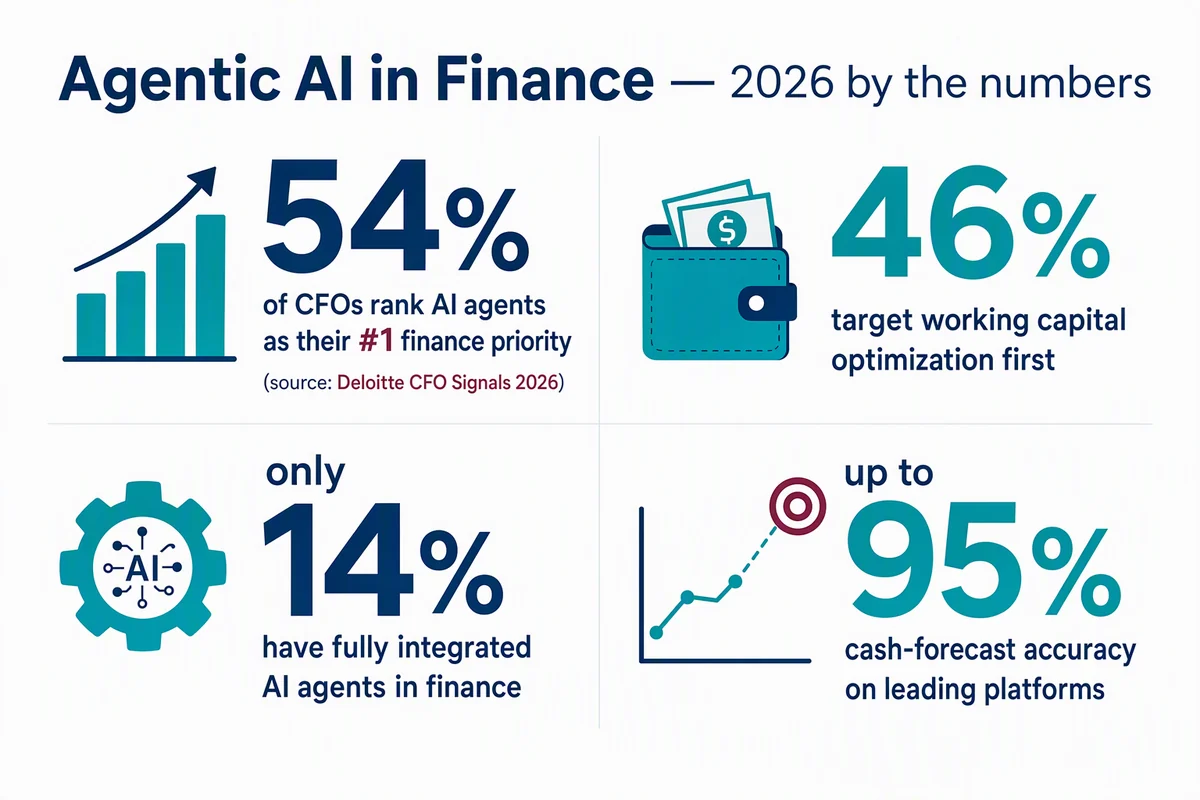
More than half of CFOs — 54%, according to Deloitte's 2026 CFO Signals — now name integrating AI agents into finance as their single biggest digital-transformation priority. Yet only 14% say they have fully integrated AI agents into the function. That gap, between intent and shipped, is where 2026 actually lives. This guide sorts the mature use cases from the ones still running on slideware.
What agentic AI actually is in a finance context
An AI agent is not a chatbot and not a macro. It reasons through a goal, breaks it into steps, acts across your systems (ERP, banking portal, billing), handles exceptions, and only escalates when it hits something outside its rules. In finance that means an agent can pull actuals, reconcile them, flag the anomalies and draft the journal entries — then wait for a human to approve. The word that matters is supervised: the agent does the legwork, a controller still signs off.
What works today
1. Cash-flow forecasting
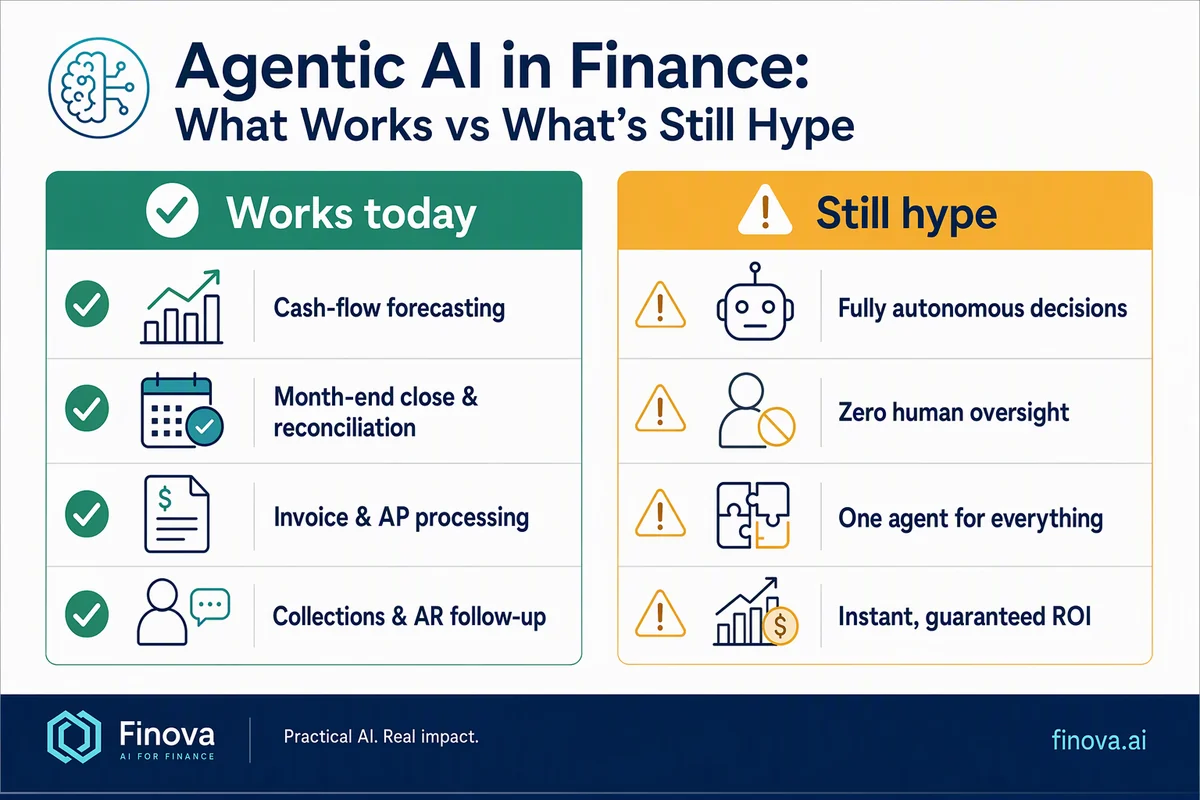
Forecasting is, by a wide margin, the most common place teams start — and the one with the clearest payback. Leading platforms now claim up to 95% accuracy on 13-week and 12-month horizons, and AI forecasting typically lifts accuracy by roughly 30% over spreadsheet models. The catch worth saying out loud: the binding constraint is almost never the model, it is data quality. A 95%-accurate engine still produces a bad forecast when the actuals are stale or the AR data isn't applied. Fix the data plumbing first.
2. Month-end close and reconciliation
Agents match transactions, chase the exceptions and draft entries, compressing a close that used to eat a week. This is high-volume, rules-heavy, repetitive work — exactly where agents shine and where a human reviewer can still catch the 2% that matters.
3. Invoice and AP processing
Reading invoices, matching them to POs and routing approvals is now routine for agentic automation. It removes keystrokes, not judgment.
4. Collections and AR follow-up
Agents prioritise overdue accounts, draft reminders and schedule follow-ups, which is why working-capital optimisation tops the list: 46% of finance leaders point to it as their first target for agentic AI.
What's still hype
Three claims deserve more scepticism in 2026:
- Fully autonomous finance. Agents that decide and act with no human in the loop are a demo, not a deployment. Audit, controls and accountability still require a signature.
- One agent for everything. The winners run narrow, well-scoped agents on specific workflows, not a single omniscient one.
- Instant, guaranteed ROI. Value shows up after the data and process work, not on day one. Teams that skip the plumbing get a confident wrong answer faster.
How to start without overpromising
Pick one workflow where the data is already clean and the volume is high — cash forecasting or AP are the usual first wins. Keep a human approval step. Measure against a real baseline (days to close, forecast error, DSO) before and after. Then expand agent by agent. The enterprises getting value in 2026 aren't the ones with the flashiest demo; they're the ones that treated agentic AI as a process upgrade with guardrails, not a magic box.
For related reading on this blog: see our pieces on AR automation and cutting DSO, on finance forecasting, and on single-agent vs multi-agent architectures.