Continuous Close: How AI Agents End the Month-End Scramble
By Delos Intelligence — 2026-10-10
AI agents turn month-end into a continuous close: from 10 days to 3, with sourced benchmarks and a 90-day starting plan.
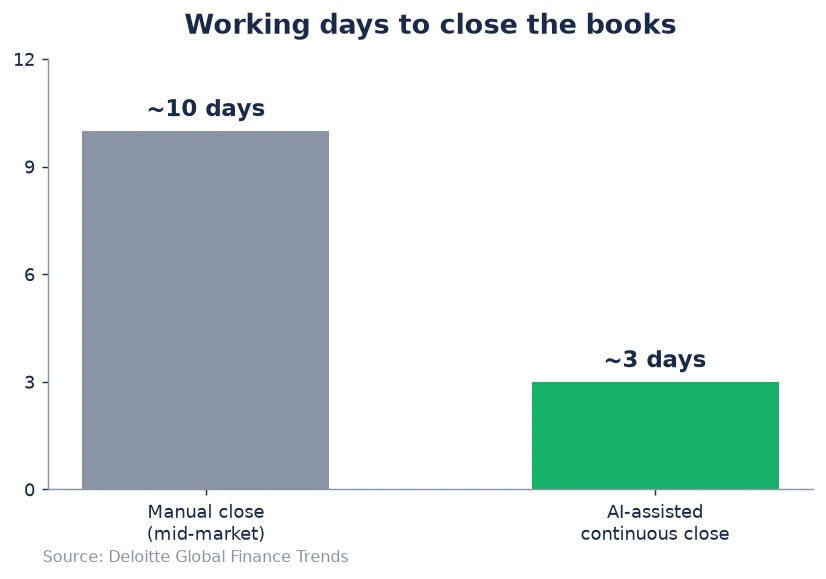
Every month, finance teams run the same marathon. The books close, but only after a week or more of reconciliations, intercompany matching, accruals and chasing numbers from upstream systems. Deloitte's Global Finance Trends research found that 62% of mid-market finance teams still spend 8 to 12 working days on month-end, and 71% of CFOs name close acceleration as a top 2026 priority. The continuous close — where transactions are categorised, matched and posted as they happen instead of at quarter-end — is how that marathon becomes a daily jog. AI agents are the piece that finally makes it practical.
What a continuous close actually means
A continuous close is not a faster version of the old close. It is a different operating model. Instead of batching every reconciliation and journal entry into a frantic end-of-period window, the work happens continuously: an AI agent ingests transactions as they post, matches them against sub-ledgers, flags only genuine exceptions for a human, and keeps a board-ready picture of the P&L available at any time.
Teams running embedded automation report a close cycle compressed from roughly 10 days to 3, with fresh numbers on day three instead of day twelve.
Why now: adoption has crossed the line
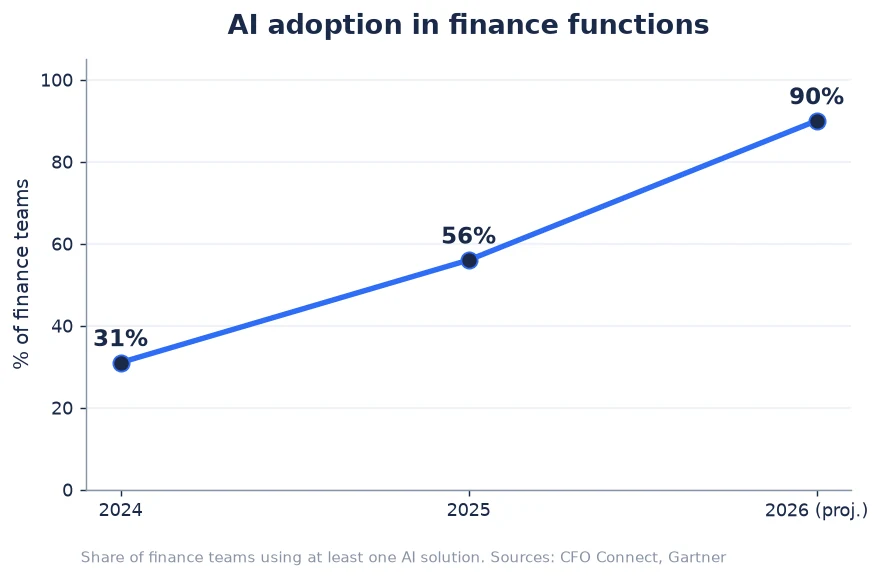
Finance was long the slowest function to adopt AI, but that changed fast. AI use among finance leaders rose from 17% in 2023 to 31% in 2024 to 56% in 2025 (CFO Connect, Top CFO Tools Report), and Gartner projects 90% of finance functions will run at least one AI-enabled solution by the end of 2026.
Deloitte's Q4 2025 CFO Signals survey found 87% of CFOs expect AI to be extremely or very important to their finance operations, and 54% named integrating AI agents into finance as a transformation priority.
Where AI agents do the work
Reconciliation and matching
GL-to-bank and intercompany reconciliation is the most rule-dense, highest-volume step in the close. McKinsey estimates finance teams spend up to 60% of their time on data gathering and reconciliation — exactly the work agents absorb, matching thousands of lines and surfacing only the handful that don't tie out.
Accruals and journal entries
Recurring accruals, prepaid amortisation and standard journal entries follow documented logic. Agents post them within hours of the triggering event and attach a deterministic decision log for each entry.
Variance and flux analysis
Instead of a controller hunting through a trial balance, the agent runs budget-versus-actual at every cutoff and writes the first-draft variance narrative, leaving the controller to judge rather than assemble.
The governance catch no one should skip
Speed without controls is a trap. An Avalara survey of more than 1,500 CFOs found only 7% say their organisation prioritises governance over deployment speed, 30% had not updated internal controls in the past year to reflect agents taking or recommending actions, and 44% were only somewhat confident they could explain an agent's actions to an auditor.
The fix is not to slow down — it is to design for it: deterministic decision logs for every posted entry, a documented chart of accounts, and a human reviewing exceptions, not rubber-stamping everything. SOX 404 and audit requirements still apply; auditors expect decision logs, not model rationales.
How to start in 90 days
Don't boil the ocean. Pick one sub-process — GL reconciliation for low-risk accounts is the most reliable entry point — and prove it over two test close cycles before expanding. A clean general ledger and a documented chart of accounts are prerequisites: automation applied to a messy ledger just amplifies existing errors at machine speed.
Top-quartile CFOs reinvest the freed capacity into FP&A rather than cutting headcount — 88% of finance teams report no headcount reductions from AI adoption (Pigment, State of AI in Finance).
The takeaway
The continuous close turns the month-end scramble into an exception-handling routine that runs quietly in the background. The technology is proven and adoption has gone mainstream; what separates the teams getting the day-three P&L from the ones still closing on day twelve is a clean data foundation, one well-chosen first process, and governance built in from the start.
Related reading: AI accounts payable and invoice automation, AI-driven financial forecasting, and AI-powered fraud detection.