Build or Buy AI Agents? A 7-Question Decision Checklist
By Workers Delos team, 2026-11-29
Build, buy or hybrid? Seven questions that settle the choice before anyone writes a line of code.

Every enterprise AI roadmap hits the same fork: do we build our agents ourselves, or buy a platform? Teams often debate it for months, and the debate hides a simpler truth. The answer depends less on your engineers' talent than on what the agent is for. This guide gives you seven questions, a realistic cost view and a decision map you can use in a single workshop.
Why this decision is harder than it looks
The 'build' option looks cheap at the start: a prototype takes days and a good engineer can wire a model to your documents over a weekend. The expensive part is everything after the demo: access control, monitoring, evaluation, model upgrades, audit trails, and the people who keep it running. 'Buy' looks safe, but a platform that does not connect to your systems, or locks your data in, only moves the problem. The right question is not 'can we build it?' but 'should we own it?'.
What building really costs
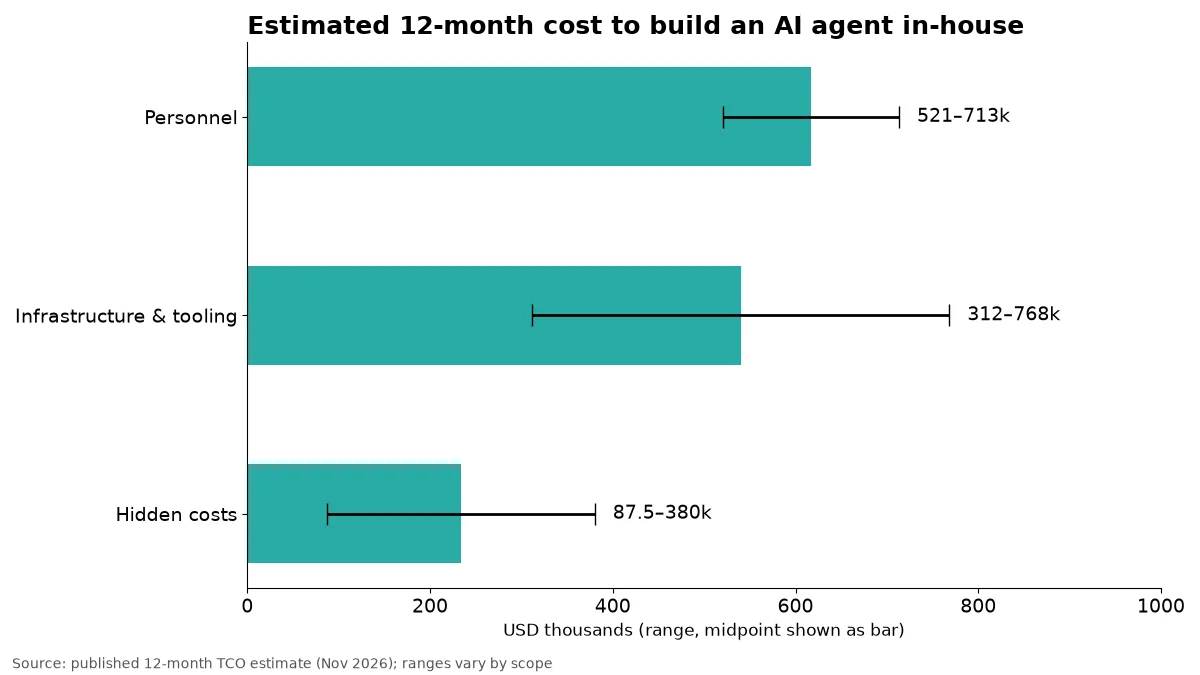
One published 12-month total-cost-of-ownership estimate for an in-house AI agent puts personnel at roughly $521K to $713K, infrastructure and tooling at $312K to $768K, and hidden costs (security reviews, evaluation, rework, incident handling) at $87.5K to $380K. Treat these as an order of magnitude, not a quote: scope changes everything. The useful lesson is the shape of the bill. People and the invisible work around the model cost more than the model itself.
The MIT NANDA 'GenAI Divide' report (2025), widely covered in the press, reported that purchased solutions from specialised vendors succeeded far more often than internal builds, roughly two thirds versus one third in the sample studied. It is one study with a specific methodology, so read it as a warning about underestimating build effort, not as a law.
The 7-question checklist
1. Is the workload generic or specific to your business?
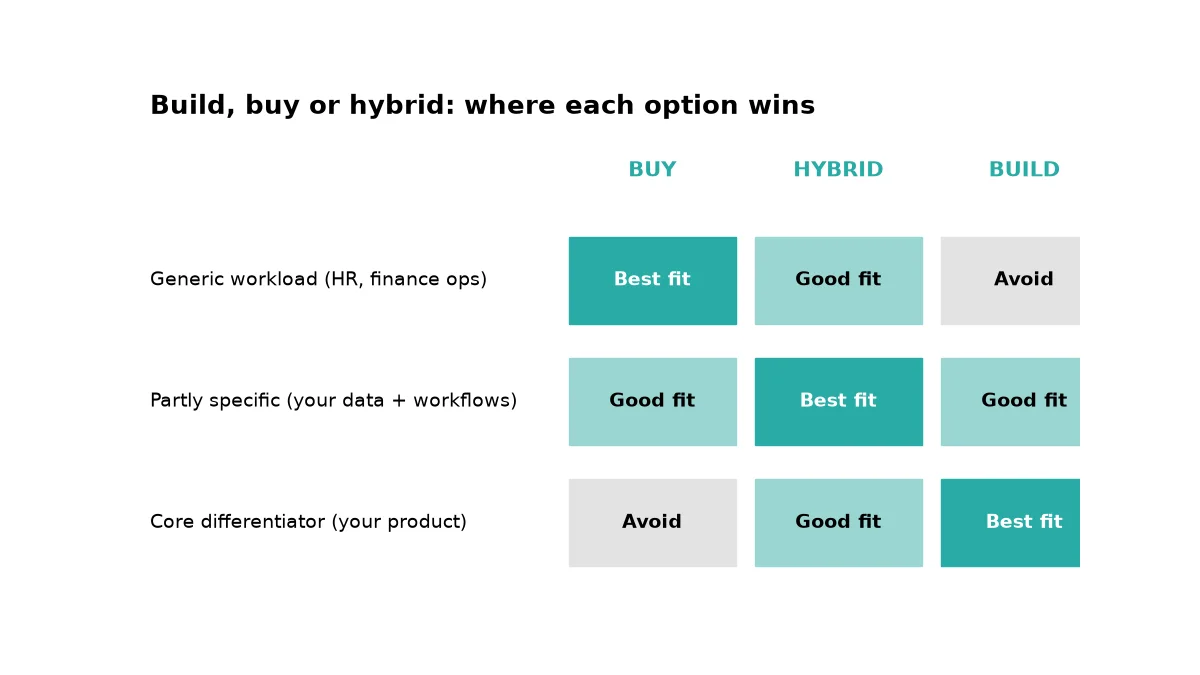
Generic workloads (HR questions, meeting summaries, invoice matching) are well served by a platform. Workloads that encode your edge (pricing logic, proprietary models) deserve ownership.
2. Is it a differentiator?
If competitors can buy the same capability next quarter, building it gives you a cost, not an advantage.
3. How sensitive is the data, and where must it live?
Check residency, encryption, retention and who can read prompts. A vendor with strong certifications can be safer than a rushed internal build; a regulated use case may still force on-premise. Frameworks such as the NIST AI Risk Management Framework help you structure the review.
4. Who will run it in month 13?
Names, not roles. If nobody owns evaluation and upgrades after launch, the agent will decay quietly.
5. How fast do you need value?
A platform can be in front of users in weeks. A build that needs data pipelines, security review and a UI rarely ships in under a quarter.
6. How deep must it integrate?
Count the systems the agent must read and write. Integration breadth is where many builds stall and where platforms with ready connectors save the most time.
7. What is your exit plan?
Ask vendors for data export, open formats and contract terms. Ask your own team how portable the build is when the model landscape shifts.
The decision map
Score the seven answers. Mostly generic, fast, broadly integrated: buy. Mostly specific, differentiating, with a named owner: build. A mix, which is the most common outcome: go hybrid, meaning buy the platform and build the parts that are truly yours on top of it.
What hybrid looks like in practice
A finance team buys an agent platform for invoice matching and builds only its own approval rules on top. An HR team deploys a ready-made onboarding assistant (see our first-week onboarding plan) and keeps its internal policy content in-house. A manufacturer pilots a vendor tool for failure prediction before deciding on custom models (see our 90-day predictive maintenance pilot). In regulated settings such as life sciences, the human sign-off step stays internal (see clinical documentation drafts with human sign-off). The pattern repeats: buy the plumbing, own the judgement.
A one-week process to decide
Day 1: list the candidate use cases and score each with the seven questions. Day 2: shortlist two vendors and one build option. Day 3: security and data review. Day 4: run the same real task on all options and compare results and effort. Day 5: decide, name an owner and set a review date at 90 days. Analyst coverage such as McKinsey's State of AI survey and Gartner's work on AI agents can help calibrate expectations, but your own pilot is the best evidence.
Common mistakes
- Comparing a vendor's price with the cost of a prototype instead of the cost of a production service.
- Choosing on a demo rather than on your own data.
- Ignoring exit costs on either side.
- Treating the choice as permanent: revisit it every six months, because both the vendor market and your capabilities move fast.
Conclusion
Build what makes you different, buy what makes you faster, and write down who owns the result. To see what a ready-made, integrated approach looks like, explore Workers Delos: AI colleagues specialised by job, connected to your tools.