Predictive Maintenance Pilots: A 90-Day Plan That Survives Contact With the Shop Floor
By Delos team, 2026-11-26
Most predictive maintenance pilots stall after the demo. Here is a 90-day plan, with selection criteria and a go/no-go test, that gets you to a decision.

Most predictive maintenance pilots do not fail on technology. They fail because nobody agreed on what success looks like, the wrong machine was chosen, or alerts arrived that maintenance teams did not trust. Deloitte-attributed figures widely cited in the industry quote up to 70% fewer breakdowns and 25% higher productivity, and a Deloitte 2023 estimate puts unplanned downtime in large plants at around USD 260,000 per hour. Those numbers explain the appeal. They do not tell you how to prove the value in your own plant. This guide does.
Why pilots stall after the demo
A vendor demo shows a clean vibration curve and a neat alert. Production is messier: sensors drop out, operators change settings, and the one failure you hoped to catch does not happen during the trial. Three causes come up again and again: no baseline, too many assets, and no owner on the maintenance side. Fix those three and most of the risk disappears. For the broader plant context, see our guide to unplanned downtime.
Step 1 (weeks 1-2): choose 3 to 5 assets, not 30
A pilot is a test, not a rollout. Score candidate assets on four criteria: cost of one hour of downtime, how often the asset fails, whether a sensor can be fitted without stopping production, and whether usable history already exists (maintenance logs, CMMS work orders, PLC data).
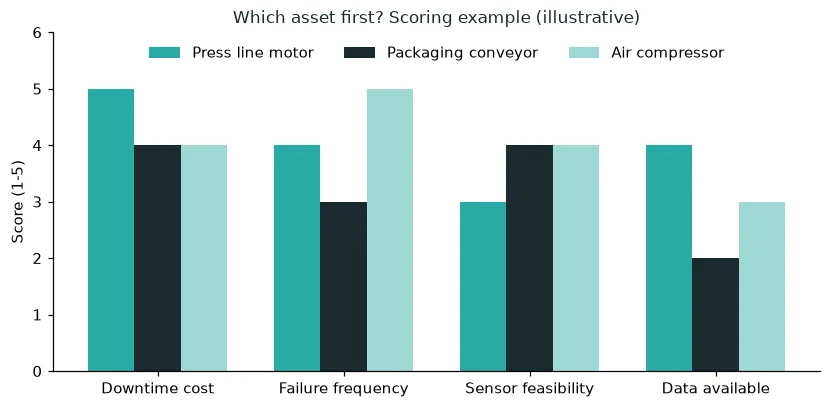
Pick assets that score high on downtime cost and failure frequency; a rotating motor, a compressor or a conveyor drive are typical good candidates. Avoid the one-off critical machine that fails once every five years: you will never collect enough events to learn anything.
Step 2 (weeks 2-4): lock the baseline before you install anything
Write down, for the last 12 months, per asset: number of unplanned stops, total downtime hours, emergency repair cost, spare parts used. Take it from the CMMS and from shift reports, and have the maintenance manager sign it. This sheet is the only way to answer the CFO's question later: what did we gain? Without it, a pilot can show only anecdotes.
Step 3 (weeks 4-8): install, collect, and tune alerts with the technicians
Fit wireless vibration and temperature sensors, connect them to your existing data sources, and run in shadow mode first: the system flags anomalies, but nobody acts yet. Review every flag with a technician each week. Label it real, false or unclear. This labelling is where the model learns your plant, and where trust is built. A pilot reported in a published study of low-cost predictive maintenance systems showed downtime reductions of nearly 20%, which is a realistic order of magnitude for a first deployment, far below the headline numbers.
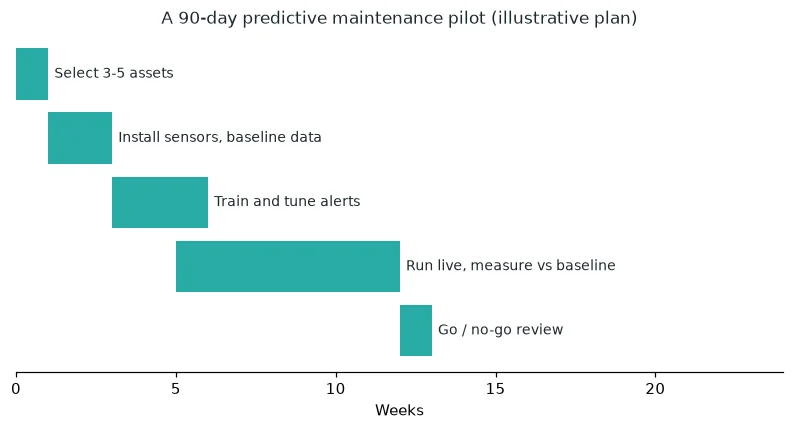
Step 4 (weeks 8-12): go live and measure against the baseline
Switch alerts from shadow to action. Each alert must create a work order with a named owner and a deadline. Track five numbers: alerts raised, alerts confirmed by inspection, failures caught before stoppage, planned interventions that replaced emergency ones, and downtime hours versus the same period in the baseline. Do not claim savings from failures that would not have happened anyway: count only confirmed catches.
The go / no-go test
Decide in advance. A simple rule: go if at least 60% of alerts are confirmed by inspection, at least one significant failure was caught early, and projected annual savings cover sensors, licences and technician time within 12 to 18 months. These thresholds are examples; set yours with finance before the pilot starts. See our predictive maintenance ROI guide for a worked payback calculation.
What to expect: reading published numbers carefully
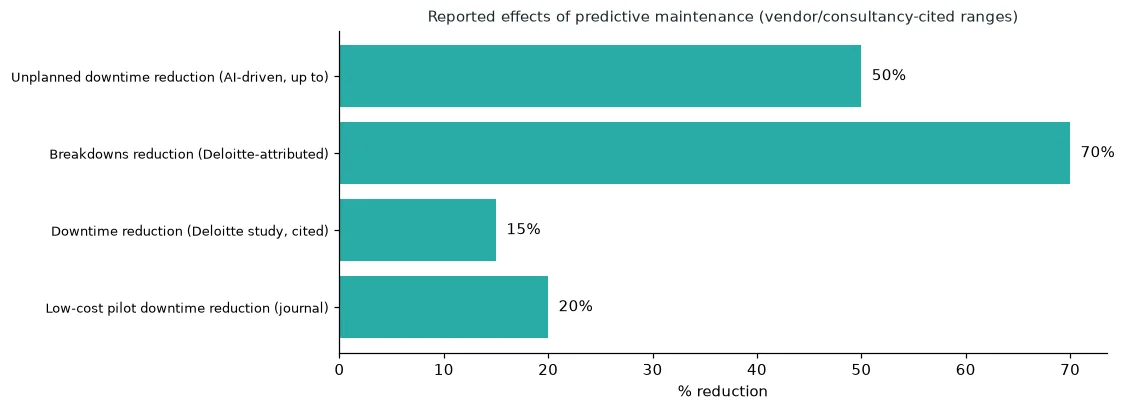
Published ranges vary widely: 15% to 20% downtime reduction in some studies, 30-50% in AI-driven programmes cited by industry sources, 70% fewer breakdowns in Deloitte-attributed figures. Differences come from plant maturity, asset type and how results are measured. Treat the top of the range as a target, and your own baseline as the truth. For the wider framework, see Deloitte Insights on predictive technologies for asset maintenance, McKinsey's operations insights, and ISO 55000 for asset management governance.
Where AI workers help
The slow part of a pilot is not the model, it is the paperwork around it: consolidating maintenance logs, drafting the baseline sheet, summarising weekly alert reviews, turning confirmed alerts into work orders and producing the go/no-go report. A Workers Delos assistant connected to your CMMS and shared drives can handle that coordination, so your technicians spend their time on the machines. The same division of work applies to handling supply chain exceptions.
Checklist
- 3 to 5 assets, scored on four criteria
- 12-month baseline signed by maintenance
- Shadow mode first, weekly labelling with technicians
- One work order, one owner, one deadline per alert
- Go/no-go thresholds agreed with finance in week 1
Conclusion
A good pilot is small, measured and decided on numbers. Run 90 days, compare to the baseline, and either scale with evidence or stop with a clear lesson.