Clinical Documentation with AI: Drafts for Speed, Humans for Sign-Off
By Lucia, 2026-11-28
How life sciences teams use AI to draft clinical notes, CRFs and reports faster while keeping human sign-off, audit trails and GCP compliance.

Ask a clinical operations lead where the week goes and the answer is rarely “science”. It is notes, case report forms, monitoring reports, deviation logs and the follow-up questions that come with each. AI can draft most of these in seconds. The real question for life sciences teams is different: how do you use drafts without weakening the one thing regulators check, which is who decided what, and when?
1. Why documentation is the bottleneck
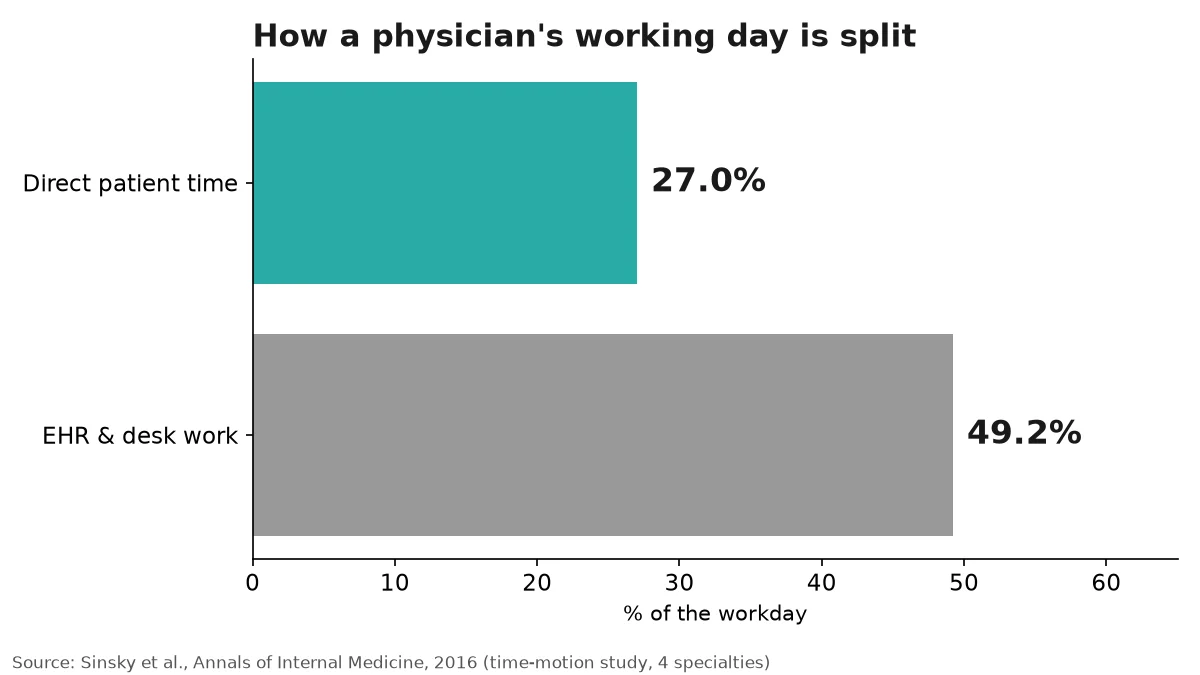
In a widely cited time-motion study, Sinsky and colleagues found that physicians spent 27.0% of their day on direct clinical face time and 49.2% on EHR and desk work (Annals of Internal Medicine, 2016). The study covered ambulatory physicians in four specialties, so read it as a signal, not a universal constant. Research sites feel the same pressure: every visit generates source notes, every source note must be transcribed or reconciled into a case report form, and every discrepancy becomes a query.
The cost is not only hours. Late or rushed documentation is where data quality problems begin.
2. What AI can safely draft
Start with tasks where a draft is easy to check against a source.
Visit and encounter notes
Structured summaries from a recorded or typed encounter, formatted to your template.
CRF pre-population
Propose field values from source documents, each with a pointer to the passage it came from.
Monitoring and site visit reports
Turn raw findings into the standard report structure.
Deviation and query responses
Prepare first-draft wording for the investigator to correct.
Each shares one property: a reviewer can verify the draft in less time than writing it from scratch. See also our guide to clinical trial document review with AI agents.
3. What must stay human
AI proposes, a named person decides. Keep humans on eligibility and safety assessments, causality and seriousness judgments for adverse events, protocol deviation classification, and the final signature on any record that enters the trial master file or a patient record. The updated ICH E6(R3) Good Clinical Practice guideline, adopted on 6 January 2025, keeps responsibility with the investigator and sponsor and asks for fit-for-purpose, risk-proportionate quality management. A tool does not carry that responsibility. A person does.
4. The workflow that holds up to an audit
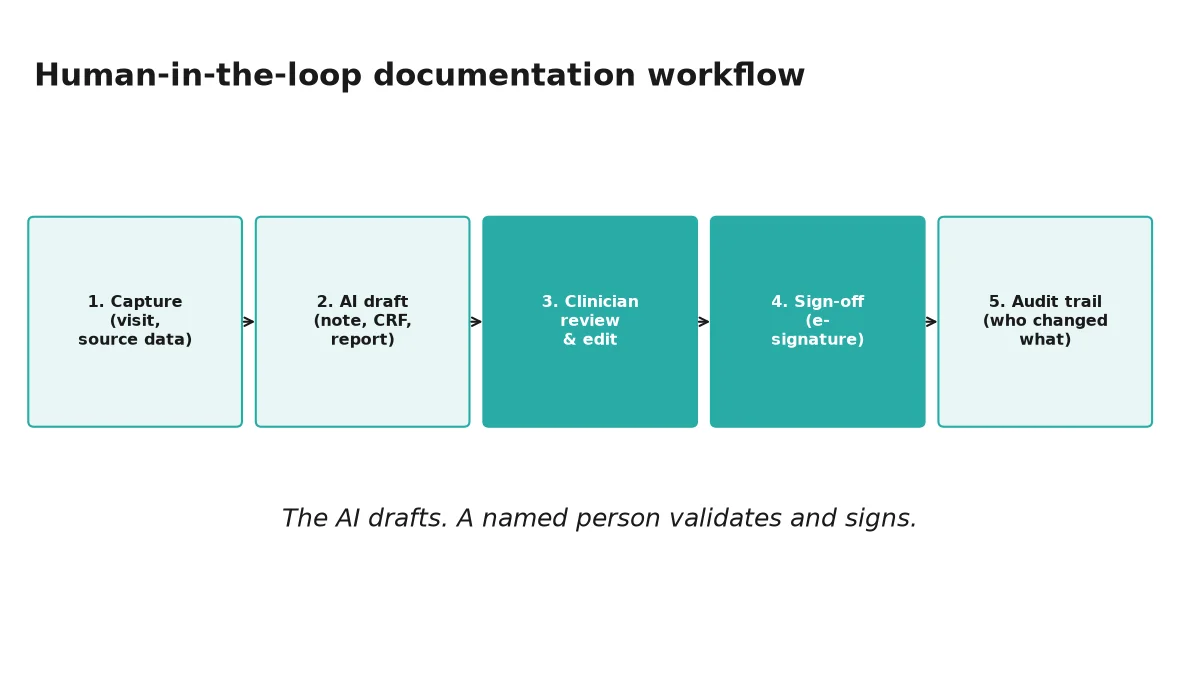
Five steps, in this order:
- Capture the source: visit, source data or document.
- Generate the draft with the source attached.
- Review and edit: the clinician or study staff make changes visible.
- Sign off with an e-signature tied to an individual identity, in line with applicable 21 CFR Part 11 (FDA) and EU Annex 11 expectations.
- Keep the audit trail: who changed what, when, and which version of the draft they started from.
If your system cannot show steps 3 and 5 to an inspector, the speed gain is not worth it.
5. A 30-day pilot you can run
- Week 1: Pick one document type (for example monitoring visit reports) and one study, and define the check against source.
- Week 2: Run drafts in parallel with the current process and log every correction.
- Week 3: Classify corrections (factual error, missing item, wording) and fix prompts or templates.
- Week 4: Decide with three numbers you set in advance: median time to a signed document, share of drafts needing a factual correction, and reviewer satisfaction. Targets are yours to set; do not copy someone else's.
6. Controls to put in place before you start
Restrict what data the tool can see and where it is processed; document the intended use and validate it for that use; log prompts, outputs and edits; train reviewers to check against source rather than skim; and agree with QA how AI assistance is recorded in your quality system. Involve QA and your data protection officer from day one: it is faster than retrofitting later. For more on assigning responsibility, see our guide to AI agent accountability.
7. Where Delos Workers fit
A Delos Worker can prepare the draft, attach the source passages, route it to the right reviewer and keep the trail, while your clinicians keep the decisions. Start small, measure, then extend to the next document type.
Key takeaways
- Draft with AI where a reviewer can verify fast.
- Keep judgment and signature human.
- Make the audit trail non-negotiable.
- Pilot on one document type for 30 days with targets set in advance.