Onboarding Week One: A Day-by-Day Plan That Keeps New Hires
By Delos team, 2026-11-27
More than 15% of new hires leave within three months. Here is a practical day-by-day plan for week one, and what HR can safely automate.

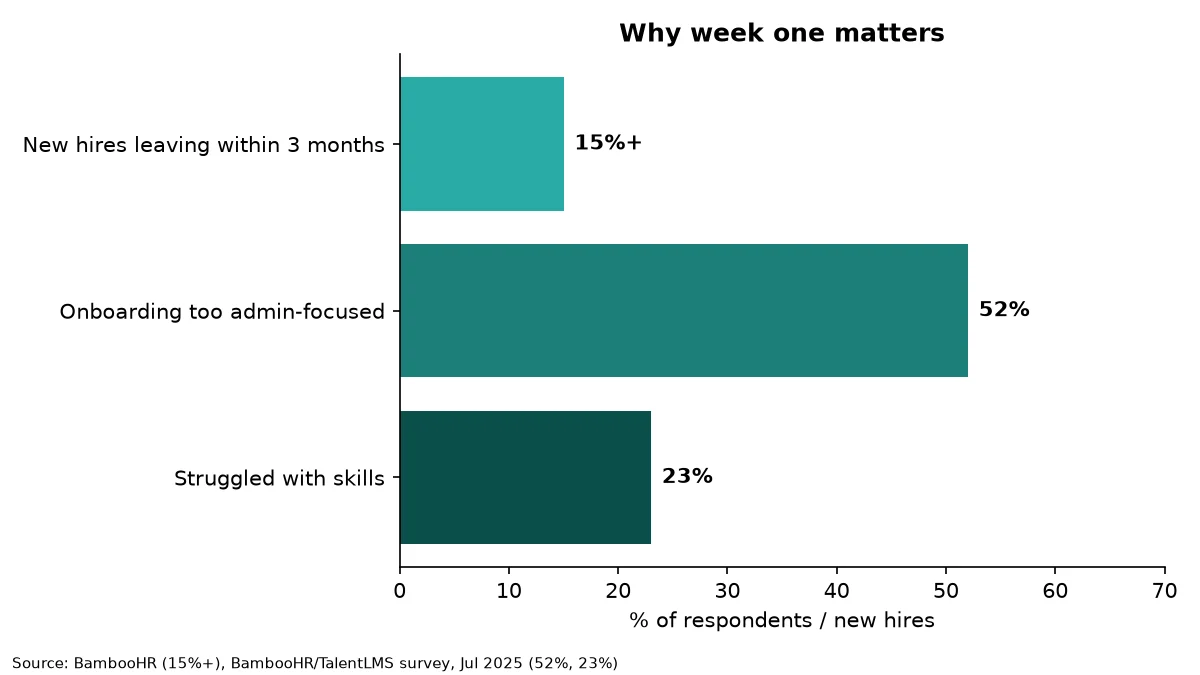
The first week is when a new hire decides whether they made the right choice. BambooHR reports that more than 15% of new hires leave within their first three months, and a July 2025 TalentLMS/BambooHR survey found that 52% of employees said admin-heavy onboarding overshadowed job readiness, while 23% struggled with skills. Week one is therefore not a formality: it is the cheapest retention lever HR owns.
1. Why week one decides so much
Most onboarding programs front-load paperwork: contracts, policies, equipment forms. The paperwork is necessary, but when it crowds out the work itself, people arrive on Monday and still cannot do their job on Friday. The goal of week one is simple: by Friday, the person has shipped one small real thing, knows who to ask, and knows what success looks like at 30, 60 and 90 days.
2. The three failures we see most
Access not ready
Laptop, accounts and tools arrive on day three. Fix: a pre-boarding checklist closed the Friday before the start date.
No first task
Reading documents for days feels like being ignored. Fix: a scoped first deliverable defined by the manager before day one.
No feedback loop
Nobody asks how it is going until the 30-day review. Fix: a short check-in at the end of day one and on Friday.
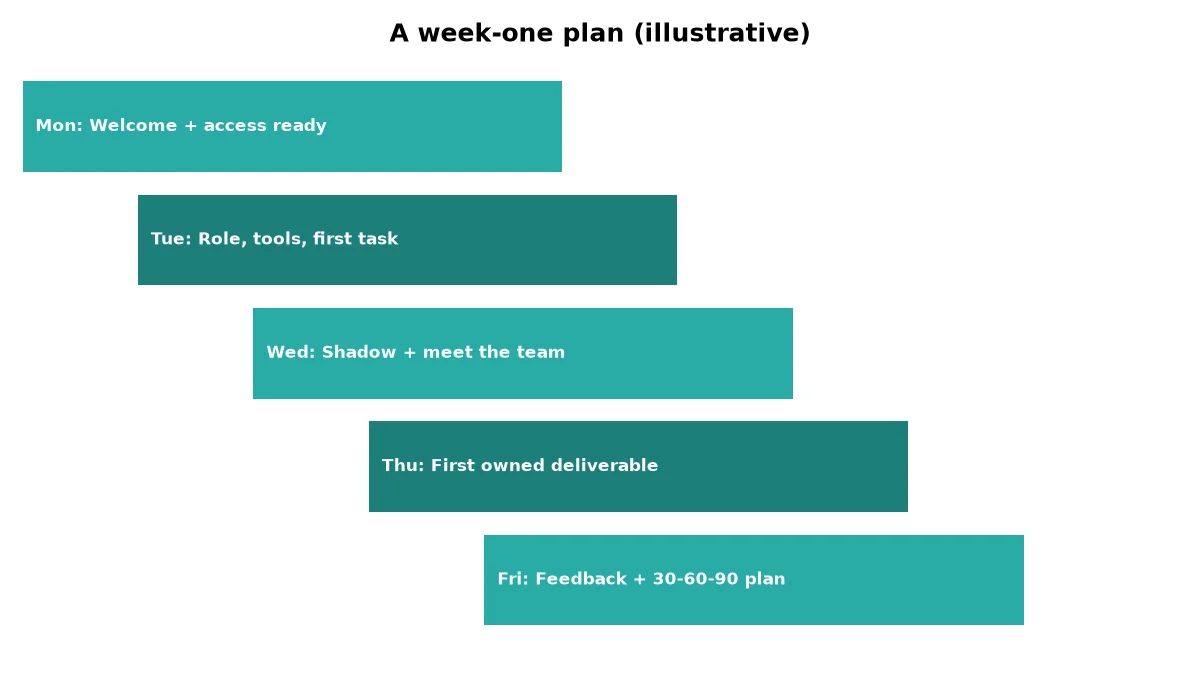
3. A day-by-day plan for week one (illustrative)
Monday: welcome and access
Greet in person or on video, confirm every account works, and introduce the buddy. Keep paperwork under 90 minutes.
Tuesday: role, tools, first task
Walk through the role and the tools actually used, and hand over the first scoped task.
Wednesday: shadow and meet the team
Set up two or three shadowing sessions and short introductions with the people the new hire will depend on.
Thursday: first owned deliverable
Something small, real and reviewable. A finished small task beats ten read documents.
Friday: feedback and the 30-60-90 plan
The manager and new hire review what worked and what was confusing, and write down the goals for 30, 60 and 90 days. For what comes next, see our 30-day onboarding checklist.
4. What HR can automate, and what it should not
Automate repetitive work and reminders: pre-boarding checklists, account requests, welcome messages, scheduling intro meetings, document collection and answers to recurring policy questions. Keep the welcome, the buddy conversation, the feedback and anything touching a person's doubts human. An AI worker can run the checklist and chase pending items so the HR team spends its time on conversations rather than on follow-ups. Delos Workers can connect to the tools you already use (HRIS, calendar, chat), with a human approving anything sensitive.
For more examples, see our five-day checklist an AI agent can run and our comparison of onboarding and offboarding automation.
5. How to measure it
Track four simple indicators: time to full access, time to first deliverable, satisfaction score on day five and 90-day retention. Compare cohorts before and after you change the plan. There is no universal benchmark here: the figures vary by company and sector, so use your own baseline.
Conclusion: the checklist before the next start date
- Close pre-boarding the Friday before.
- Define the first deliverable.
- Book the day-one and Friday check-ins.
- Automate the reminders.