Sales Forecasting: 6 Signals Your CRM Is Hiding (and How to Catch Them)
By Delos team — 2026-11-22
Every sales leader knows the feeling: the pipeline looks full on Monday, and the quarter still closes short. The problem is rarely the forecasting formula. It is the CRM data feeding it. A CRM records what reps typed, not what buyers did. Between the two sit signals that quietly distort every weighted pipeline. This guide lists six, shows how to check each in minutes, and ends with a weekly routine where AI agents prepare the evidence and your team keeps the decision. (We found no reliable public benchmark of forecast accuracy by industry, so we give none: measure your own error rate, as explained at the end.)

Every sales leader knows the feeling: the pipeline looks full on Monday, and the quarter still closes short. The problem is rarely the forecasting formula. It is the CRM data feeding it. A CRM records what reps typed, not what buyers did. Between the two sit signals that quietly distort every weighted pipeline. This guide lists six, shows how to check each in minutes, and ends with a weekly routine where AI agents prepare the evidence and your team keeps the decision. (We found no reliable public benchmark of forecast accuracy by industry, so we give none: measure your own error rate, as explained at the end.)
Why a full pipeline is not a forecast
A weighted pipeline multiplies each deal amount by a stage probability. That math is only as good as two assumptions: the stage reflects reality, and the deal is still alive. Both degrade silently. Reps update CRMs when forced to, usually before a review, so data is freshest when it matters least. Salesforce's State of Sales research series points to data quality and time spent on non-selling tasks as persistent pain points, which is why forecasts drift. Treat every deal as a claim that needs evidence.
The 6 signals your CRM is hiding
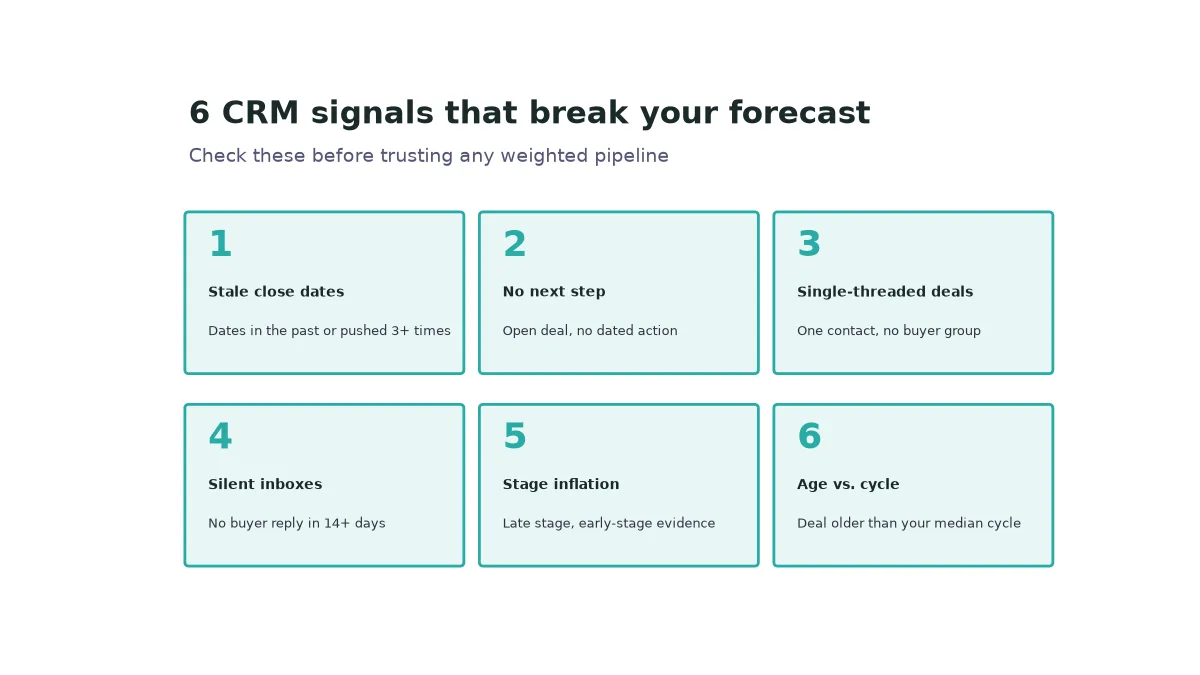
Six hidden CRM signals that distort sales forecasts
1. Stale close dates
A close date in the past, or pushed three times or more, is a deal nobody believes in. Filter open deals with a past close date every week; each is either closed-lost or needs a new, evidenced date.
2. No dated next step
An open deal with no scheduled action is drifting. Rule of thumb: no next step within 7 days and it leaves the commit category until someone acts.
3. Single-threaded deals
One contact means one point of failure: a job change, a holiday, a veto. Count contacts per deal; large deals with a single contact deserve a flag and a multi-threading plan.
4. Silent inboxes
The CRM rarely knows the buyer has not replied in two weeks, but your mailbox does. Compare the last buyer reply date with the stage: a late-stage deal with 14+ days of silence is at risk whatever the stage says.
5. Stage inflation
Reps move deals forward to look good or to unlock support. Check each stage's exit criteria (budget confirmed, decision maker met, proposal sent) against actual evidence in emails and notes.
6. Age versus your own cycle
Compute your median sales cycle from closed-won deals. Deals far older than that median usually close at lower rates in a team's own history; check yours rather than trusting a generic number.
What an AI agent can check, and what it should not decide
The six signals are checks, not judgment calls, so they suit agent work: read the CRM export, read the email and calendar metadata the team has authorised, compare against rules, and produce a short list of deals with evidence attached. A worker such as Laura, the Delos sales assistant, can prepare that list before every pipeline review. What the agent should not do is move a deal's category on its own. A rep knows that a quiet buyer is on holiday, or that a signature is imminent. The agent proposes, the rep confirms. The same principle applies when choosing between one agent or several (see our decision guide) and when deciding what to automate after a meeting.
A weekly routine
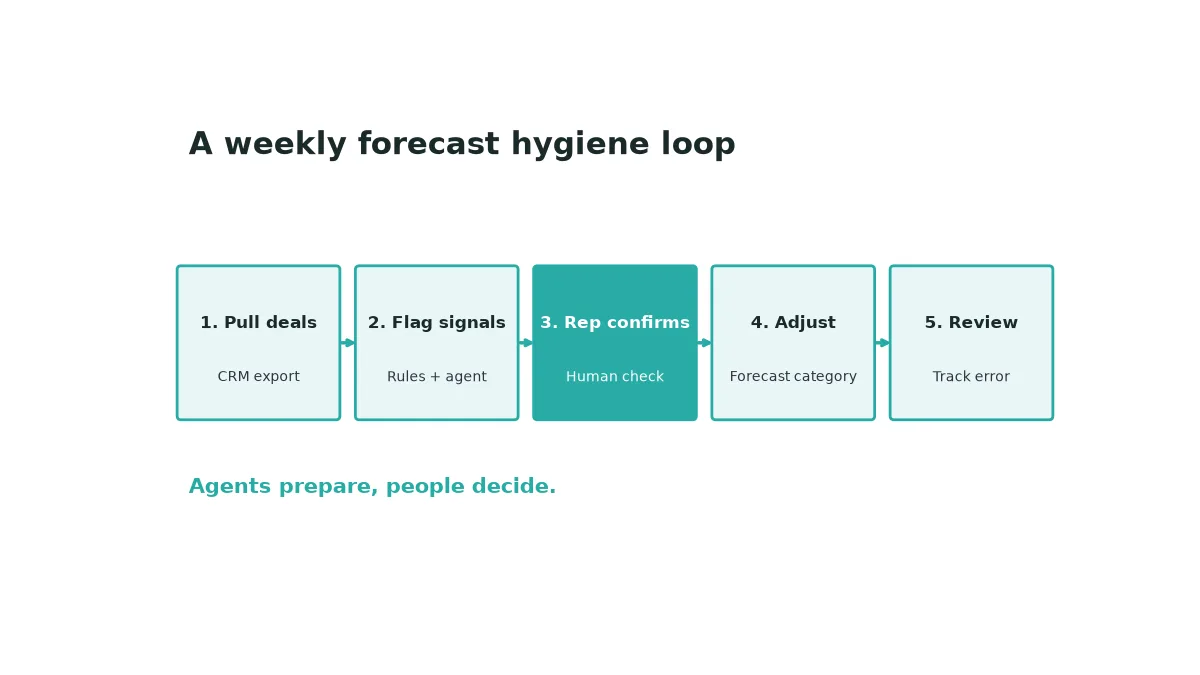
Weekly routine for checking and adjusting your sales forecast
Monday, 15 minutes: pull and flag
Export open deals, run the six checks, list flagged deals with evidence.
Tuesday: rep confirmation
Each rep confirms or contests flags in one line. Silence defaults to downgrade.
Before the forecast call: adjust
Move unsupported deals from commit to best case. Do not delete them: the goal is honesty, not a smaller number.
After the quarter: measure your error
Compare forecast and actuals by rep and by category and keep that error rate visible. Without it, nobody learns which signal predicts misses best in your business.
Common mistakes
- Buying a forecasting tool before fixing next steps and close dates: the tool will model bad inputs.
- Punishing reps for downgrades: they will hide risk again.
- Tracking too many signals: start with these six, keep the two that best predict your misses.
Key takeaways
- Forecasts fail on CRM evidence, not on math.
- Six checks catch most drift.
- Agents prepare evidence; people decide categories.
- Measure your own forecast error every quarter.
Further reading: Salesforce State of Sales, Gartner sales research, Harvard Business Review sales topic.