Why Your Sales Follow-Ups Get No Reply (and What an AI Agent Changes)
By Delos Intelligence — 2026-10-28
Silence after a proposal is usually a process failure, not a no. Fix timing, relevance and consistency with a five-step cadence.
Your reps send the first email, then life happens. The deal that was “hot” on Monday goes quiet by Friday, and nobody notices until the quarter review. Silence after a proposal is rarely a “no”. It is usually a process failure on your side.
Why follow-ups go unanswered: three causes
1. Timing: leads cool fast
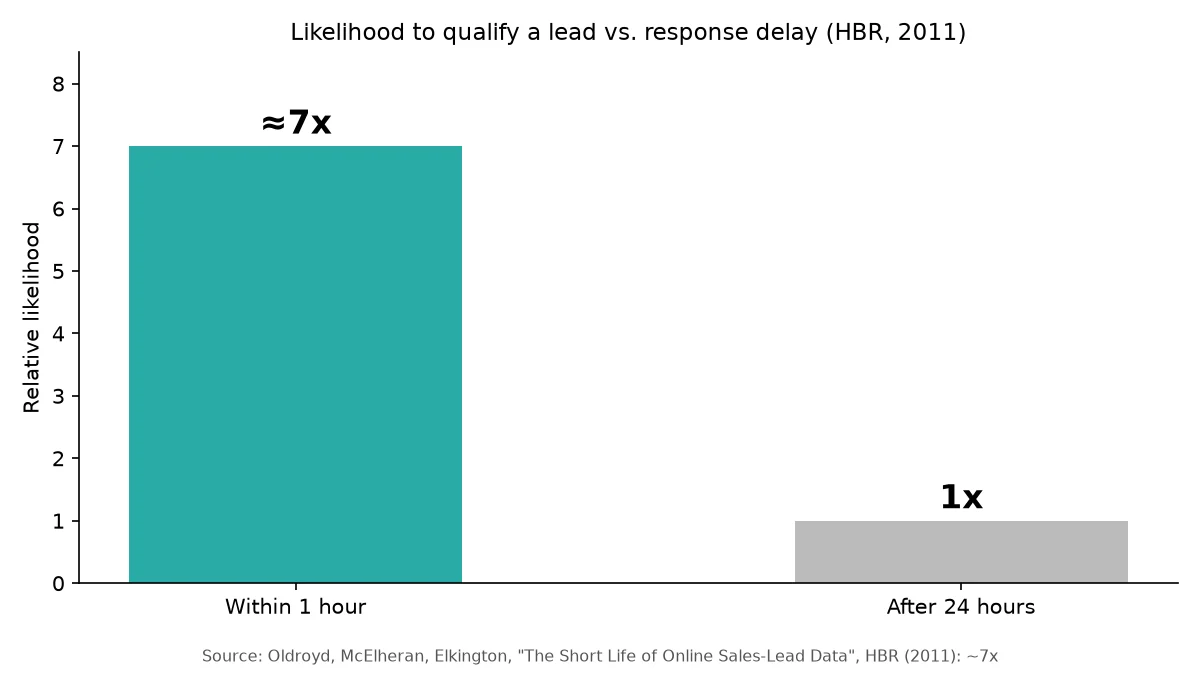
A well-known Harvard Business Review study by Oldroyd, McElheran and Elkington (2011), “The Short Life of Online Sales-Lead Data” found that firms contacting a web lead within an hour were about seven times more likely to qualify it than those waiting a day. The point is not to rush a generic message; it is to respond while the request is still relevant. See also our guide to AI SDR lead qualification.
2. Relevance: “Just checking in” adds nothing
A follow-up must bring one new piece of information: a case, a number, or an answer to an objection. Without that, it is another notification, not a reason to reply.
3. Consistency: memory does not scale
Follow-ups depend on a rep's memory and calendar. Under load, the third and fourth touch simply never happen. Prioritizing the right deals helps; read our article on predictive lead scoring.
A 5-step cadence that works
- Day 0: reply within the hour.
- Day 2: send a short recap plus one question.
- Day 5: bring a new angle with a case or proof.
- Day 9: create a call task for a human.
- Day 14: close the loop politely.
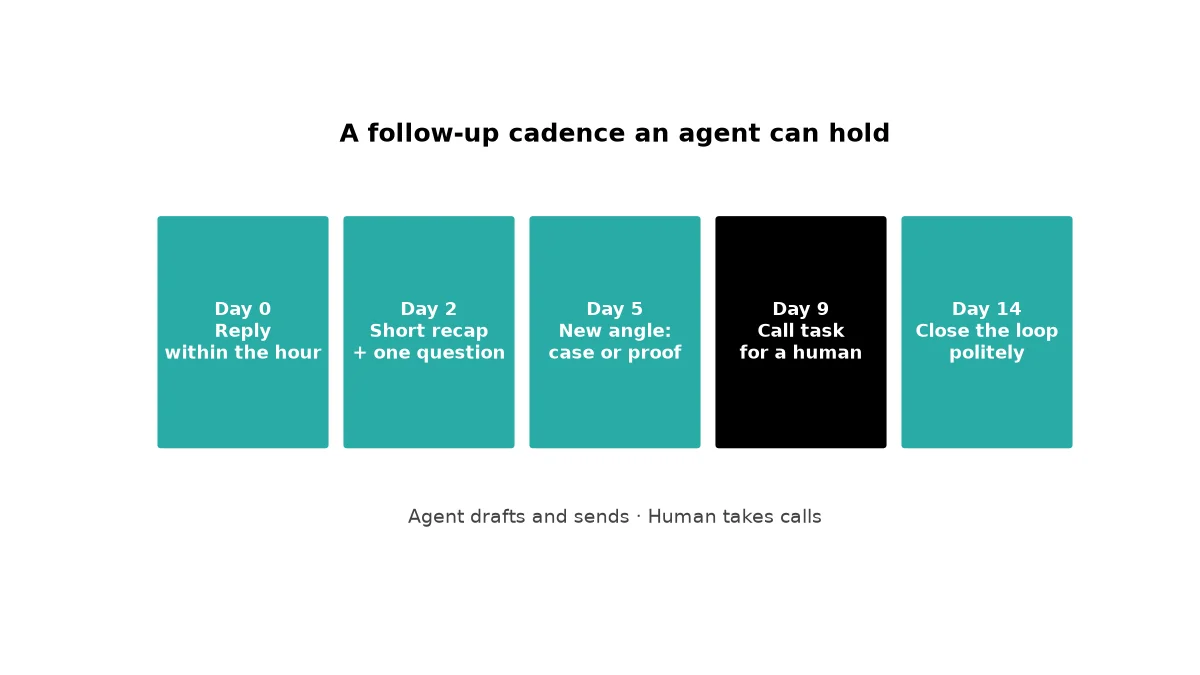
This cadence is a starting point to test on your own data, not a universal benchmark.
Rules to keep
- One message, one ask.
- Reference the last real exchange.
- Stop when the prospect answers or says no.
- Never send more than five touches without a human decision.
What an AI agent can take off the plate
An agent can monitor the pipeline for stalled deals (no activity for N days), draft a follow-up from CRM history and the last email thread, send routine touches on days 0, 2 and 5 under rules set by the sales lead, log every touch in the CRM, flag replies and create a call task for the rep. The human remains accountable for the relationship.
What it should not do: negotiate prices or discounts, send to strategic accounts without approval, or invent product facts. Keep a human approval step for key accounts. For a wider view of sales-team workflows, consult Salesforce State of Sales.
A concrete example
A 12-person B2B team receives about 80 inbound requests a month. An agent drafts replies within minutes, reps approve in one click during a daily 10-minute review, and stalled deals surface every morning in a short list. This is an illustrative scenario, not a customer result.
How to start in a week
- Export deals with no activity for 14 days.
- Write the five-step cadence and the stop rules.
- Let the agent draft only, while humans send, for two weeks.
- Measure reply rate and time-to-first-response before and after.
- Allow automatic sending for low-risk touches only.
Takeaways
- Speed beats polish.
- Each follow-up needs new information.
- Consistency is a system problem, not a motivation problem.
- Keep humans on calls and negotiation.