Prior Authorization Eats 13 Hours a Week: What an AI Agent Can (and Can't) Take Off Your Plate
By Delos Intelligence — 2026-10-26
Prior authorization consumes 13 hours a week. Here is where an AI agent can help with the packet, what clinicians must decide, and a practical 30-day pilot.
On Monday, a cardiology practice orders a scan. By Wednesday, nobody is sure whether this patient's plan requires prior authorization, which payer portal to open, or where the clinical notes ended up. The scan is not the hard part. Getting permission to schedule it is.
Multiply that uncertainty by roughly 40 requests per physician each week. In the AMA's May 2026 release on its 2025 survey, prior authorization consumes an average of 13 hours of physician and staff time per week; 95% of physicians say it at least sometimes delays necessary care. An AI agent cannot authorize treatment. It can remove some of the searching, copying and chasing that precedes a decision.
The real price of a request
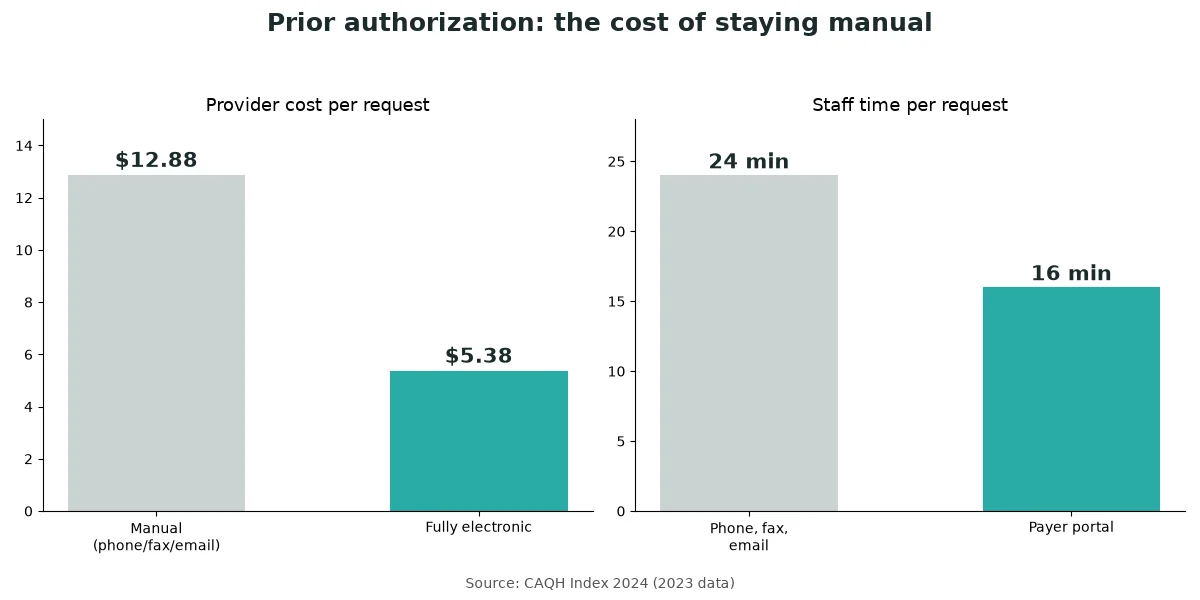
The CAQH Index illustrates the cost of the channel, not just the form. Its 2024 edition, using 2023 data, puts provider cost at $12.88 per manual prior-authorization transaction versus $5.38 when fully electronic. Staff spend about 24 minutes on a phone, fax or email request, compared with 16 minutes via a payer portal. A portal is faster, but still makes somebody log in, find the request and follow up.
For a five-physician practice doing 40 requests per physician per week, that is 200 requests weekly. At the manual benchmark, 200 × $12.88 × 52 is about $134,000 annually in transaction costs. This is an illustrative scenario, not a measured bill for every clinic; it excludes denials, appeals, delayed scans and patients who abandon treatment. The comparison also does not mean an agent automatically achieves the fully electronic rate.
What changed in January 2026
Under CMS-0057-F and CMS's electronic prior authorization program, affected payers must make decisions on urgent requests within 72 hours and standard requests within seven calendar days, and supply a specific reason for a denial. The decision-time requirements took effect in January 2026. They cover specified Medicare Advantage, Medicaid, CHIP and exchange plans; drugs and employer plans are outside the rule's direct scope. The rule's required prior-authorization APIs have a separate January 2027 implementation date: do not assume every payer already supports an API today.
Faster decisions on the payer side do not assemble the packet on the practice side. If the referral, imaging, treatment history and clinical justification are scattered, the clock only starts once somebody has put together a valid request. This short AMA explainer provides context for the CMS final rule:
Where the hours actually go
Not mainly into typing a form. First, someone checks whether the specific procedure code and insurance plan require authorization, sometimes for a particular site of service. Next comes finding the right route: the payer portal, Availity, another vendor, or fax. Then staff gather chart notes, imaging, prior treatments and the clinician's rationale. They check status, answer requests for more information and tell the patient what is happening.
When a request is denied, the work branches into corrections, an appeal or a peer-to-peer conversation. Each handoff loses context. A team can submit quickly and still spend days discovering that one attachment did not arrive. Mapping those transitions is more useful than buying a faster form-filler.
What an AI agent can take on
1. Intake and requirement check
Given an order, procedure code, patient plan and site of service, the agent checks current payer rules, cites the rule it used and flags uncertainty. It should never treat an old coverage policy as a guaranteed approval.
2. Packet assembly
With authorized, limited access to the chart, it gathers relevant notes, imaging and treatment history into a draft packet. The clinician checks that the evidence supports the request and that irrelevant patient data is not included.
3. Submission and tracking
After sign-off, the agent selects a supported channel, submits the approved packet where integration permits, records a receipt and reminds staff when an answer or additional information is due. Where there is no reliable integration, it prepares a handoff for a person instead of pretending the request went through.
4. Denial and appeal drafting
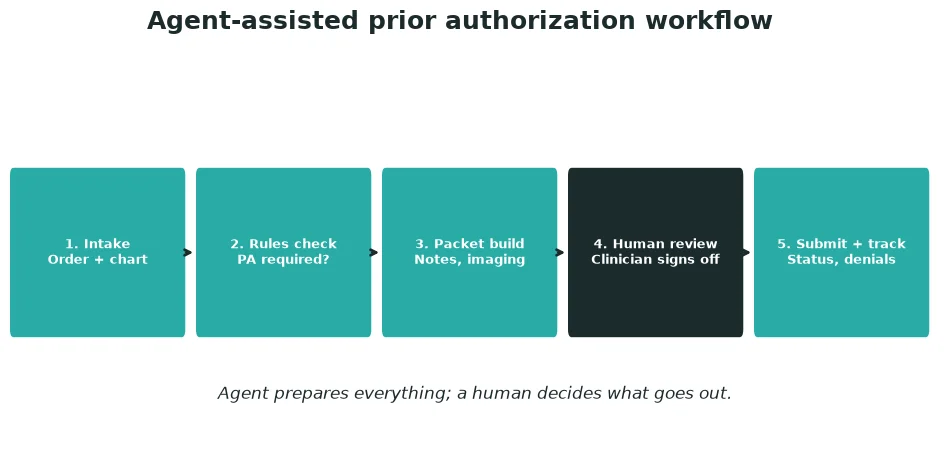
It can match a denial reason to missing evidence and draft an appeal for review. It cannot invent clinical facts, guarantee coverage or conduct the clinician's peer-to-peer call. The workflow is deliberately interrupted for human review:
What must stay human
Clinical judgment stays with the clinician. A person signs off before anything leaves the practice, conducts peer-to-peer discussions and decides what to do when evidence conflicts or the agent's confidence is low. The rule is simple: the agent prepares; a clinician decides. Keep a trace of sources, edits, approvals, submission receipts and outcomes for every packet.
Patient information needs more than a promise of security. Ask who can read the EHR, what may be written, and how access is revoked. Give the agent least-privilege access, not a shared administrator login. The same pattern of documented handoffs and oversight appears in our guide to AI-agent governance and accountability.
A 30-day start
- Week 1 — baseline: for the five most-requested procedures, record requests per week, staff minutes per request, denial rate and time to decision. Separate manual, portal and electronic channels.
- Week 2 — map: document payer requirements, current channels, necessary evidence and the staff member who signs each packet. Verify exceptions rather than encoding guesses as rules.
- Week 3 — shadow mode: let the agent check requirements and draft packets beside the existing process. Humans still submit everything. Log false positives, missed notes and time saved or lost.
- Week 4 — supervised submission: allow submission only after clinician sign-off, for a small supported subset. Compare turnaround, rework, denials and staff time against week one before expanding.
Questions to ask any vendor
- Where is protected health information (PHI) stored and processed, and who can access it?
- Can we export a complete audit log, including the source of each clinical assertion?
- What happens on low confidence, conflicting rules or a failed submission?
- Which payer channels are actually supported today, and which still require a human?
Ask for a demonstration with one of your real, de-identified workflows, not a perfect sample case. An agent that knows when to stop is safer than one that always produces an answer. The same boundary matters when agents process safety-critical evidence; see our article on AI in pharmacovigilance.
Conclusion
Prior authorization will not disappear. But the 13 hours can shrink if an agent does the preparation, a clinician keeps the decisions, and the practice measures what actually changed. These figures and rules are US-based; the workflow logic applies wherever a payer requires pre-approval before care.