Who's Accountable When Your AI Agent Acts Alone? A Governance Playbook
By Delos Intelligence — 2026-10-13
When an autonomous AI agent books, pays or emails on its own, who answers for it? A practical 2026 governance playbook: ownership, guardrails, audit trails and escalation.
Your newest hire never sleeps, never asks for a raise, and can file an expense, send a customer email, or reroute a shipment before you've finished your coffee. It's an AI agent, and it's already acting on its own across your systems. That's the upside. The quieter question nobody wants to answer in the kickoff meeting: when it gets something wrong, who's on the hook?
This isn't hypothetical anymore. As agents move from suggesting to doing, accountability stops being a compliance footnote and becomes the thing that decides whether you can scale them at all.
The maturity gap is real (and uncomfortable)
Most enterprises have agents in production and governance on a slide. According to Deloitte's State of AI in the Enterprise, only about 1 in 5 organisations have a mature governance model for autonomous agents. Meanwhile, IBM's Cost of a Data Breach Report found that 63% of organisations hit by an AI-related breach either had no governance policy or were still building one. And 73% of enterprise leaders name data privacy and security as their top AI risk.
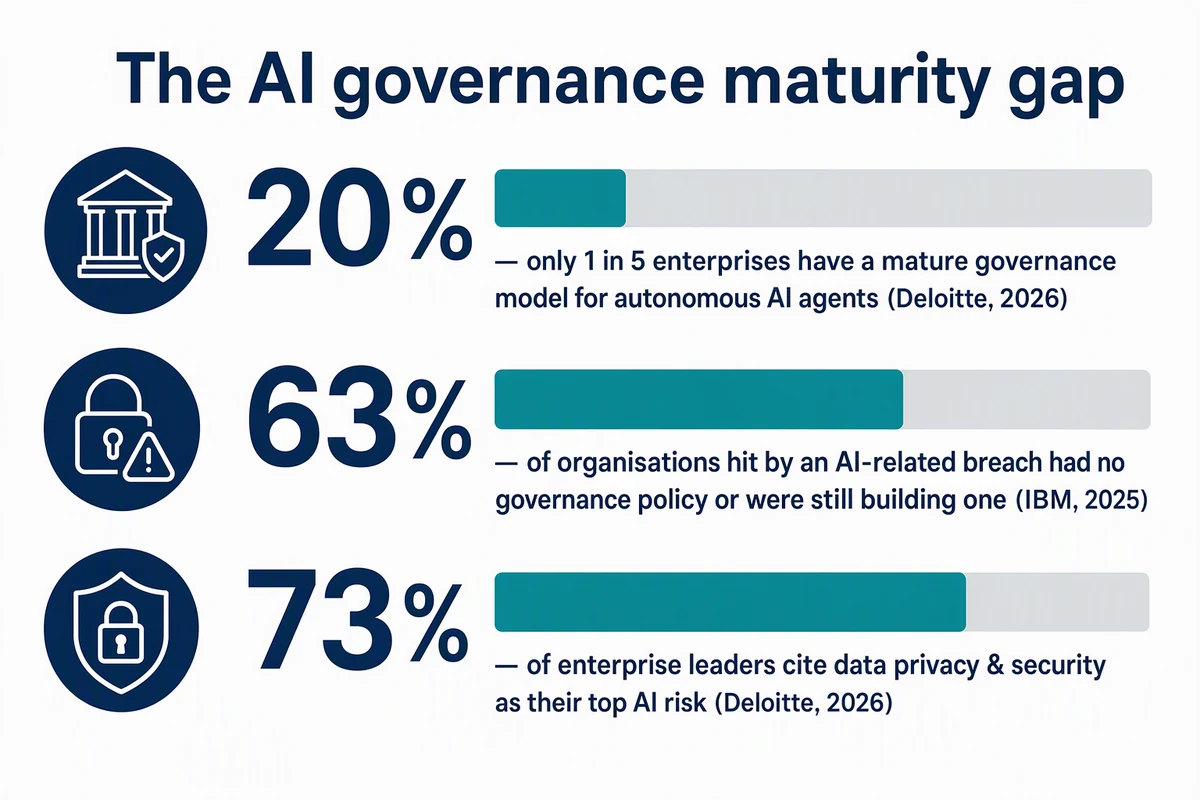
Read those together and the picture is clear: agents are shipping faster than the rules that are supposed to govern them. That gap is exactly where accountability goes to die.
Why “the AI did it” is not an answer
When a human employee makes a costly mistake, there's a chain of responsibility: the person, their manager, the policy that should have caught it. Autonomous agents break that chain in three specific ways.
- Speed and scale. An agent can repeat a bad decision a thousand times before anyone notices once.
- Opacity. If you can't reconstruct why an agent acted, you can't assign responsibility or fix the root cause.
- Diffusion. The model vendor, the integrator, the team that deployed it and the business owner can all point at each other.
“The AI did it” is a liability vacuum. Regulators, auditors and customers will route the responsibility to a human regardless, so you're better off deciding in advance which human that is. This becomes even more important in multi-agent systems, where several agents can participate in one decision.
The accountability chain: five links that hold
Good agent governance isn't a 40-page policy nobody reads. It's a short, enforced chain where each link has a clear owner. Here's the playbook. For the broader operating model, see our AI governance frameworks guide.
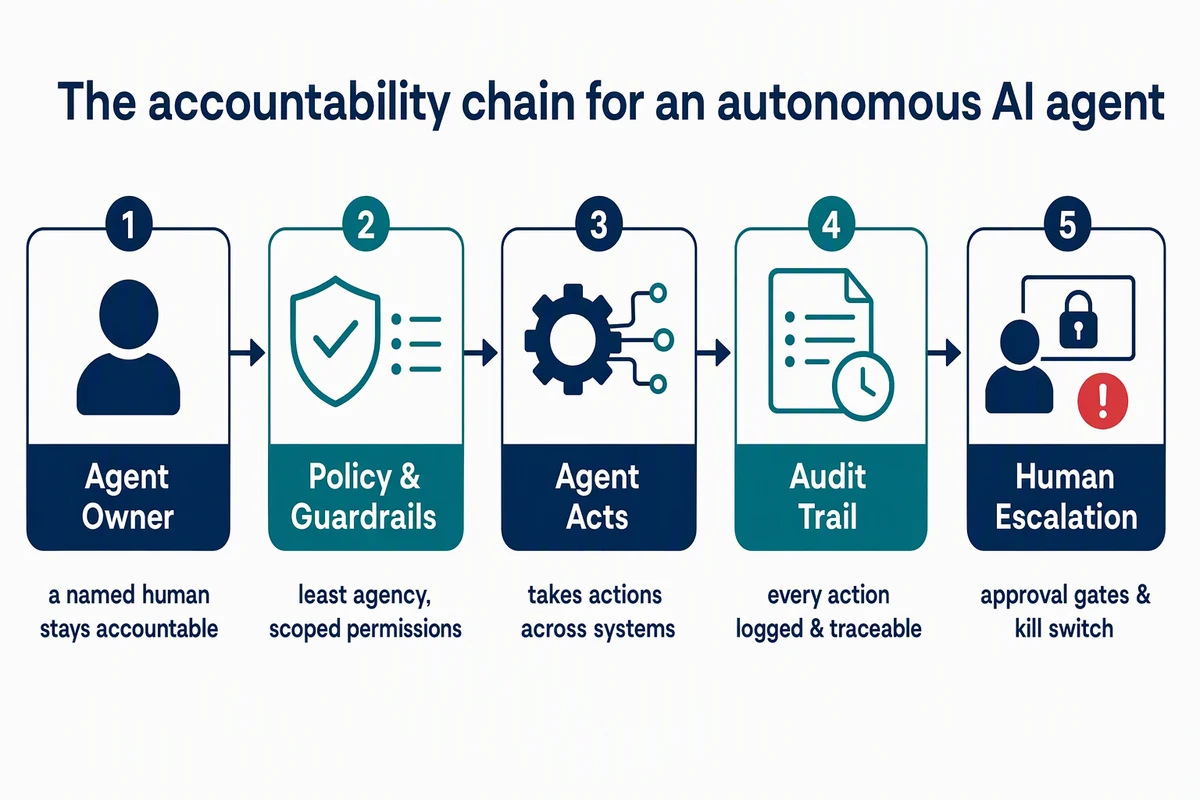
1. Every agent has a named owner
No anonymous agents. Each one is registered with a human accountable owner, a defined business purpose, and an expiry/review date. If an agent can act, a specific person answers for it. Treat agents like employees with a manager, not like scripts.
2. Policy and guardrails: the principle of least agency
Borrow “least privilege” from security and extend it: give an agent the least agency it needs. Scope its permissions tightly, whitelist the systems and actions it can touch, and set hard limits (spend caps, rate limits, data boundaries). An agent that can't wire money can't wire money to the wrong place. See our AI data-security guide for IT leaders for the underlying data controls.
3. The agent acts, inside the lines
Within its guardrails the agent operates autonomously. That's the point, and that's fine, as long as the first two links are real. Low-risk, reversible actions run freely; high-risk, irreversible ones don't get to.
4. An audit trail for every action
This is the link most teams skip, and it's the one auditors care about most. Every meaningful action an agent takes should be logged: the input, the decision, the tool call, the result, and the identity it acted under. If you can't replay what happened, you can't be accountable for it. A real audit trail is also what turns a bad incident into a fixable bug instead of a mystery.
5. Human escalation and a kill switch
Define which decisions require a human in the loop before they execute, not after. Payments above a threshold, anything touching sensitive personal data, anything contractual: these hit an approval gate. And every agent needs a kill switch an owner can pull in seconds. Watch the IBM walkthrough below for a concrete view of how these safeguards fit together.
How to start Monday (without a committee)
You don't need a governance transformation program to get the first 80%. Three moves:
- Inventory your agents. You can't govern what you can't see. List every agent in production, who owns it, and what it's allowed to do. Most teams are surprised by the answer.
- Turn on logging before you expand autonomy. Make the audit trail a prerequisite, not a retrofit. Map your controls to an external standard like the NIST AI Risk Management Framework so you're not inventing categories from scratch.
- Set approval gates for the irreversible stuff. Money, personal data, contracts, external communications. Everything else can run, with a log.
Accountability is what lets you go faster, not slower
It's tempting to read all of this as a brake. It's the opposite. The organisations that scale agents confidently are the ones that know, for every agent, who owns it, what it can do, and how to see what it did. That clarity is what lets a leader say yes to the next deployment instead of freezing. Governance isn't the tax you pay on autonomy; it's the permission slip.
If you're deploying agents that take real actions, like the Delos Workers themselves, build the accountability chain first. It's far cheaper to add the owner, the guardrails and the audit trail on day one than to reconstruct them after the incident.