40 Million Adverse Event Reports and Counting: How AI Agents Are Rescuing Pharmacovigilance
By Pam — 2026-10-08
Drug-safety teams are drowning in adverse-event reports. See how AI agents cut ICSR case-processing time and cost while keeping humans firmly in control.
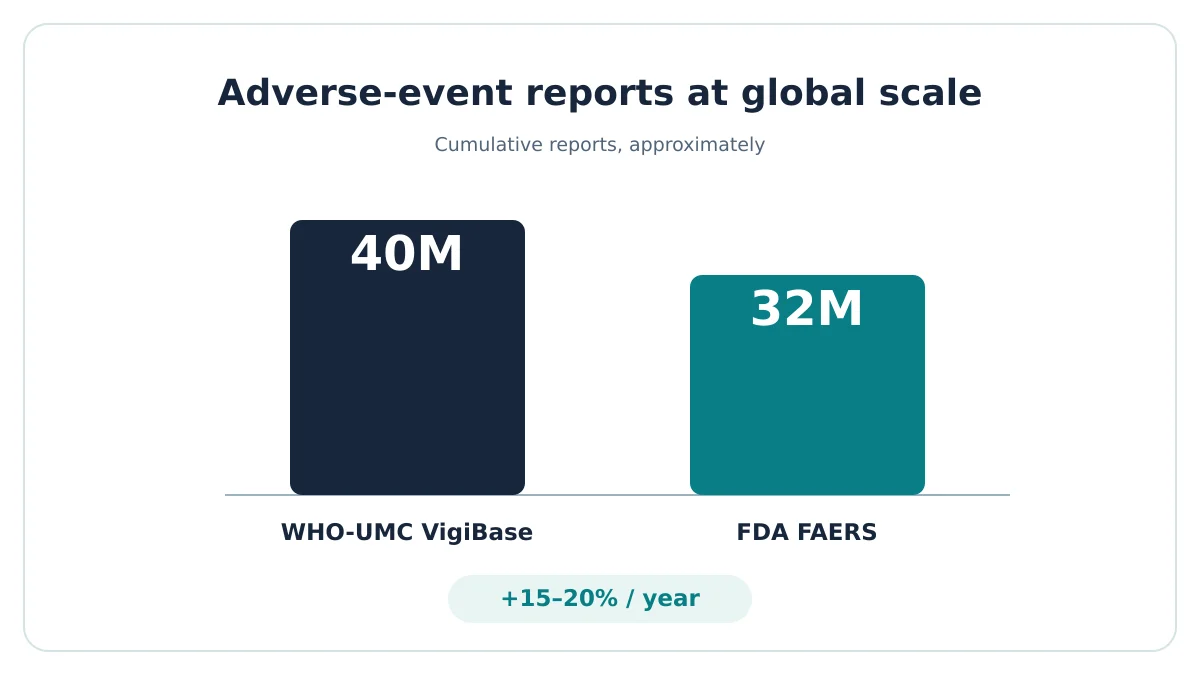
Pharmacovigilance used to be a paperwork problem. In 2026 it is a scale problem. The World Health Organization's global safety database, VigiBase, has now passed 40 million individual case safety reports (ICSRs), and the volume keeps climbing 15–20% every year. The US FDA's FAERS system holds more than 32 million reports and takes in over 2 million new ones annually. No safety team can hire fast enough to keep pace with a dataset that doubles faster than headcount ever could.
This is where AI agents have stopped being a slide in a vendor deck and started doing real work. Here is where they help, where they don't, and how to deploy them without failing an inspection.
Why pharmacovigilance hit a wall
Drug-safety obligations run from a molecule's first clinical trial through its entire commercial life. Every suspected adverse event has to be collected, assessed, coded, and reported to regulators on tight clocks: serious cases within 15 days, fatal or life-threatening ones within 7. Miss those deadlines and you are looking at compliance findings, not just inefficiency. The same pressure starts upstream in clinical-trial patient recruitment.
The economics are brutal. Industry analyses estimate that case processing alone consumes up to two-thirds of a pharmacovigilance budget — the manual intake, data entry, medical coding, and narrative writing that happens before anyone does actual safety science. Average manual adverse-event reporting still takes 5 to 10 days per case. Meanwhile the global pharmacovigilance market is set to grow from $10.4 billion in 2025 to $22.3 billion by 2034. The workload is growing; the talent pool is not.
Where AI actually delivers
The honest version of the AI story is narrow and useful, not magical.
Literature monitoring
Regulators require companies to screen scientific literature for safety signals — a task most teams struggle to keep up with manually. AI agents scan PubMed, MedLine, and regulatory bulletins continuously, flag articles that mention a product and a suspected reaction, and pre-extract the relevant passages. Humans still decide, but they start from a filtered, structured shortlist instead of thousands of abstracts.
Case intake and ICSR processing
This is the biggest prize. Natural-language models read inbound reports — emails, call-center transcripts, portal forms, PDFs — and extract the structured fields an ICSR needs: patient, product, event, dates, outcome. They draft the MedDRA coding and a first-pass narrative. A case processor who used to type for an hour now reviews and corrects for a few minutes. The underlying extraction techniques are covered in our document intelligence guide.
Signal detection
Once cases are structured, models surface disproportionality patterns across millions of reports far faster than quarterly manual review, helping safety physicians spot an emerging signal weeks earlier.
The multi-agent blueprint
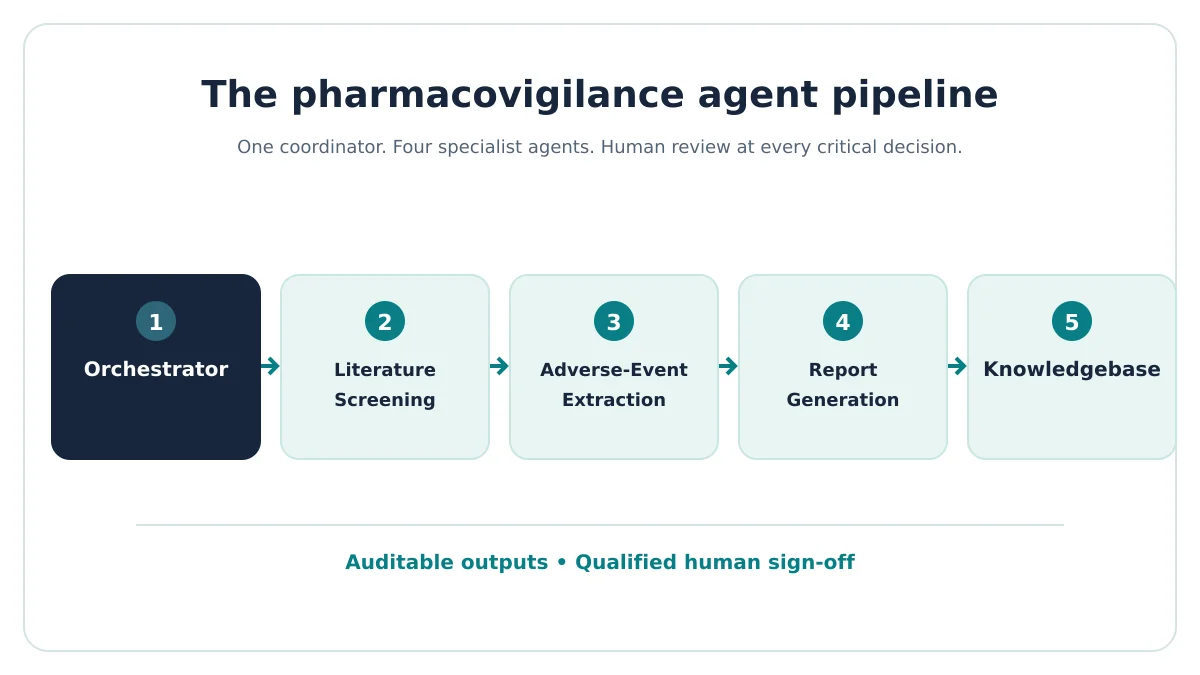
The pattern winning in 2026 is not one giant model but a team of specialized agents. Deloitte's drug-safety framework, for example, coordinates five of them: an Orchestrator that routes the work, a Literature Screening agent, an Adverse-Event Extraction agent, a Report Generation agent that produces regulator-ready ICSRs, and a Knowledgebase agent that cross-checks against prior cases and product data. Each agent is auditable and does one job well — which matters enormously in a regulated setting.
Human-in-the-loop is non-negotiable
Early pharmacovigilance AI failed for a structural reason, not a technical one: first-generation systems produced outputs with no auditable reasoning chain. In a GxP environment, “the model said so” is a regulatory incompatibility, not an inconvenience. See our human-in-the-loop playbook for the practical oversight tiers.
The workable model keeps a qualified person firmly in control. The AI drafts; the human validates. The Qualified Person for Pharmacovigilance (QPPV) still owns the decision. Done this way, the gains are real without the risk: Deloitte's 2026 analysis projects early adopters cutting operational costs by around 20% — not by firing safety experts, but by redirecting them from data entry to oversight and genuine signal evaluation. The EMA's pharmacovigilance overview sets out the regulatory context.
A pragmatic rollout
- Start with intake, not decisions. Automate extraction and narrative drafting first; keep causality and reporting calls human.
- Demand audit trails. Every AI output needs traceable reasoning and a human sign-off log — build it in from day one.
- Measure the right things. Track case cycle time, on-time reporting rate, and coding accuracy before and after.
- Keep the QPPV in the loop. Oversight is a feature, not a bottleneck to engineer away.
Pharmacovigilance will not be run by autonomous robots any time soon, and it shouldn't be. But the teams that pair specialized AI agents with disciplined human oversight are the ones clearing their backlog, hitting their deadlines, and spending their expertise where it belongs — on patient safety, not data entry.