Supply Chain Exceptions: 5 Rules for Letting AI Agents Handle the Routine
By Delos Intelligence — 2026-10-24
Planners lose hours to routine supply chain exceptions. Here are 5 rules for deploying AI agents that resolve them safely, with Gartner data and a rollout plan.
It is 7:40 on a Monday. A supplier confirms a three-day delay, two orders now miss their promise date, and a warehouse in the south is short on a fast-moving SKU while the north holds surplus. Nothing is broken. This is simply the routine of a supply chain, and it eats planners' mornings. The question is no longer whether AI can help, but which of these exceptions an agent can safely resolve alone.
Why exceptions are the right place to start
Most supply chain teams already have forecasts, dashboards and control towers. The expensive gap is execution: turning a signal into a decision across inventory, capacity, logistics and customer promise. Gartner forecasts that spend on supply chain software with agentic AI will grow from under $2 billion in 2025 to $53 billion by 2030, and that 60% of enterprises using supply chain management software will adopt agentic features by then, up from 5% in 2025.
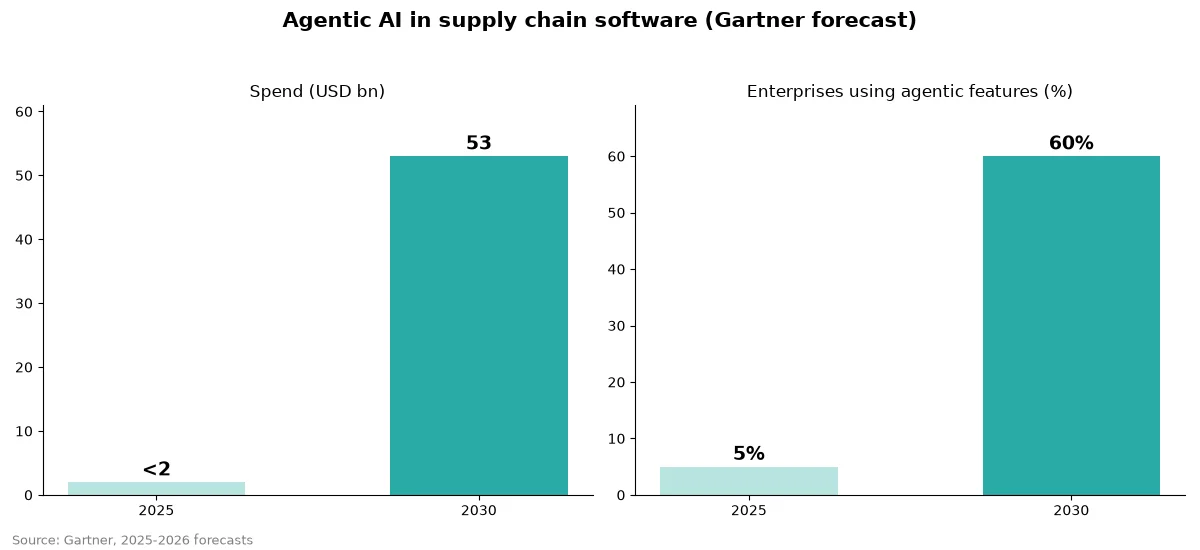
The signal is clear: buyers want systems that act, not another dashboard. Exceptions are the ideal entry point because they are frequent, rule-bound, and easy to measure: a late inbound shipment, a stock-out risk, an order that cannot meet its date, a carrier rejection, an invoice mismatch with a purchase order.
What an AI agent actually does here
A supply chain agent is a governed software worker. It senses an event, pulls context from approved systems (ERP, WMS, TMS), checks constraints, recommends or executes a scoped action and leaves an audit trail. It is different from a copilot that summarises a dashboard: it calls tools and completes multi-step work, such as checking available stock across nodes, proposing a transfer, and updating the order. For more on this distinction, see our guide to agentic enterprise workflows.
The 5 rules
Rule 1: Classify exceptions before you automate any
List the last 90 days of exceptions and sort them by frequency, value at stake and reversibility. Start with high frequency, low value, reversible cases: reallocating stock between two warehouses, rebooking a delivery slot, chasing a supplier confirmation. Leave contract disputes and strategic allocations to humans.
Rule 2: Give the agent levels of autonomy, not a blank cheque
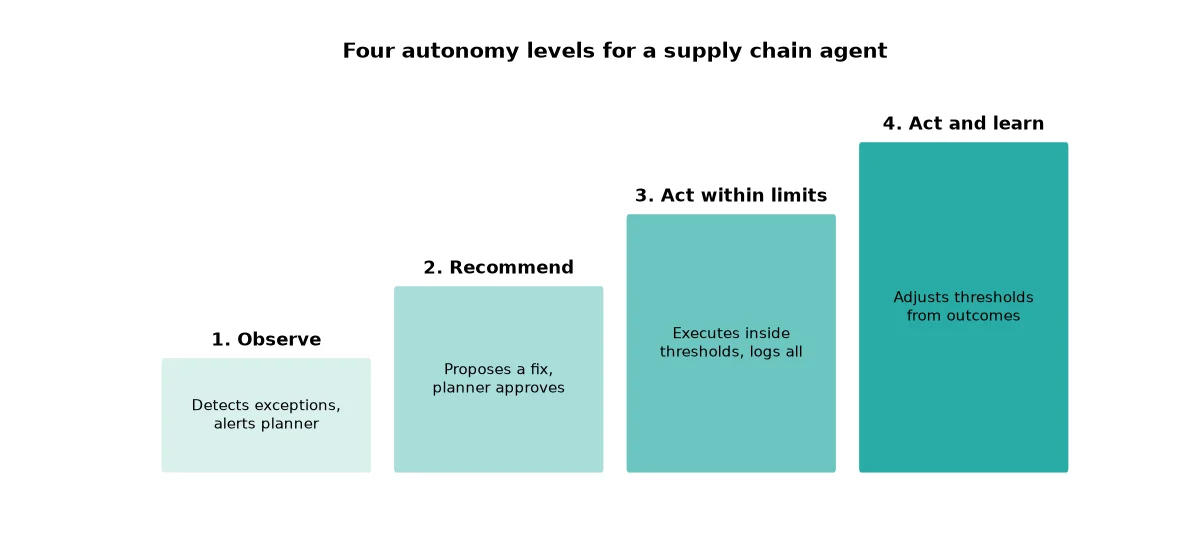
Use four levels: observe, recommend, act within limits, act and learn. Every exception type starts at level 1 or 2. It moves up only after the planner's approval rate stays high over a defined period (for example 95% over four weeks). For practical approval gates, read our human-in-the-loop oversight guide.
Rule 3: Write thresholds in business terms
'Transfer up to 500 units if the cost is under 2% of order value and service level stays above target' is a rule an agent can follow and an auditor can read. Vague instructions create vague behaviour.
Rule 4: Make every action traceable
Log the trigger, the data read, the options considered, the action taken and who approved. When a planner asks 'why did it move that stock?', the answer must take ten seconds, not ten emails. This also matters for governance: Gartner has warned that over 40% of agentic AI projects will be cancelled by the end of 2027, often because of unclear value or weak controls.
Rule 5: Measure the planner's time, not the model's accuracy
Track exceptions resolved without human touch, average time to resolution, expedite costs and planner hours freed. These are the numbers your finance team will recognise.
A concrete example
Take a distributor with three regional warehouses. A supplier delay puts a top-selling SKU at risk in the south. The agent detects the delay from the supplier portal, checks stock in the other two sites, finds 800 surplus units in the north, calculates that a transfer costs less than expediting the supplier, and (at level 3) books the transfer and updates the promise dates in the order system. The planner sees a one-line summary and a log entry. (Illustrative scenario, not a customer result.)
A 30-day rollout plan
Week 1: extract and classify 90 days of exceptions, pick two types. Week 2: connect read-only access to ERP, WMS and TMS; run the agent at level 1. Week 3: move to level 2 and measure approval rates. Week 4: enable level 3 on the safest type with written thresholds, and review the audit log with operations and finance.
Where Delos fits
Delos Workers are autonomous AI workers with persistent memory that connect to your tools and work alongside your teams; the same governance logic applies: scoped access, written limits, full traceability. Read how McKinsey frames the shift in its video 'Powering Supply Chain With Agentic AI' and Gartner's guidance on an autonomous-ready supply chain.
Key takeaways
- Start with frequent, low-value, reversible exceptions.
- Climb autonomy levels step by step.
- Write thresholds in business language.
- Log everything.
- Measure planner hours freed.