Lead qualification: the 5-minute rule is shakier than you think (and what to do instead)
By Belle — 2026-11-07
Everyone quotes the 5-minute rule. Few know it rests on six companies. Here is the real data and a qualification flow you can run today.
Every sales deck says it: answer a lead within five minutes. The figure is repeated so often that nobody checks it. We did. The rule is directionally right, but the numbers behind it are older, smaller and messier than the slogans suggest.
Where the 5-minute rule really comes from
The famous claim, that the odds of contacting a lead are 100 times higher when the first attempt comes within 5 minutes rather than 30, comes from a 2007 study of six companies run by InsideSales.com and MIT. It measured contact and qualification odds, not closed deals. Newer figures are mostly surveys or vendor data. A review of sources by Digital Applied makes the same point: keep each number with its year, sample and publisher.
What measured data shows
The most solid dataset is an audit published by Harvard Business Review in 2011: 2,241 US companies received test leads. Among those that replied within 30 days, the average response time was 42 hours. Only 37% replied within an hour, and 23% never replied at all. A later InsideSales study of about 30 million contact attempts found that fewer than 1% of first attempts happened within five minutes, and that more than 57% waited over a week; conversion was 8 times higher when the first attempt came within five minutes versus six minutes or later. A 2017 survey of 433 B2B companies found only 7% responded within five minutes. Vida's speed-to-lead review summarises these findings.
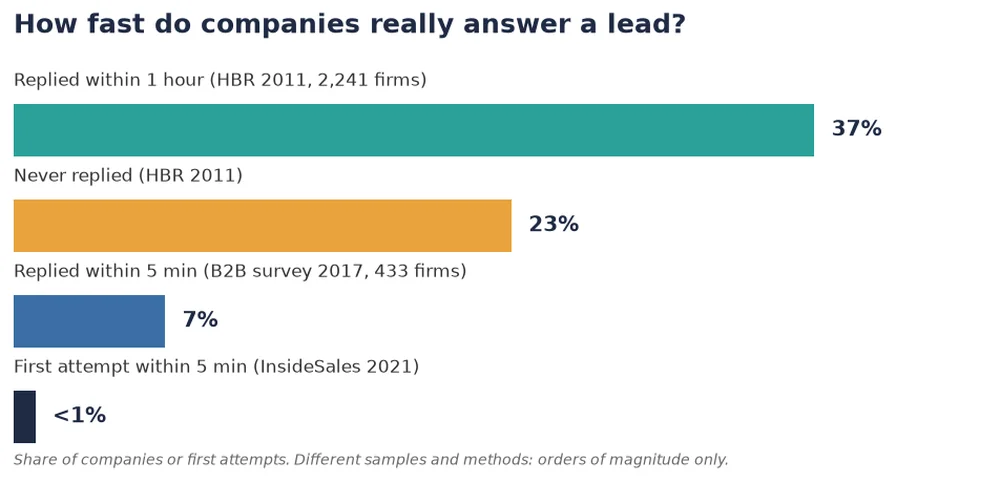
Takeaway: the real story is not that five minutes is magic. It is that most companies are slow or silent, so any reliable fast reply is an edge.
What the numbers cannot tell you
- They mostly measure contact and qualification odds, not revenue.
- Samples are small, old, or self-reported surveys.
- Vendor close-rate claims (for example 32% vs 12%, or +391%) publish little or no method. Treat them as a reason to run your own test, not as a forecast.
Speed is not qualification
A fast reply that asks nothing useful just moves the delay to the next step. Qualification means deciding quickly whether a lead has a need, a budget, a timeline and a decision path, and what happens next. Fast and relevant beats fast and generic.
A qualification flow that works at any hour
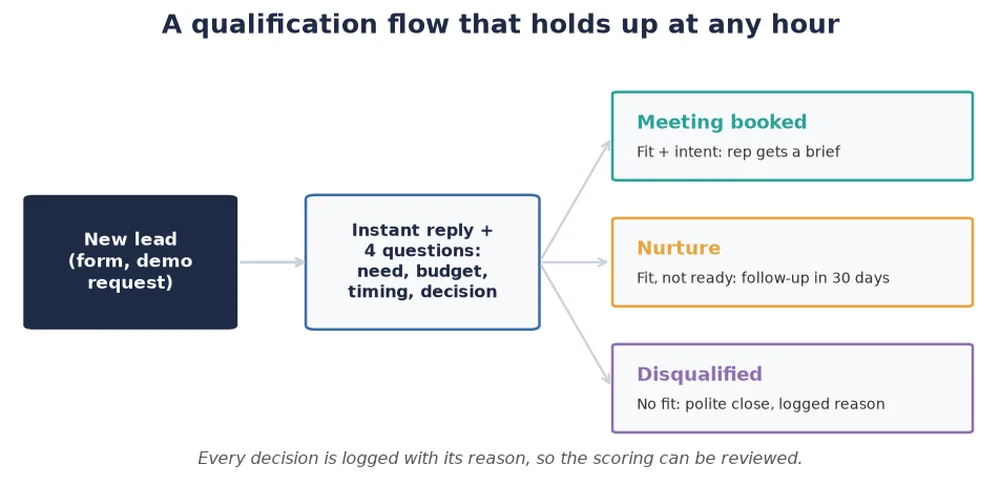
A lead arrives from a form or a demo request. An instant reply confirms receipt and asks four short questions: need, budget range, timing, who decides. The answers route the lead into one of three outcomes: meeting booked (the rep receives a short brief), nurture (good fit, not ready, follow-up in 30 days), or disqualified (polite close with a logged reason).
Where an AI worker fits
The instant reply, the four questions, the CRM update and the brief for the rep are repeatable steps. An AI worker such as Belle at Delos can handle them outside office hours, and hand over to a human the moment a lead asks for a person or a complex quote. Humans keep the decisions that need judgment: pricing, exceptions, relationship.
A 30-day test to run on your own data
- Timestamp every first touch and every qualification outcome.
- Set a written response target (for example 15 minutes in business hours, next morning otherwise) and publish it to the team.
- Split leads by source and measure contact rate, qualification rate and meetings booked.
- Review disqualification reasons weekly to adjust your questions.
- Compare the same metrics before and after automating the first reply.
Related reading: Predictive lead scoring: stop chasing the wrong leads and Why your sales follow-ups get no reply (and what an AI agent changes).
FAQ
Is the 5-minute rule true?
Directionally yes: faster first contact raises contact and qualification odds. But the headline numbers come from small or old samples, so test on your own leads.
What should a first reply contain?
A confirmation, one clear next step, and two to four short qualifying questions.
Can AI qualify leads on its own?
It can run the repeatable steps and route leads. Keep humans on pricing, exceptions and sensitive accounts.
Do not chase a magic number. Reply reliably, ask useful questions, log every outcome, and measure your own results.