Onboarding in 5 Days: The Checklist an AI Agent Can Run for You
By Delos Intelligence — 2026-10-27
Most onboarding fails on logistics, not on welcome. Here is a 5-day checklist that splits the work between an AI agent and your people.
Ask a new hire what went wrong in week one and the answer is rarely culture. It is the laptop that arrived late, the access request nobody followed up, the training link sent twice. Those are logistics, and logistics is exactly what an AI agent does well.
Why the first week decides so much
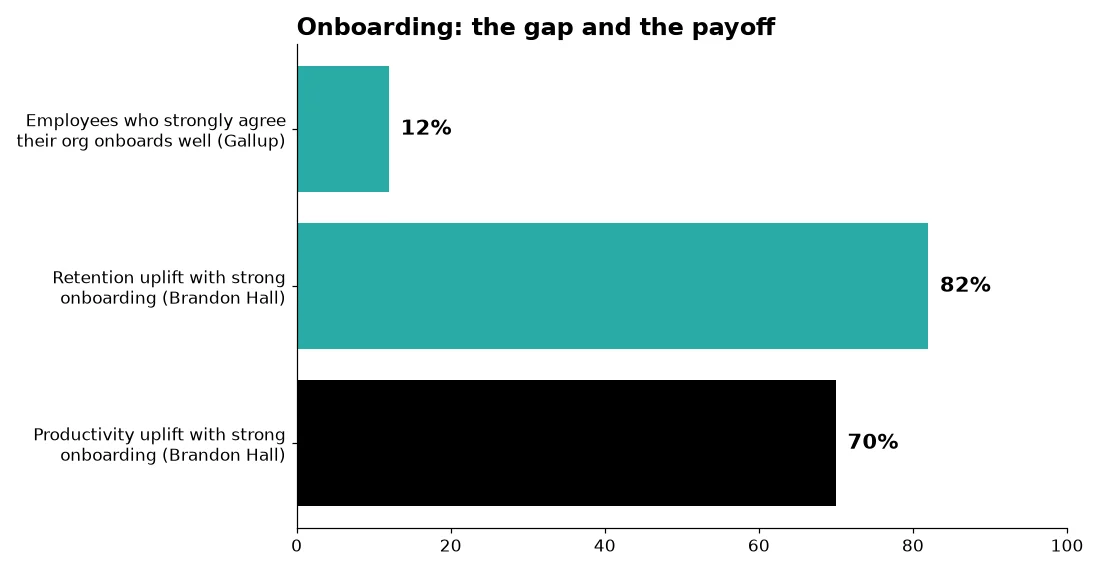
Gallup has reported that only about 12% of employees strongly agree their organization does a great job onboarding new people. Brandon Hall Group research, widely cited by HR teams, links a strong onboarding process to roughly 82% better new hire retention and over 70% higher productivity. Treat these as directional figures: methodologies differ, but the direction is consistent. The first week is where trust is built or lost, and it is also where HR and IT lose the most hours to chasing tasks across tools.
What an agent should run, and what it should not
Good fits for an agent
Order equipment and create accounts through your existing ticketing flow; send the welcome pack and a personalised day-by-day schedule; check that each tool access actually works on day 1; remind the new hire and the manager of pending trainings and policy sign-offs; compile a summary for HR at the end of the week. For a broader view of the process, see our guide to AI-enhanced employee onboarding.
Keep with humans
The welcome itself, choosing a buddy, explaining why the role matters, giving feedback on the first deliverable, and any sensitive conversation. An agent that books the 1:1 is useful; an agent that replaces it is not.
The 5-day checklist
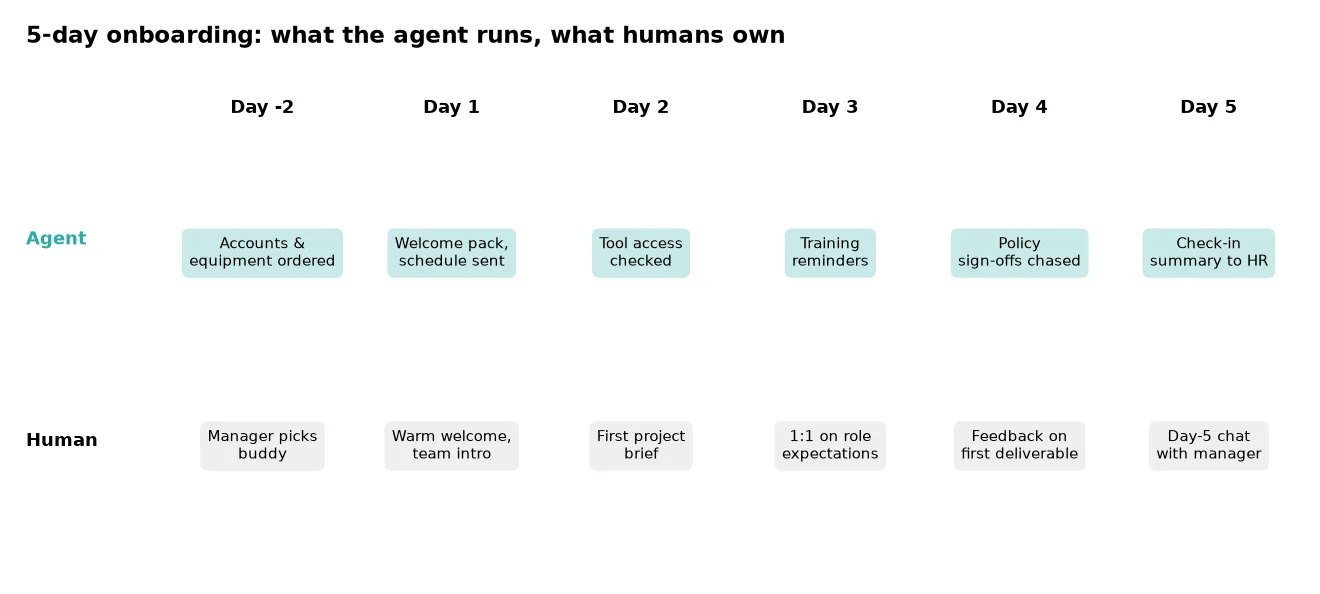
- Day -2 — agent: equipment and accounts requested, access list confirmed with IT, manager notified of anything missing. Human: manager picks a buddy.
- Day 1 — agent: welcome pack and schedule sent, access to email, chat and core tools verified. Human: warm welcome and team introductions.
- Day 2 — agent: checks tool access is complete and flags blockers to IT. Human: first project brief.
- Day 3 — agent: training reminders and progress tracking. Human: 1:1 on role expectations.
- Day 4 — agent: chases policy sign-offs and missing documents. Human: feedback on the first deliverable.
- Day 5 — agent: sends a one-page summary to HR (done, pending, blocked). Human: day-5 conversation between manager and new hire.
How to set it up in a week
- Write the checklist as it really happens today, including the unofficial steps.
- Mark each step as agent, human or shared.
- Give the agent access only to what each step needs (least privilege) and keep a log of what it did.
- Run it on the next two hires with HR watching the summary.
- Ask the new hire on day 5 what was missing, and update the list.
For a practical approach to permissions, read our article on least-privilege access for AI agents.
Pitfalls to avoid
Automating a broken process just makes it fail faster; fix the checklist first. Do not let the agent send messages that sound like a human wrote them personally when they did not. Check data protection rules before the agent touches personnel files; ask your DPO. Measure something simple: days until the new hire is fully operational, and the number of IT follow-ups per hire. SHRM offers additional HR resources for teams refining their onboarding practices.
Use case
As an illustrative scenario, not a measured result: a 200-person company hiring 3 people a month typically spends several hours per hire across HR, IT and the manager on pure follow-up. Offloading follow-up to an agent gives that time back to the welcome and the coaching.
Conclusion
Delos Workers can run the logistics layer of your onboarding while your managers focus on the human part.