Clinical Trial Document Review: Where AI Agents Save Weeks, and Where They Must Not
By Delos — 2026-11-17
Document review is where trial teams lose weeks. Here is what AI agents can safely take over, and the decisions that must stay human.
A clinical trial produces thousands of documents: protocols, informed consent forms, investigator CVs, ethics approvals, monitoring reports, safety letters. Each must be complete, consistent, current and filed in the Trial Master File (TMF). Teams spend a large share of their time checking, cross-referencing and chasing. This is exactly the kind of repetitive, rule-based reading that AI agents do well. It is also a regulated activity, so 'automate everything' is the wrong answer.
Why document review is the bottleneck
The TMF must be available for inspection by regulators at any time during and after the trial. Typical failure points: missing or expired documents, a protocol version that does not match the consent form version, an unsigned signature page, a document filed in the wrong TMF zone. None of these is intellectually hard. All of them are tedious, and tedium is where errors hide.
What the regulators actually say
ICH E6(R3), the updated Good Clinical Practice guideline, was finalised in January 2025 and is built around proportionate, risk-based quality management and fit-for-purpose computerised systems. The FDA published a draft guidance in January 2025 on using AI to support regulatory decision-making for drugs and biologics, centred on a risk-based credibility framework. The EMA published a reflection paper on AI across the medicinal product lifecycle in 2024. Common thread: you may use AI, but you must define its context of use, validate it for that use, and keep humans accountable.
Where AI agents save weeks
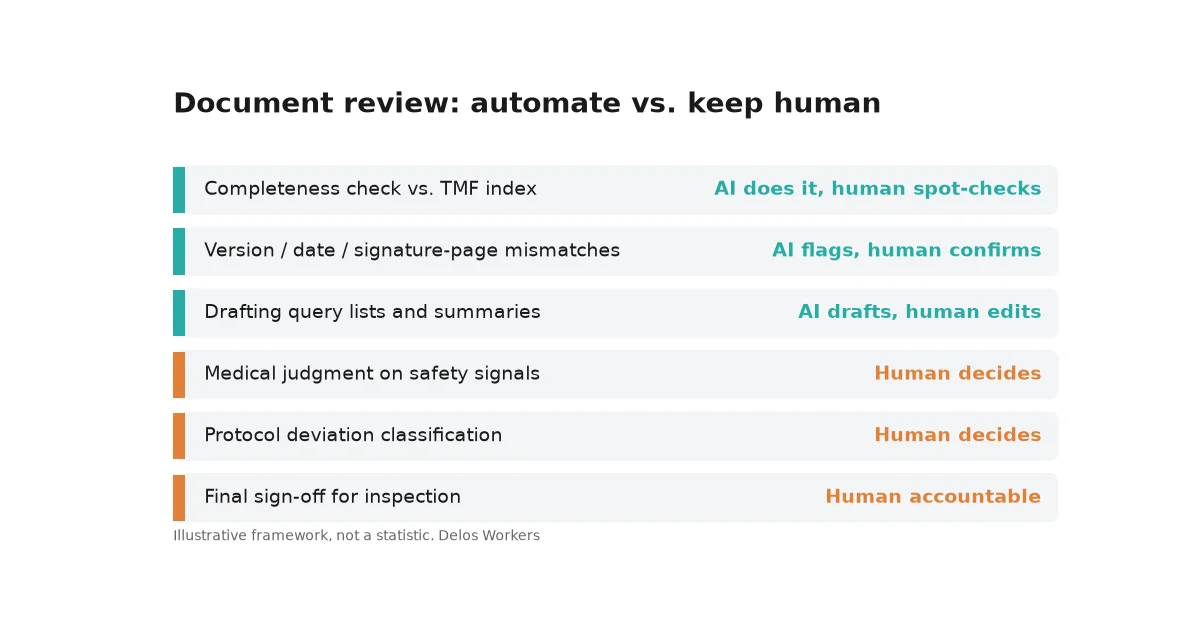
Completeness checks
An agent compares the TMF index against the documents actually filed and lists gaps by site, country and document type, every day instead of before an audit.
Consistency checks
Agents flag version, date and name mismatches across protocol, consent forms and approvals, and unsigned or undated signature pages.
Drafting queries and summaries
Agents draft query lists to sites and one-page summaries of long monitoring reports. A reviewer edits and approves; the agent never sends on its own.
Where they must not decide
Medical judgment on safety signals, classification of protocol deviations as major or minor, and final sign-off before inspection stay with qualified people. An AI output can inform these decisions. It cannot own them, because accountability under GCP is personal and traceable.
A pipeline with human gates
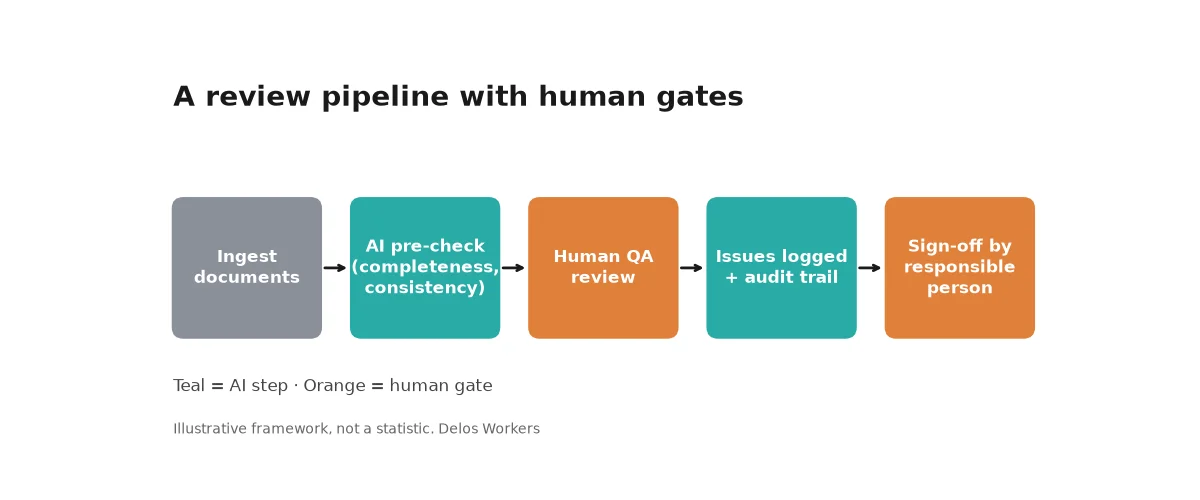
The pattern that works: ingest, AI pre-check, human QA review, issues logged with an audit trail, sign-off by the responsible person. The AI step produces findings, not decisions. Every finding keeps a link to the source document and page, so the reviewer verifies in seconds instead of searching.
Validation: the part teams skip
Treat the agent like any computerised system touching GxP data. Write down the intended use (for example: 'flag missing TMF documents against the approved index'). Test it on a sample with known errors and measure what it misses, not only what it catches. Fix a review frequency. Keep the audit trail. Re-validate when the model, the prompts or the document templates change.
A 30-day starting plan
1. Week 1: pick one narrow use case, such as TMF completeness for one study.
2. Week 2: build a gold set of 50 to 100 documents with known issues.
3. Week 3: run the agent in parallel with the current process and compare.
4. Week 4: decide, document, and expand only if misses are acceptably low.
Conclusion
AI agents earn their place in trial operations by removing the checking work, not the checking responsibility. Start narrow, validate for the specific use, and keep a named human at every gate. Delos Workers can be configured with that exact pattern: pre-check, flag, hand over to a person.
For related reading, explore pharmacovigilance automation and safety-signal triage and AI agent accountability and governance.