Pharmacovigilance automation: how to triage safety signals without losing compliance
By Ivan — 2026-11-05
Case processing eats up to two thirds of drug-safety resources. A practical guide to automating intake and triage while keeping a human accountable.
Every pharmacovigilance (PV) team knows the arithmetic. Adverse event reports keep arriving from patients, physicians, literature and partners, and each one must be logged, assessed and, if serious, reported within a regulatory clock. Automating the front of that pipeline is the most obvious productivity lever in drug safety. It is also the one where a careless implementation creates audit findings. This guide shows where automation pays, where it must stop, and how to roll it out step by step.
1. Why case processing is the bottleneck
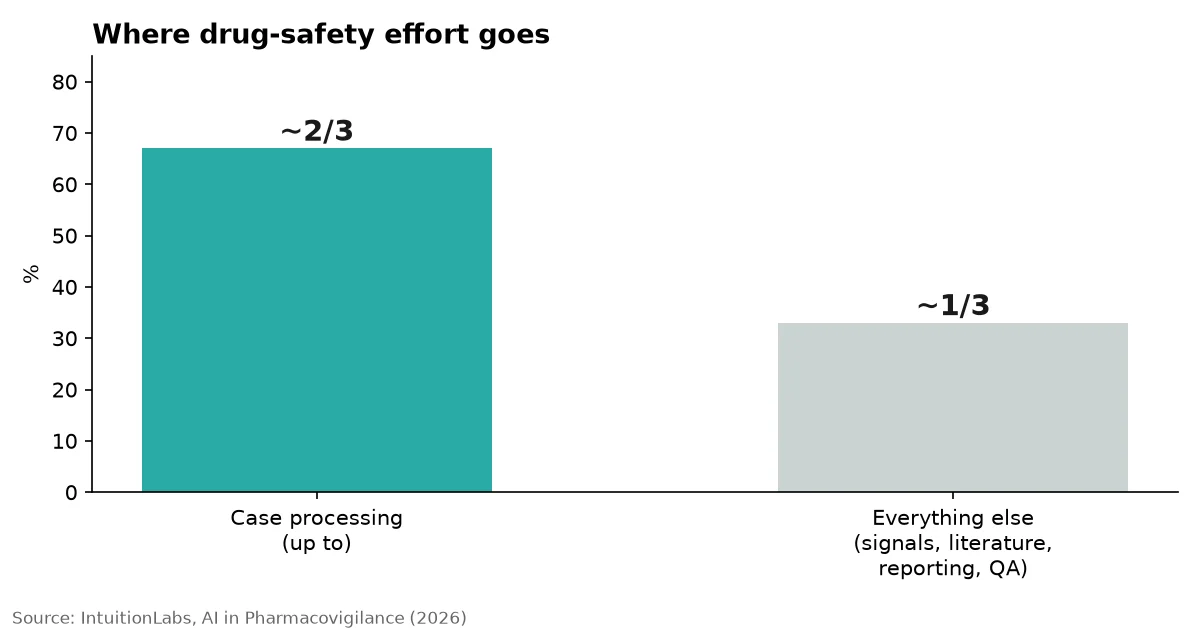
According to IntuitionLabs' 2026 review of AI in pharmacovigilance, case processing can consume up to two thirds of a typical pharmaceutical company's PV resources, making it the largest single cost driver in drug safety. The same review cites a Deloitte survey in which 90% of biopharma companies aimed to reduce case processing costs. Volume explains the pressure: WinWire reports that drug safety cases grow by 10 to 15% every year and that adverse event reports to the US FDA rose by 84% between 2014 and 2020. Meanwhile, more than 90% of real adverse events never reach official systems, so more channels (patient apps, social listening, wearables) will add volume, not remove it.
2. What you can automate safely today
Intake and data capture
Reports arrive as emails, PDFs, call notes, web forms and literature articles. Extraction models can pre-fill the case form: reporter, patient, suspect product, event terms, dates. A person then confirms instead of retyping. This is where the quickest, lowest risk time savings sit.
Triage and seriousness flagging
A model can propose whether a case looks serious (death, hospitalisation, life threatening, disability), whether it is a duplicate, and which clock applies. Treat the output as a recommendation with a confidence score. Route low-confidence cases to a person by default.
Coding and translation
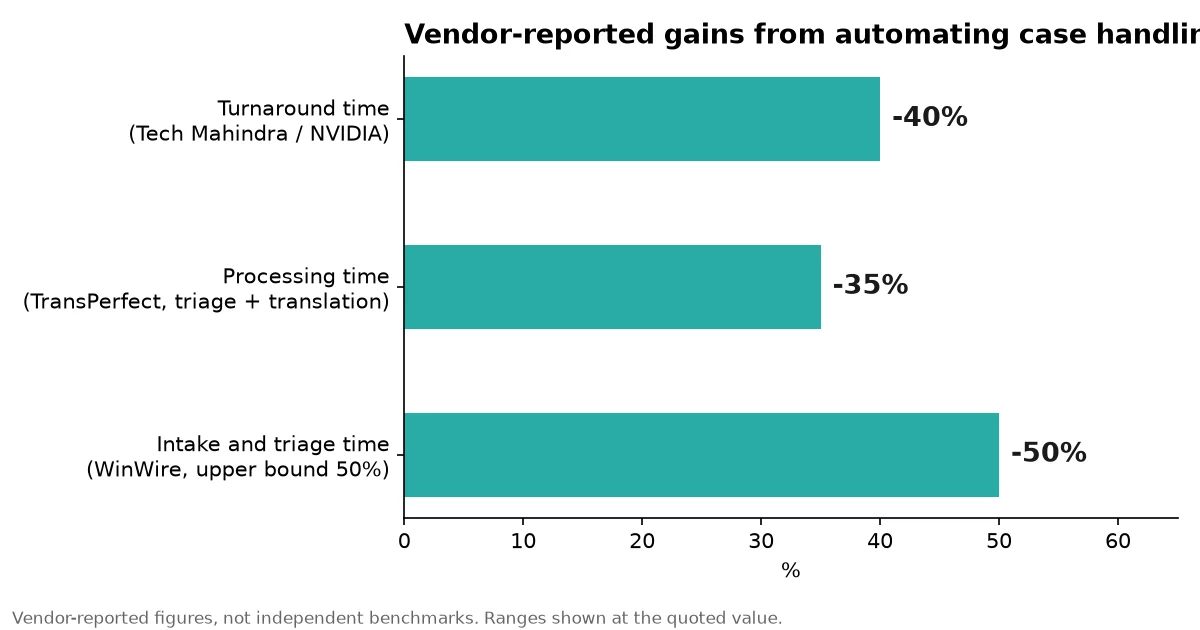
Suggesting MedDRA terms and translating foreign-language narratives are repetitive and well suited to language models. TransPerfect reports that automating triage and translation of adverse event reports cuts processing time by more than 35%.
3. What the numbers really say
Vendor figures are encouraging but should be read with care. Tech Mahindra and NVIDIA report up to 40% shorter turnaround times and 30% better data accuracy for an agentic PV solution. WinWire claims 40 to 50% less time on case intake and triage and 40 to 60% lower cost. These are vendor-reported results on their own scope, not independent benchmarks. Use them to set a hypothesis, then measure on your own case mix during a pilot.
4. Where automation must stop: the human in the loop
Regulators are explicit. IntuitionLabs notes that the FDA considers most AI PV applications not yet performant enough to run without human intervention, and that the marketing authorisation holder remains responsible for its pharmacovigilance system even when AI is used, including validated processes and human oversight. In practice this means a safety physician or trained case processor makes and signs the final medical judgement on seriousness, causality and reportability.
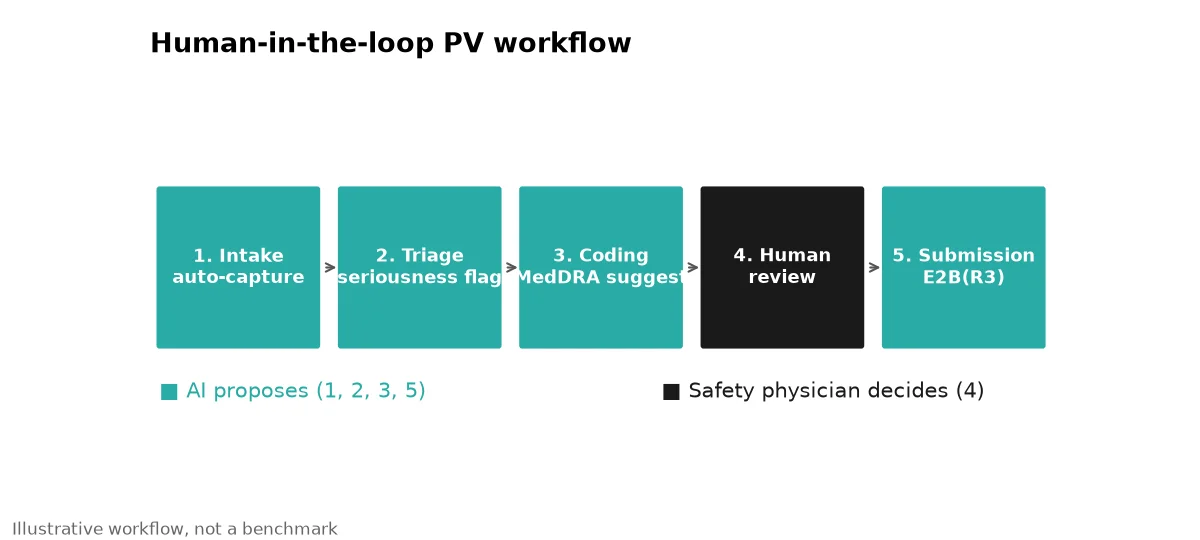
Design the workflow so the AI proposes, the human decides, and every step is logged: input, model version, suggestion, human edit, final decision. That audit trail is what an inspector will ask for.
5. A 6 step rollout checklist
- Pick one narrow flow. For example, literature screening or intake for one product family.
- Build a gold set. A few hundred cases already processed and reviewed by your team, used for testing.
- Define acceptance criteria before the pilot. Sensitivity on serious cases first, then field accuracy, then time saved. Missing a serious case is the failure that matters.
- Run in shadow mode. The model runs alongside the team for a few weeks; compare, do not act on it.
- Validate and document. Treat the tool as a computerised system under your quality system, with change control for model updates.
- Go live with a human gate and monitor drift. Review a sample every month and track override rates.
6. Where Workers Delos fit
A Delos Worker can take the repetitive layer: reading incoming emails and attachments, pre-filling case forms, drafting narratives, translating, and preparing the review queue for your safety team. Learn how to structure that kind of supervised automation in our guide to agentic AI enterprise workflows, and see how we measure returns in our ROI breakdown for predictive maintenance, a method that transfers well to PV automation.
Key takeaways
- Case processing is the biggest PV cost, up to two thirds of resources.
- Automate intake, triage suggestions, coding and translation first.
- Treat vendor gains (35 to 50%) as hypotheses and measure on your own cases.
- Keep a qualified human accountable for every final decision, with a full audit trail.
Sources
IntuitionLabs, AI Applications in Pharmacovigilance and Drug Safety · WinWire, Pharmacovigilance Case Intake Process Automation · TransPerfect, Transforming Pharmacovigilance with AI and Automation