AI Demand Forecasting: 5 Mistakes That Quietly Wreck Your Supply Chain Plan
By Delos — 2026-11-13
Five common mistakes explain why AI forecasts go unused. A practical checklist and a 30-day starting plan for supply chain teams.
Most supply chain teams already have a forecast. The question is no longer whether to use AI, it is why so many AI forecasts end up ignored by the planners who should use them. In our reading, the technology is rarely the problem. These five mistakes are.
What the numbers really say
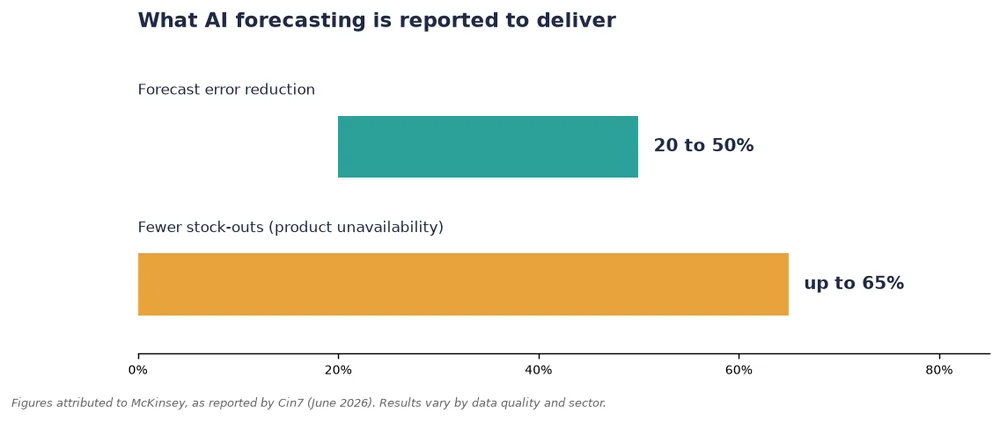
Figures attributed to McKinsey and relayed by Cin7 (June 2026) suggest AI-powered forecasting can reduce forecasting errors by 20 to 50% and cut product unavailability by up to 65%. Treat them as upper-range reports, not promises: results depend on data quality, product mix and how the forecast is used.
Other vendor-reported results, such as 27% accuracy gains and 30% less overstock from one provider (Quant), are marketing claims that should be tested on your own data.
Mistake 1: Forecasting at the wrong level
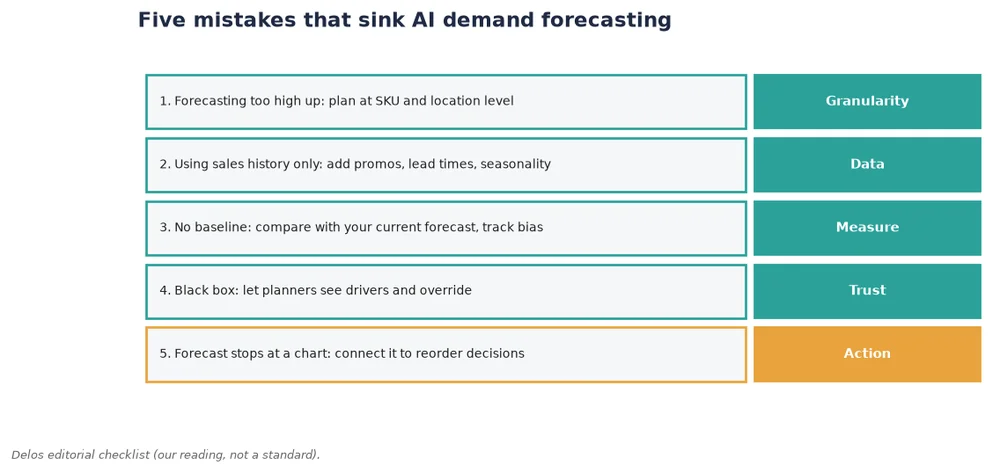
A forecast that is accurate for the whole country can be useless for a single warehouse. Replenishment decisions are made per SKU and per location, so that is where accuracy must be measured. Start with the 20% of references that drive most of your revenue or your stock-outs.
Mistake 2: Feeding the model sales history only
Sales are not demand: a stock-out hides what customers wanted. Add promotions, price changes, supplier lead times, seasonality and out-of-stock flags. Machine learning earns its keep precisely because it can combine these signals, which a spreadsheet moving average cannot.
Mistake 3: No baseline, no bias tracking
Before switching, record how your current forecast performs (WAPE or MAPE) and its bias, meaning whether it systematically over- or under-forecasts. Run the AI forecast in parallel for a few cycles. If you cannot say “we went from X to Y on the same products”, you cannot defend the project.
Mistake 4: A black box planners cannot challenge
Planners know about the contract that just got signed or the factory that is closing. If they cannot see the main drivers behind a number and override it with a comment, they will go back to their own file. Keep a human in the loop and log overrides: they show where the model is blind.
Mistake 5: Stopping at a chart
A forecast only creates value when it changes an order, a transfer or a production slot. Connect the output to reorder points and safety stock, and define who approves what. This is where AI agents help: a Delos worker can monitor deviations, prepare the replenishment proposal and flag the exceptions for human review.
A 30-day starting plan
Week 1: Measure the baseline
Pick 50 to 200 critical SKUs and measure the baseline.
Week 2: Assemble the extra data
Assemble the extra data: promotions, lead times and stock-out flags.
Week 3: Run in parallel
Run the model in parallel and compare on the same SKUs.
Week 4: Decide on the first scope
Review gaps with planners, decide go or no-go on a first replenishment scope.
For broader planning resources, explore ASCM and Gartner’s supply chain resources.
Use case: a distributor with seasonal products
A mid-size distributor with seasonal items typically over-orders before peaks and under-orders on fast movers. Forecasting at SKU-location level with promotion data, then sending exceptions to planners, is the usual first step. (Illustrative scenario, not a customer result.)
Continue with our guides on AI agents for supply chain exceptions and predictive maintenance ROI.
Conclusion
AI forecasting works when it is measured against a baseline, fed with more than sales, explainable to planners and wired into ordering. Start small, prove the gain, then scale.