Shadow AI: How to Govern the Tools Your Teams Already Use
By Delos Intelligence — 2026-10-19
Shadow AI is already inside your company. Here's a practical governance playbook to turn unsanctioned AI use into a managed, secure advantage.
Here's an uncomfortable truth most CISOs already suspect: your employees are using AI tools you never approved, right now, on documents you'd rather not see pasted into a public chatbot. It's called shadow AI, and pretending it isn't happening is the one strategy guaranteed to fail.
The reflex is to ban it. The smarter move is to govern it. This article lays out how.
What shadow AI actually is
Shadow AI is any use of AI tools, models or features inside a company that hasn't been vetted, approved or secured by IT or security. It's the free chatbot a marketer uses to rewrite a deck, the code assistant a developer wired into their IDE, the meeting-notes bot nobody signed a DPA with.
It's the natural successor to shadow IT — but faster, because signing up takes thirty seconds and no budget line.
Why banning it backfires
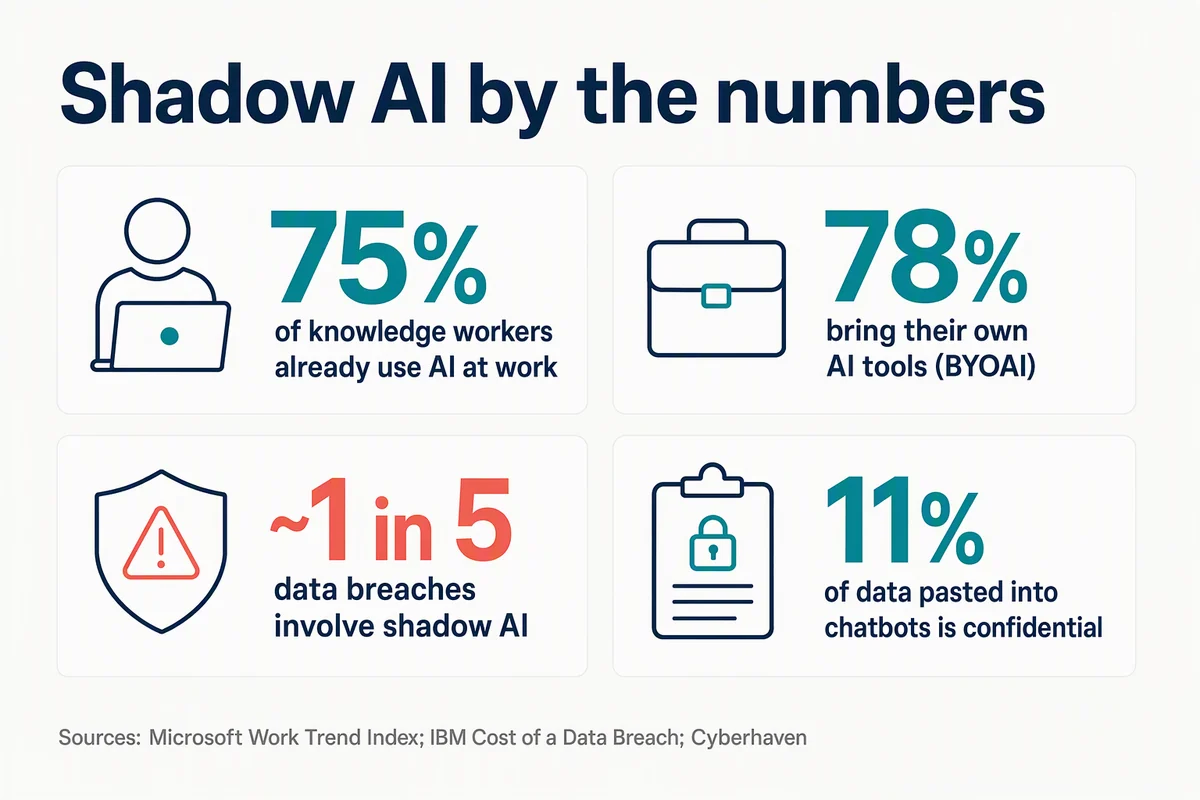
Three-quarters of knowledge workers already use AI at work, and most bring their own tools when the company doesn't provide a sanctioned one, according to the Microsoft Work Trend Index. A blanket ban doesn't remove the behaviour — it just pushes it further underground, onto personal accounts and personal devices where you have zero visibility and zero controls.
The real risks aren't hypothetical; the IBM Cost of a Data Breach report examines the cost of breaches and the role of AI security:
- Data leakage — confidential text, source code and customer data pasted into tools that may train on it.
- Compliance exposure — personal data processed outside any contract, potentially in breach of the EU GDPR or sector rules.
- Hallucinated output — unverified AI content flowing into decisions, contracts and code.
- No audit trail — when something goes wrong, you can't even reconstruct what happened.
For a deeper dive into technical controls, see our guide to AI agent guardrails.
A four-step governance playbook
Governing shadow AI isn't a policy PDF. It's an operating loop you run continuously. Our enterprise AI governance framework provides a broader foundation.
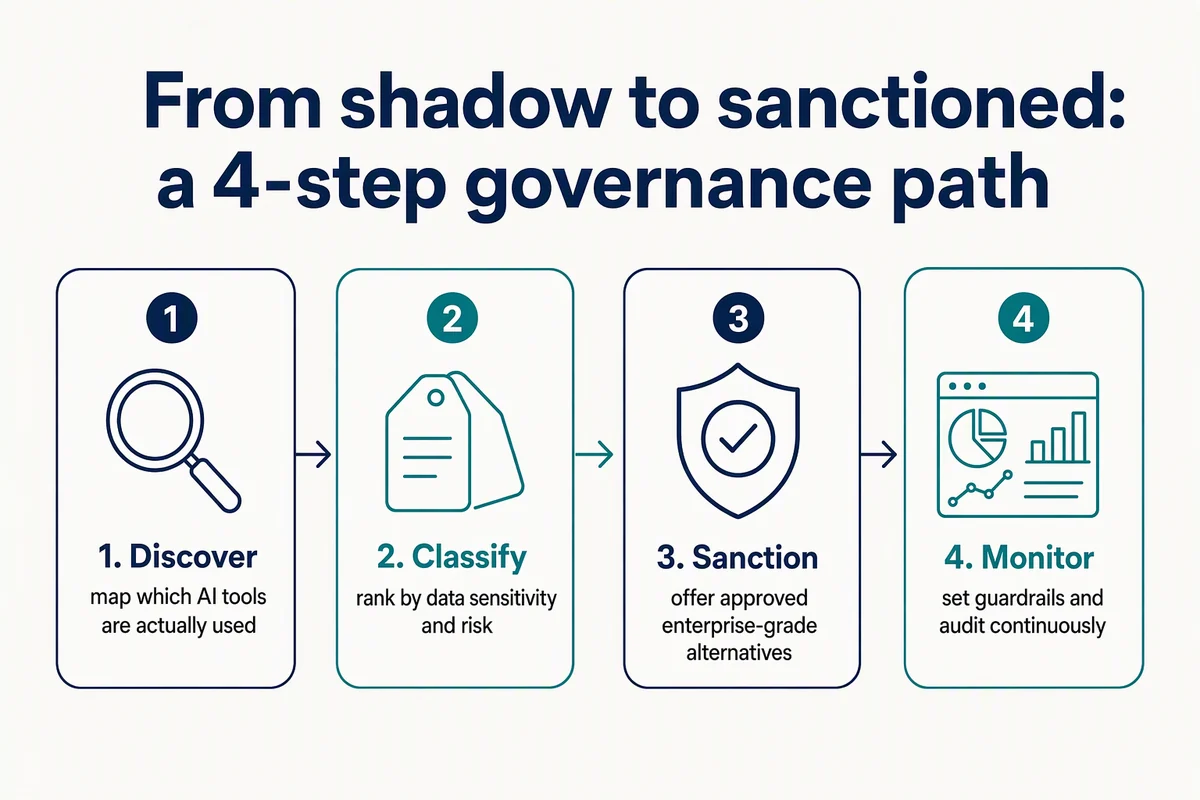
1. Discover
You can't govern what you can't see. Map which AI tools are actually in use — through network telemetry, SSO and expense data, and honest conversations with teams. Make it safe to admit usage; a witch-hunt guarantees people hide.
2. Classify
Rank each use by data sensitivity and business risk. A marketer brainstorming headlines is not the same risk as finance pasting customer records. Most usage is low-risk and should be encouraged, not punished.
3. Sanction
Here's the step most companies skip: give people a better, approved alternative. Enterprise-grade AI with data-residency guarantees, no training on your data, SSO and audit logs. People use shadow tools because they're useful — win by being more useful and safe.
4. Monitor
Set guardrails (DLP rules, allow-lists, prompt logging where lawful) and audit continuously. Governance is a loop, not a one-off memo.
Where AI workers change the equation
Part of why shadow AI spreads is that sanctioned tools are often clunky. Purpose-built AI workers — agents with a defined role, a persistent memory and proper access controls — give teams the capability they're seeking from consumer chatbots, but inside the enterprise perimeter: scoped permissions, audit trails and no data leaving to train someone else's model. Choosing the right architecture matters too: see our single-agent vs multi-agent guide.
That's the whole bet behind Delos: when the sanctioned option is genuinely better than the shadow one, governance stops being a fight.
Start this quarter
You don't need a committee. Pick one high-usage team, run the four steps on them, and offer a sanctioned alternative. Measure what moves. Then widen the loop. Shadow AI isn't going away — but with the right approach it becomes a managed advantage instead of an unmanaged liability.