$1.7 Trillion Trapped in Unpaid Invoices: How AR Automation Cuts DSO by 30%
By Delos Intelligence — 2026-10-16
$1.7 trillion is trapped in unpaid invoices. See how accounts receivable automation cuts days sales outstanding (DSO) by 30% and speeds up cash collection.
Your company has already done the work. The product shipped, the service was delivered, the invoice went out. And yet the cash is still sitting in someone else's bank account. Across US companies, The Hackett Group's 2025 Working Capital Survey found $1.7 trillion trapped in excess working capital, with days sales outstanding (DSO) degrading for the second year running as customers push payment timelines out. Accounts receivable (AR) automation is the most direct lever finance teams have to get that cash back, and the numbers behind it are hard to ignore.
Late payments are getting worse, not better
DSO measures the average number of days it takes to collect payment after a credit sale: DSO = (Accounts Receivable / Total Credit Sales) x Days in Period. The Credit Research Foundation's Q4 2025 domestic trade receivables survey put the broad cross-industry median at 40.5 days, with the global average across all sectors nearer 59 days. Versapay's latest cash-flow research found 69% of businesses have seen late payments increase over the past 12 months. The pattern is consistent: as customer bargaining power rises, buyers stretch terms, and sellers quietly finance the gap. Every extra day of DSO is working capital you have earned but cannot use.
What a high DSO actually costs
A high DSO is not just a slow number on a dashboard. It forces companies to dip into reserves or borrow to cover payroll and supplier bills, adding interest expense on money they are already owed. It hides credit risk: the longer an invoice ages, the lower the odds it is ever paid in full. And it ties up the single cheapest source of financing a business has, its own receivables. For a company with $1.5M in quarterly credit sales, trimming DSO from 52 to 36 days frees roughly a quarter of a million dollars in cash, without a single new sale. For the calculation and practical context, see the Salesforce DSO guide.
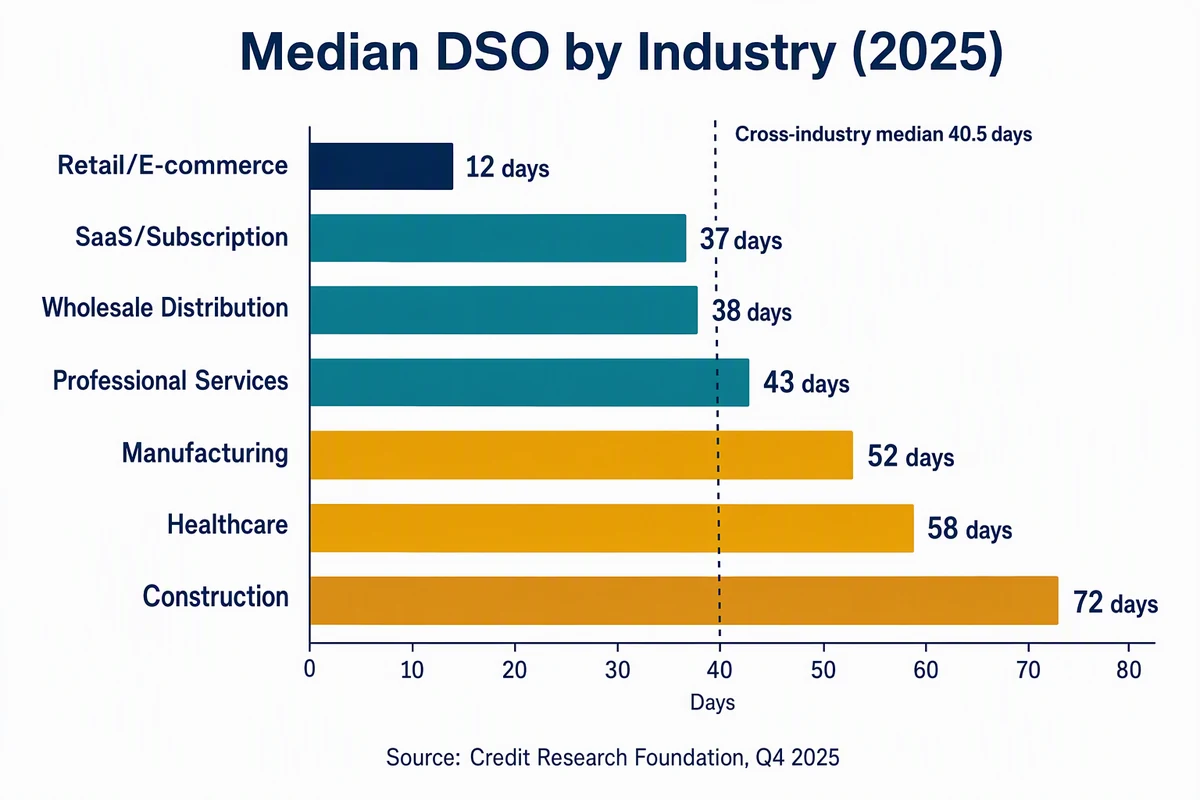
Median DSO varies widely by sector. Compare yours before setting a target. Source: Credit Research Foundation, Q4 2025.
The five levers of order-to-cash
Cutting DSO is not about chasing customers harder. It is about removing friction and delay from the entire order-to-cash cycle. Five levers do most of the work:
- Clean invoicing: send an accurate, compliant e-invoice on day zero. Billing errors are the number-one reason invoices sit in dispute instead of getting paid.
- Risk-based credit: score customers and set terms before you sell, not after they default.
- Automated reminders: schedule dunning so no overdue invoice is ever forgotten, and no high-value account waits on a manual follow-up.
- Faster cash application: auto-match incoming payments to open invoices so cash clears in hours, not days.
- Dispute resolution: route exceptions to the right owner with a full audit trail, so a single query does not freeze an entire payment.
For the other side of the ledger, explore accounts payable and invoice processing automation.
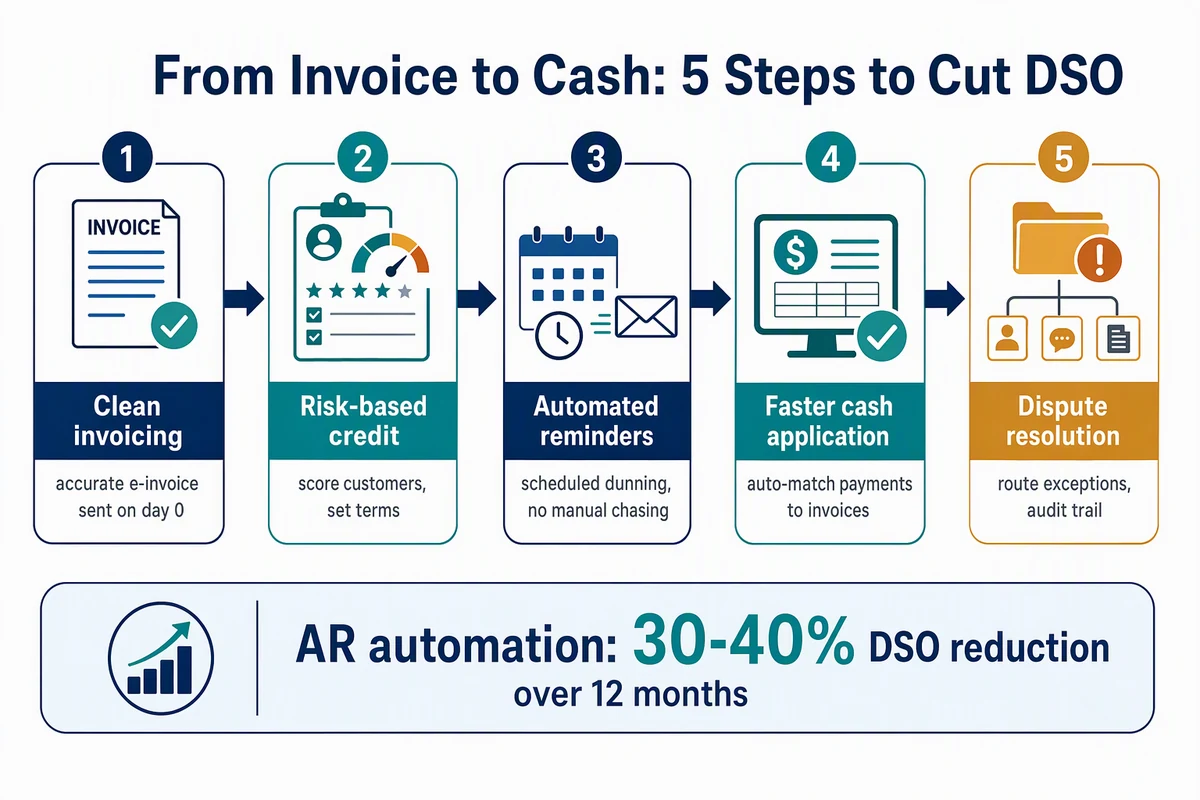
The order-to-cash cycle, step by step.
Where AI agents change the economics
Traditional AR software automates workflows but still waits for a human to decide who to chase, when, and how. AI agents close that gap. They prioritise collections by risk and payment behaviour instead of a static calendar, draft context-aware reminder emails in the customer's language and tone, reconcile messy remittances against open invoices, and flag disputes before they age. Industry benchmarks are consistent: companies with comprehensive AR automation report an average 30–40% DSO reduction over 12 months and up to a 37% drop in past-due receivables. The catch is deployment speed: a six-month rollout can consume most of the first-year cash benefit, which is why finance teams increasingly favour agents that integrate with their ERP (SAP, Oracle, NetSuite, Dynamics) in days rather than quarters. Read more about corporate treasury and cash-flow forecasting.
How to start without boiling the ocean
You do not need a year-long transformation to move DSO. A practical first 90 days: (1) measure DSO monthly and break it down by customer and aging bucket, not just a single company-wide average; (2) fix invoice accuracy and delivery first, since errors poison everything downstream; (3) automate reminders on your largest overdue balances; (4) connect cash application to your ERP so payments clear automatically; (5) set a realistic target against your industry benchmark, not a generic 30 days. Measured monthly, these steps compound fast. If you are connecting collections to planning, see AI-driven financial forecasting for CFOs.
Put your receivables to work
The cash to fund your next hire, your next inventory run, or your next product launch may already be on your balance sheet, locked inside unpaid invoices. AR automation is how you unlock it, and in a market where buyers keep stretching terms, it is quickly moving from a nice-to-have to a core finance discipline.