Why Enterprise AI Pilots Fail Before Production: A Practical Playbook
By Delos Intelligence — 2026-10-15
A promising AI pilot is not a reliable production system. Here is a practical path from demo to measurable, secure and sustainable enterprise deployment.
A prototype can impress with ten carefully chosen examples. A production system must handle thousands of real cases, respect access rights, make errors visible, and withstand changes in the underlying data. That gap is where many enterprise AI initiatives stall. The real question is not just “Can the model answer?” but “Can the whole workflow deliver a dependable service every day?”
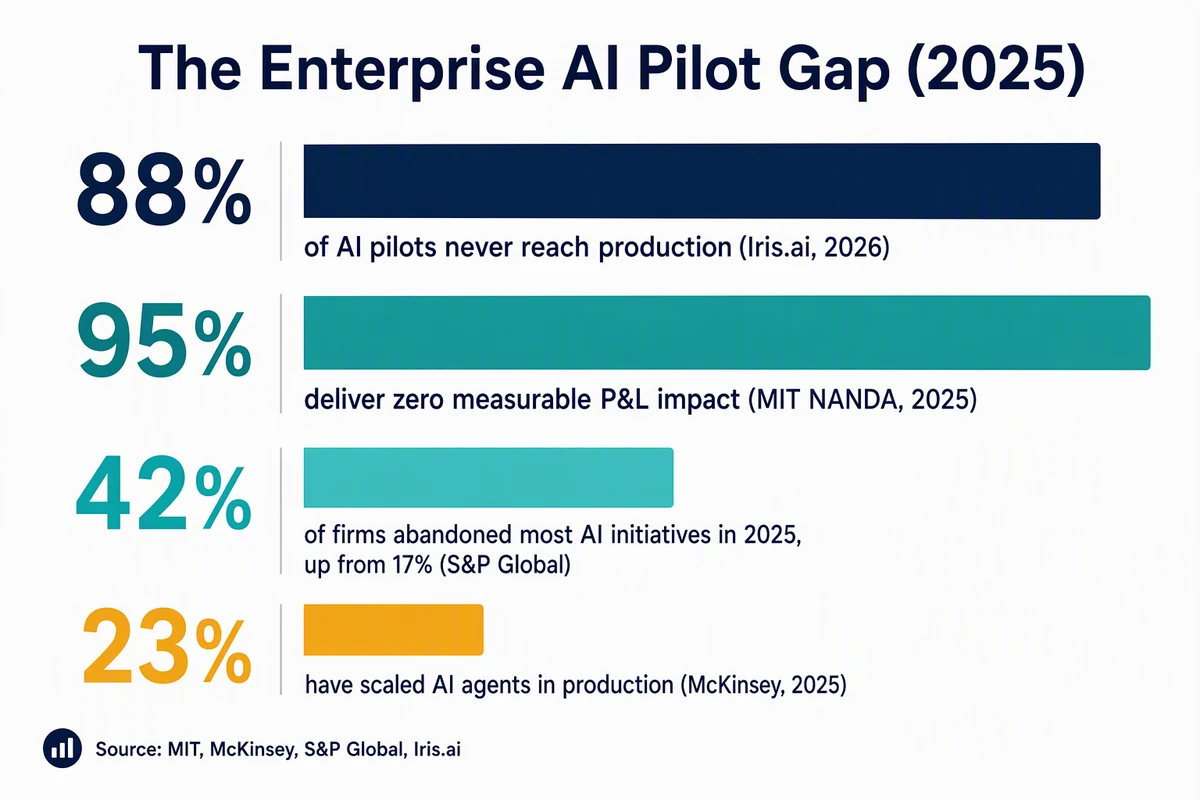
The scale of the gap is measurable. MIT Project NANDA's The GenAI Divide: State of AI in Business 2025 reports that 95% of organizations in its research saw no measurable P&L return from enterprise generative AI. This does not mean that 95% of models failed or that no employee benefited: it is a finding about measurable business impact. Separately, S&P Global Market Intelligence reports that the share of companies abandoning the majority of their AI initiatives rose from 17% to 42% year over year. These are different measures, not interchangeable failure rates. The five steps below turn those warnings into a practical production plan.
!The gap between an isolated AI pilot and production deployment at enterprise scale
Why a pilot works while production fails
A demo tests a model; production tests a system
In a workshop, the team selects clean documents, quietly corrects weak answers and ignores out-of-scope requests. On a normal workday, missing attachments, conflicting records, urgent cases and users with different permissions all show up. A success rate on a small test set is not an operational guarantee. McKinsey’s State of AI survey examines the challenge of scaling AI beyond experimentation: judge the deployment and redesigned workflow, not only the quality of the demonstration.
Dependencies surface only when the system is connected
A useful answer depends on current data, a reliable integration and an authorized next action. Map source systems, data owners, service expectations, retention rules and failure behavior. Without that inventory, a pilot bypasses the steps that production cannot bypass. For the technical architecture, see our guide to enterprise AI agent deployment patterns.
No one owns the exceptions
Who corrects a bad decision? Who stops the automation during an incident? Who approves a model change? If those answers are implicit, the initiative stalls at its first security review. The NIST AI Risk Management Framework provides a structure for governing, mapping, measuring and managing AI risks. Our guide to AI agent accountability explores what ownership looks like in practice.
A practical pilot-to-production playbook
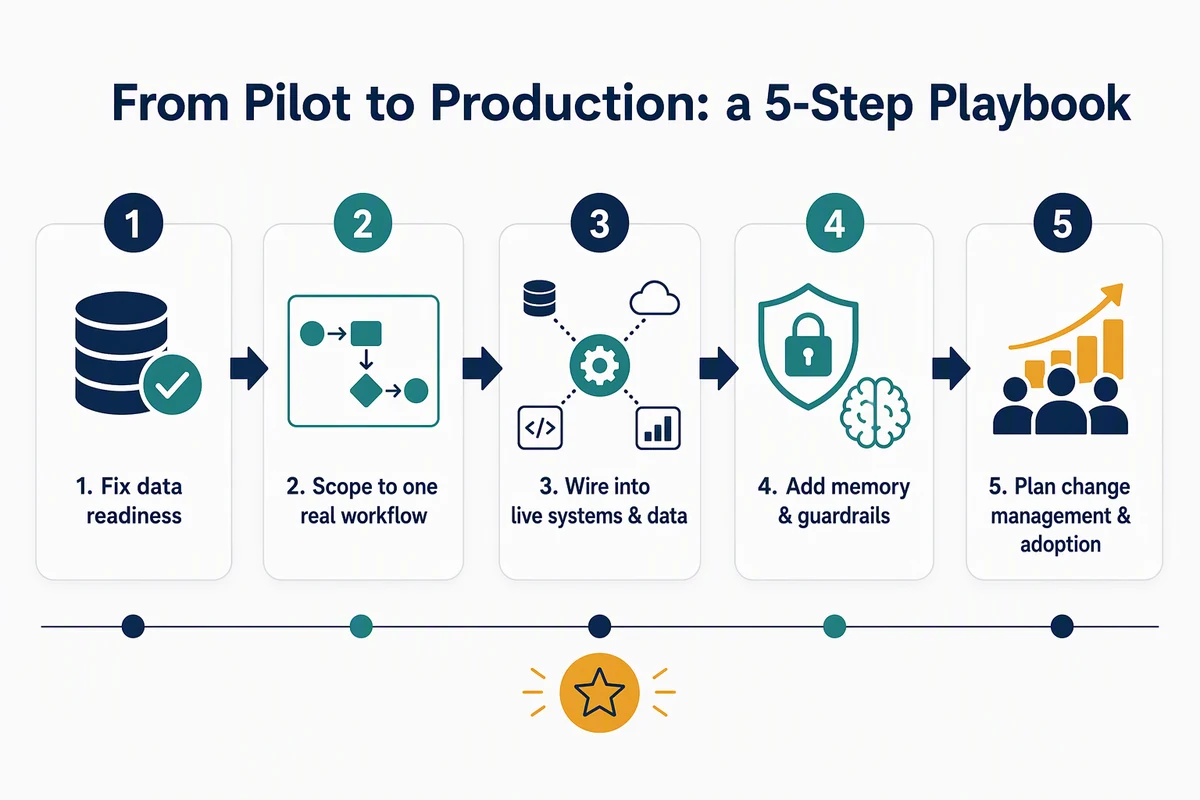
!Steps for taking an AI pilot into a measurable production service
1. Pick one workflow and define the outcome
Specify the input, output and accountable owner. Establish a baseline before automating: cycle time, error rate, cost per case and user satisfaction. Set acceptance thresholds and a cost ceiling per task. A project without a before-and-after measure can prove that it runs, but not that it creates value.
2. Test the hard cases before increasing volume
Build an evaluation set from authorized real cases, anonymized where necessary: ambiguous requests, duplicates, sensitive information, stale data, connector failures and attempts to bypass rules. Track correct responses, tolerable mistakes, severe failures and appropriate refusals separately. Rerun those tests whenever the prompt, model or source content changes. For a deeper approach, read our AI agent evaluation framework.
3. Constrain actions and access
Apply least privilege. Separate reading, proposing and executing: a drafted answer might be automatic, while a payment, deletion or external message requires human approval. Log source access, tool calls, decisions and approvals without retaining unnecessary personal data.
4. Roll out gradually and design a rollback
Start with shadow mode, move to a limited cohort and expand only when the metrics justify it. Name an on-call owner, write a shutdown procedure, keep a manual fallback and define pause criteria. Google Cloud’s guidance on MLOps and continuous delivery shows why versioning, automation and monitoring matter as much as the initial model.
5. Measure value after launch
Monitor quality by case type, escalation rate, latency, cost, incidents and real adoption. Listen to the team handling exceptions: a time saving at the front of a process can simply shift work downstream. Review thresholds regularly and retire automations that do not deliver.
Watch the video: orchestrating complex AI workflows with agents and LLMs
The decision rule before launch
Do not open production because the demo convinced executives. Open it when the workflow has an owner, edge cases have been tested, permissions are bounded, incidents have a response plan and the team can measure a net improvement. The goal is not more pilots. It is a shorter distance between a promising idea and a service that can actually be operated.