One AI Agent or a Team? A Practical Guide to Multi-Agent Systems
By Delos Intelligence — 2026-10-12
Multi-agent systems beat single agents by up to 90% on parallel work but can multiply errors 17x without orchestration. When to deploy a team of AI agents, with 2026 data.
Most enterprise AI projects start with a single agent. It is faster to build, cheaper to run and easier to debug. But the moment the work becomes a multi-step process — a fraud investigation, a claims file, a supply-chain reconciliation — the limits show. The real question is not "agent or no agent", it is: when does one agent stop being enough, and a team become worth the overhead?
Agents everywhere, scale almost nowhere
Adoption is wide and shallow. As of February 2026, 80% of Fortune 500 companies were running active AI agents (Microsoft), yet McKinsey's State of AI found 62% of organisations are still only experimenting and fewer than 10% have scaled agents in any single business function. The market reflects the appetite: multi-agent AI reached roughly $8B in 2026 and is projected toward $294B by 2035 (Precedence Research).
The reality check is just as loud. Gartner, polling more than 3,400 organisations, expects over 40% of agentic AI projects to be cancelled by the end of 2027 — killed by runaway cost, unclear value and weak risk controls. Architecture is a big part of who ends up on which side of that line.
What a multi-agent system actually is
A single-agent system is one LLM that plans and executes: it takes a prompt, reasons through the steps and returns an output. A multi-agent system (MAS) splits the work across specialised agents that coordinate under an orchestrator. In a fraud workflow, one agent analyses transactions, another reviews customer history, an aggregator synthesises the findings and a validator checks the decision before it ships. Each agent has its own role, tools and memory — and a central coordinator keeps them aligned.
When a team wins — and when it loses
The performance data is blunt about this: a team of agents is not universally better. It depends almost entirely on whether the task can be split into parallel pieces.
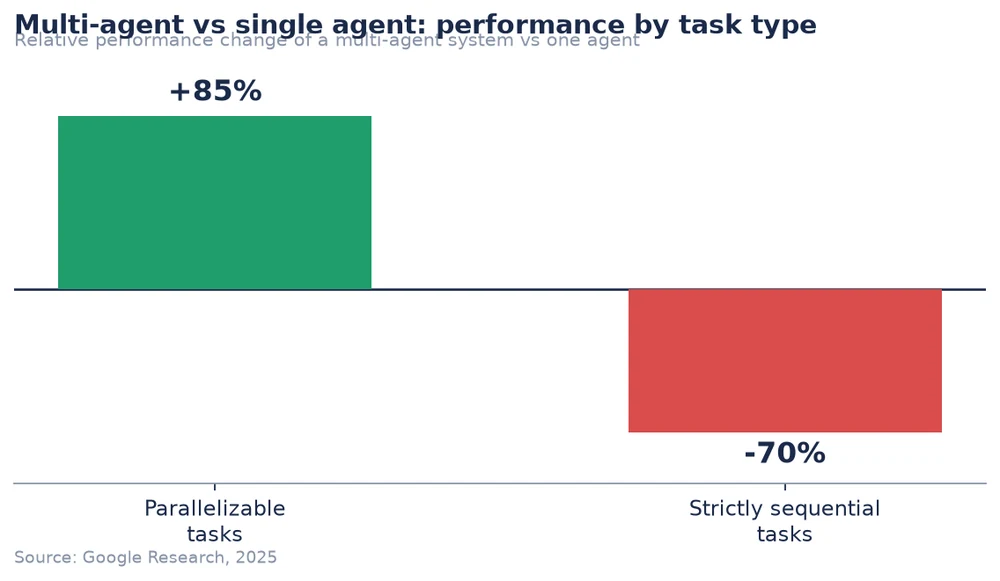
Google Research found multi-agent systems beat single agents by roughly 80–90% on parallelizable tasks, but degrade by up to 70% on strictly sequential ones. Anthropic reported that a lead orchestrator with three to five parallel subagents delivered 90.2% better performance than a single agent given the same token budget. And on complex planning, a Cornell study cited by Dataiku measured a coordinated MAS at a 42.68% success rate versus just 2.92% for a single GPT-4 setup on the same benchmark.
The rule of thumb: if the problem decomposes into independent subtasks that need different specialities, a team pays off. If it is one tight, sequential chain of reasoning, a single agent is faster, cheaper and easier to keep correct.
The hidden cost: coordination multiplies errors
Coordination buys capability, but it also buys new failure modes. The most important one is error amplification.
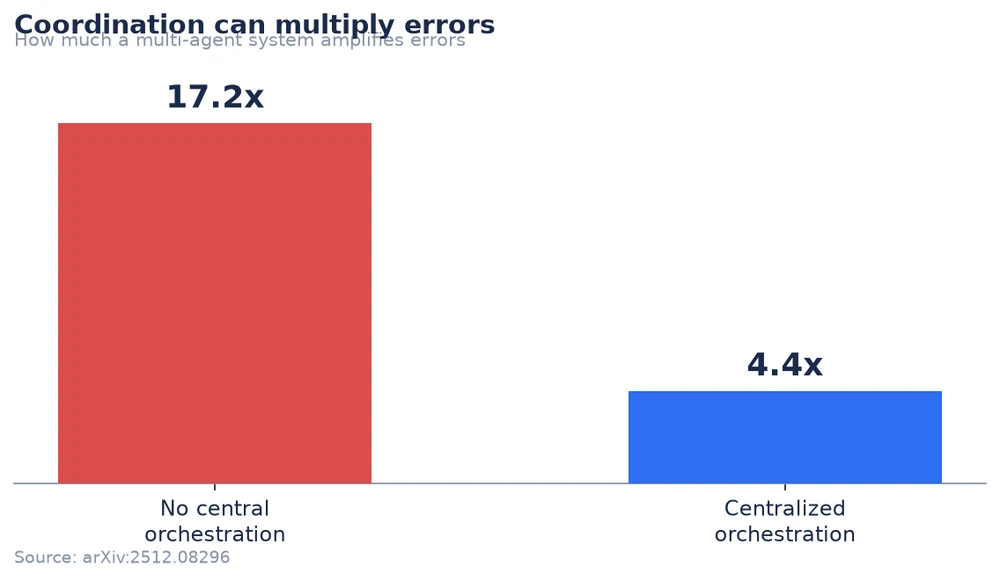
Independent agents with no central control amplify errors 17.2x; adding a central orchestrator brings that down to 4.4x (arXiv:2512.08296). Reliability is the other trap: the CLEAR evaluation framework found agent success dropping from 60% on a single run to 25% across eight consistent runs — which is why "pass^k" consistency testing beats one-shot accuracy as a production signal. Optimising for accuracy alone also made agents 4.4–10.8x more expensive than cost-aware alternatives with comparable quality.
A quick decision checklist
Reach for a single agent when the task is narrow and well-defined, the steps are sequential, latency and cost matter, and you need easy debugging — FAQ support, scheduling, a focused extraction.
Reach for a team when subtasks genuinely parallelise, the work needs different specialised tools or roles, you want fault tolerance, and volume is high — fraud investigation, claims processing, end-to-end research.
Whichever you pick, always add: a central orchestrator, explicit role boundaries, a human in the loop for consequential decisions, and continuous monitoring of cost, latency and reliability.
How to deploy without joining the 40% that get cancelled
Start with a narrow, measurable process, not a moonshot. Stand up an orchestrator plus a few subagents. Instrument cost, latency and pass^k reliability from day one. Wire in guardrails and traceability so every decision is auditable. Only scale a configuration once it is stable — and keep comparing it against a cheaper single-agent baseline, because sometimes one good agent still wins.
Where Delos fits
Delos AI Workers are specialised agents — in finance, sales, IT, legal and more — that already operate with memory, tools and human oversight, and coordinate on shared work. That is a multi-agent system you staff like a team rather than wire from scratch. If you are mapping where agents fit, start with our guide to agentic AI for enterprise workflows, see how it differs from legacy automation in from RPA to AI agents, and look at a concrete single-role deployment in AI SDRs for lead qualification.