Predicting Who Will Quit Is Easy. Acting on It Is the Hard Part.
By Delos Intelligence — 2026-10-21
AI can flag flight-risk employees months in advance with up to 95% accuracy. Here is how HR teams turn those predictions into retention that actually sticks.
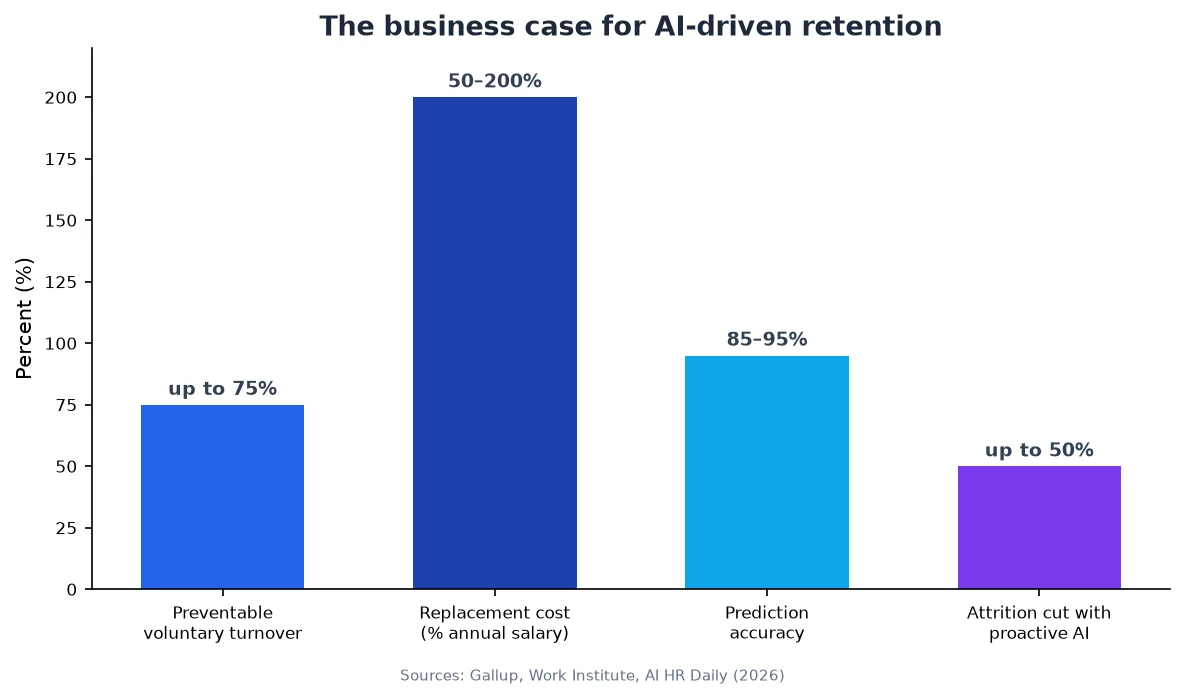
Replacing an employee costs between 50% and 200% of their annual salary once you add recruiting, onboarding, lost productivity and institutional knowledge walking out the door (Gallup, Work Institute). Modern attrition models now predict who is likely to leave three to six months ahead with 85–95% accuracy.
So the hard problem in 2026 is no longer detecting flight risk. It is doing something useful with the signal before it becomes a resignation letter. Most HR teams get the first half right and the second half wrong: they build a dashboard, watch the red flags light up, and still lose the same people.
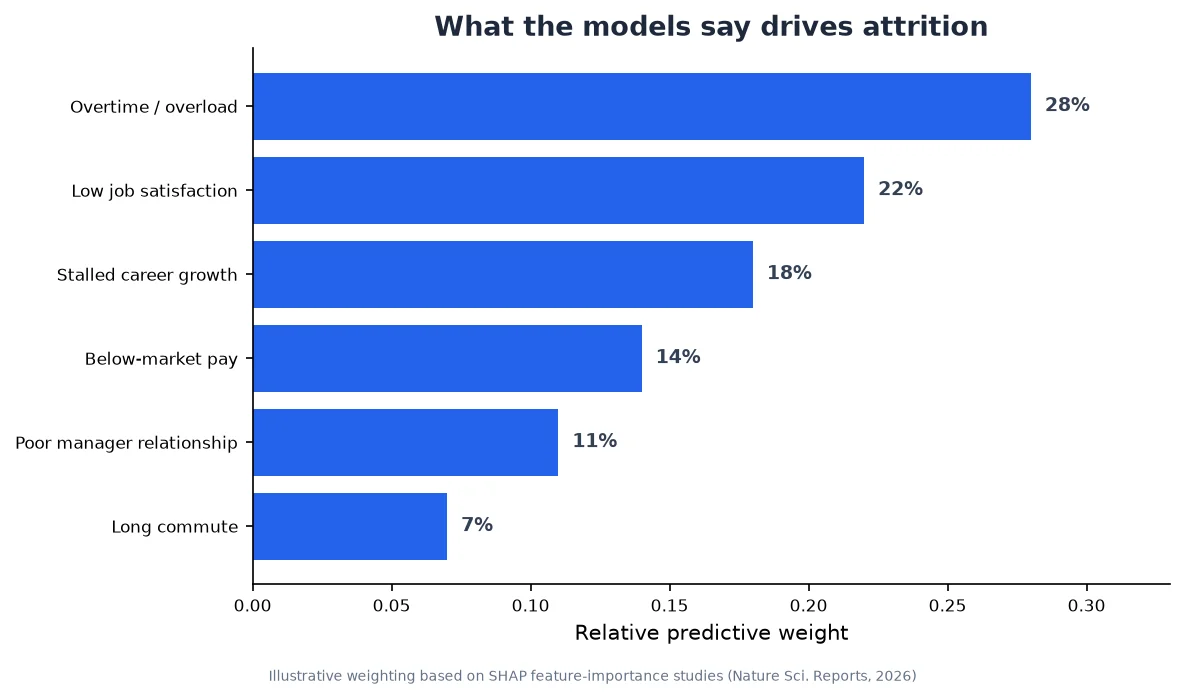
What a turnover model actually learns
Models ingest signals already in HR systems: tenure, time since last promotion, compensation versus market band, overtime and workload, engagement-survey scores, internal-mobility applications, manager changes and commute distance. Gradient-boosted trees and similar models weight these into an individual flight-risk score, refreshed monthly. Modern tooling adds explainability (SHAP values) so each score comes with its top contributing factors, not just a number. A score without a reason is useless to a manager. For a broader view of the data, read our guide to HR analytics and attrition prediction.
Why most predictions never change anything
Three failure modes keep appearing:
The score goes to the wrong person
It goes to HR, not the manager who can act.
The ranking has no next step
It arrives as a ranking with no recommended action.
Nobody closes the loop
There is no record of what intervention was tried and whether it worked. A prediction that lands in a dashboard nobody owns is just anxiety with a timestamp.
From signal to a retention conversation
The payoff is the proactive conversation. When a high-value employee crosses a risk threshold and the top driver is “stalled career growth”, the system routes a prompt to their manager suggesting a development conversation and surfacing open internal roles that match the person's skills. This connects the signal with the opportunities described in our internal talent marketplace guide. When the driver is “workload/overtime”, it flags the team's capacity; our workforce planning guide explains how to address that constraint.
The manager still owns the human conversation; the AI just makes sure it happens before, not after. Companies that pair prediction with structured, driver-specific intervention cut preventable voluntary turnover by up to 50% (AI HR Daily, 2026).
Governance: predicting people is sensitive
Flight-risk scores are high-sensitivity personal data. Never use them punitively: a flagged employee must never be sidelined from projects or raises because a model says they might leave. Keep a human in the loop on every action, be transparent about what data feeds the model, audit for bias across protected groups, and comply with GDPR and the EU AI Act for workforce analytics. A retention model that quietly becomes a loyalty-surveillance tool destroys the trust it was meant to protect.
Where AI workers fit
AI workers can run the unglamorous half that humans skip: refreshing scores monthly, attaching the explanatory drivers, routing the right prompt to the right manager at the right moment, and logging which intervention was tried and the outcome so the loop finally closes. The judgment and the conversation stay human; the follow-through gets automated.
The organizations winning on retention in 2026 are not the ones with the most accurate model. They are the ones that turned an accurate model into a timely, human, well-governed conversation. Prediction is a commodity now. Acting on it, consistently and fairly, is the differentiator.