Internal Talent Marketplaces: How AI Fills Roles From Inside Before You Hire Outside
By Delos Intelligence — 2026-10-09
Internal talent marketplaces use AI to match employees to open roles, projects and mentorships. See how they cut hiring cost, speed up staffing and lift retention.
Most companies spend heavily to recruit people they already employ. A role opens, a requisition goes to an external agency, and three desks away sits someone who could do the job with four weeks of coaching. Internal talent marketplaces are the software layer that closes that gap, and AI is what finally makes them work at scale.
What an internal talent marketplace actually is
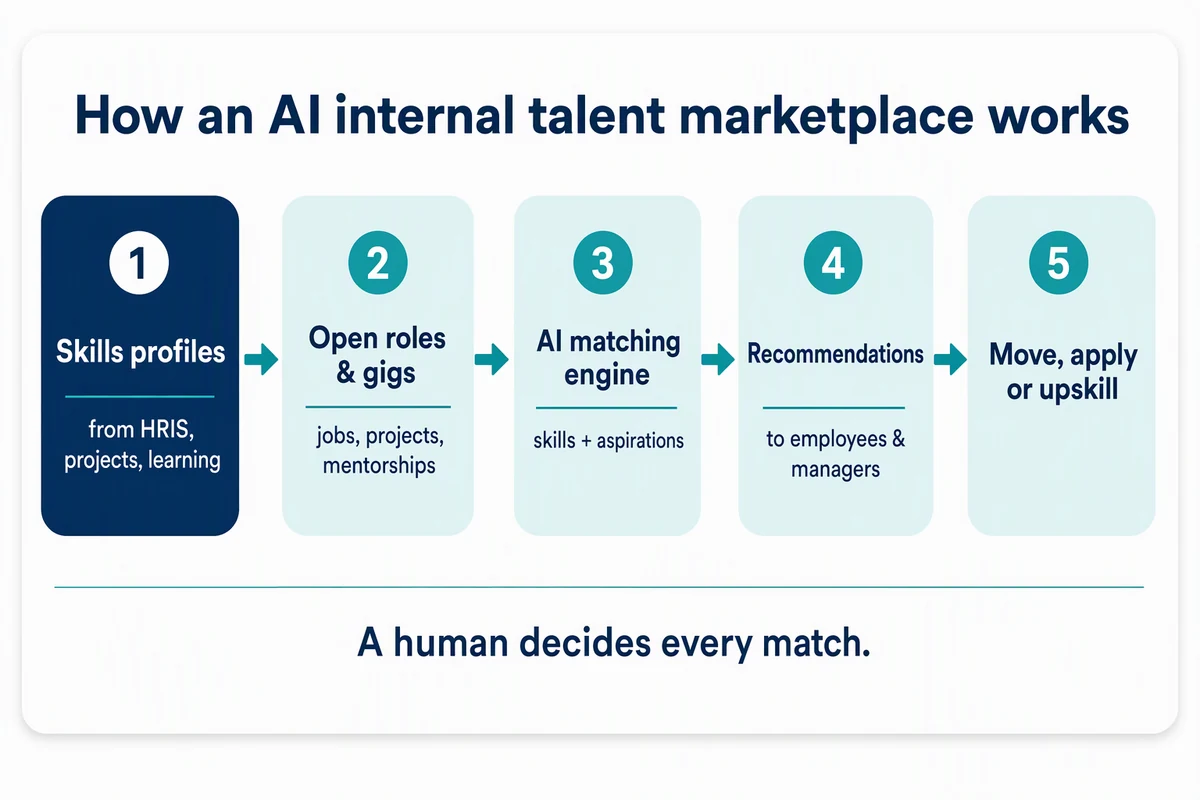
An internal talent marketplace is a platform that matches your existing employees to internal opportunities: full-time roles, short-term projects, gigs, mentorships and stretch assignments. Instead of a static job board nobody checks, an AI engine reads each person's skills, experience and stated aspirations, then surfaces opportunities to them and candidates to managers.
The shift is from posting and hoping to matching and nudging. The same engine that powers external recruiting is pointed inward, where you already have verified performance data.
Why it matters now
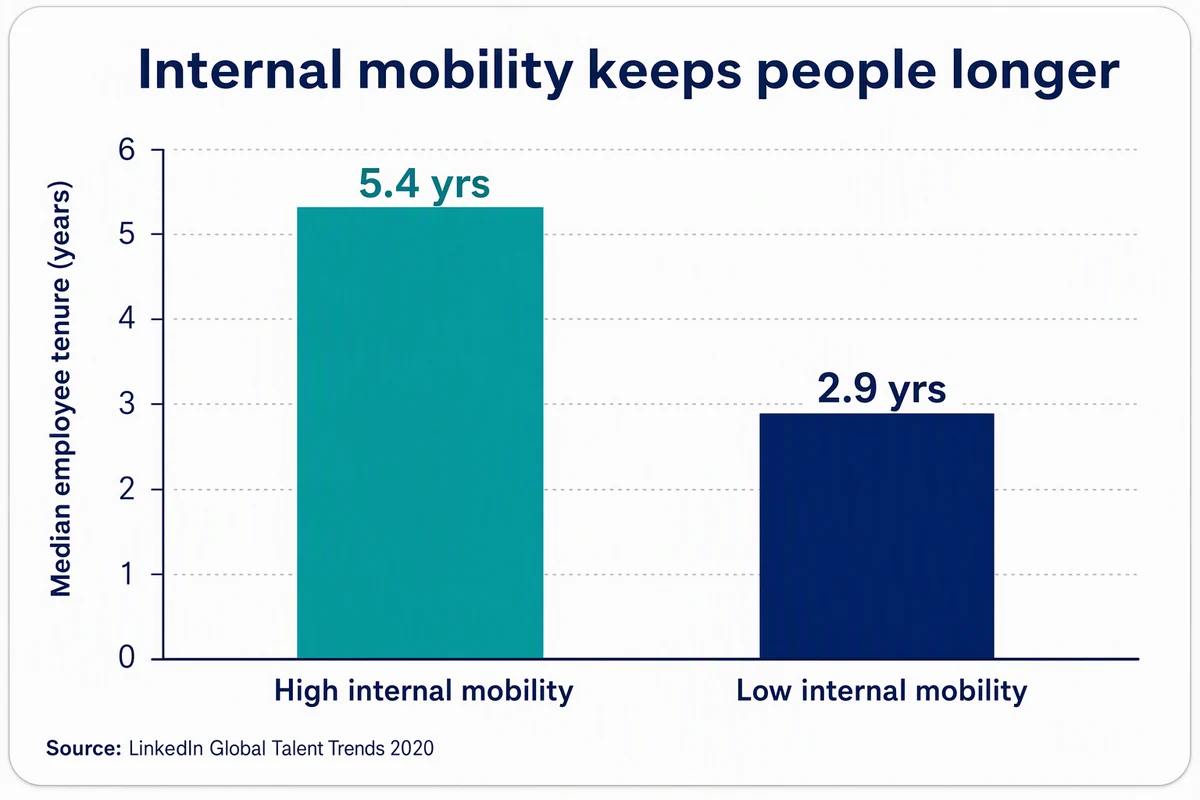
Two numbers explain the urgency. First, retention: LinkedIn's Global Talent Trends found that employees at companies with high internal mobility stay roughly twice as long, a median of 5.4 years versus 2.9 at low-mobility companies. Second, cost: SHRM benchmarks put the average cost-per-hire near 4,700 USD and average time-to-fill around 44 days. Every role you fill internally avoids most of both.
There is a skills angle too. McKinsey research has repeatedly shown that a majority of executives expect meaningful skills gaps in their workforce within a few years. You cannot hire your way out of that fast enough; you have to redeploy and reskill the people you have.
How AI changes the mechanics
Skills inference, not self-reporting
The old blocker was data. Employees rarely keep skills profiles current. Modern engines infer skills from project history, tickets closed, code committed, documents written and completed training, so the profile builds itself and stays fresh.
Matching on aspiration, not just fit
A good match is not only who can do the job today, but who wants to grow into it. AI weighs stated career goals alongside current skills, which is exactly what keeps high performers from leaving to find that growth elsewhere.
Nudging both sides
The marketplace recommends opportunities to employees and shortlists to managers, with a clear reason for each match. A human still decides every move; the AI removes the search cost that killed internal mobility before.
Concrete use cases
- Project staffing: a two-month data-migration project is staffed in days from people with proven adjacent skills, instead of a contractor onboarding for a month.
- Backfilling critical roles: when a specialist resigns, the engine surfaces three internal candidates already 80% ready, with the exact gap to close.
- Reskilling pathways: employees whose roles are shrinking get matched to adjacent growth roles plus the learning needed to qualify.
- Mentorship and gigs: short internal gigs spread knowledge and let people test a new function before committing.
Where it goes wrong
Internal marketplaces fail for predictable reasons. Managers hoard talent and block moves, so leadership has to reward releasing people, not just hiring them. Skills data that is stale or biased produces bad matches, so inference and human review both matter. And if employees fear that raising their hand flags them as a flight risk, participation collapses, so the culture has to treat mobility as normal, not disloyal.
Getting started
Start narrow: one business unit, project and gig matching only, with a human recruiter in the loop on every match. Measure internal fill rate, time-to-staff and 12-month retention of movers. Expand once the matches are trusted. The technology is ready; the hard part is governance and manager incentives.
AI did not invent internal mobility. It removed the friction that made it theoretical. The companies that win the next few years will fill most roles from the inside, and know exactly who is ready before the job is even open.
Related reading: AI talent acquisition, AI employee onboarding, AI workforce planning.