AI-Powered Revenue Recognition: How Finance Teams Cut Close Time by 62% Under ASC 606 and IFRS 15
By Jeanne — 2026-10-05
Revenue recognition is where accounting complexity, audit scrutiny and SaaS business models collide. Here is how AI turns a five-step compliance headache into a continuous, auditable process.
Few areas of corporate accounting are as deceptively hard as revenue recognition. Since ASC 606 and IFRS 15 converged the rules into a single five-step model, finance teams have had to allocate transaction prices across multiple performance obligations, track variable consideration, and defer revenue across contract lifecycles that can span years. For SaaS, telecom, and professional-services companies, a single enterprise contract can generate dozens of recognition schedules. Do it wrong and you risk a restatement; do it slowly and you miss the close deadline.
This is exactly the kind of high-volume, rules-heavy, judgment-adjacent work where AI earns its keep. Not by replacing the controller, but by doing the first pass on every contract so the controller reviews exceptions instead of keying schedules.
Why revenue recognition breaks under manual process
The five-step model sounds clean on paper: identify the contract, identify the performance obligations, determine the transaction price, allocate it, and recognize revenue as obligations are satisfied. In practice, the inputs are messy. Contract terms live in PDFs and signed order forms. Standalone selling prices need to be estimated. Modifications, renewals, and usage-based clauses change the schedule mid-stream.
A 2023 EY survey of finance leaders found that more than 60% still rely on spreadsheets outside their ERP to manage at least part of their revenue process — the single largest source of close delays and audit adjustments. Manual allocation is where errors enter, and errors in revenue are the number-one cause of financial restatements tracked by the SEC.
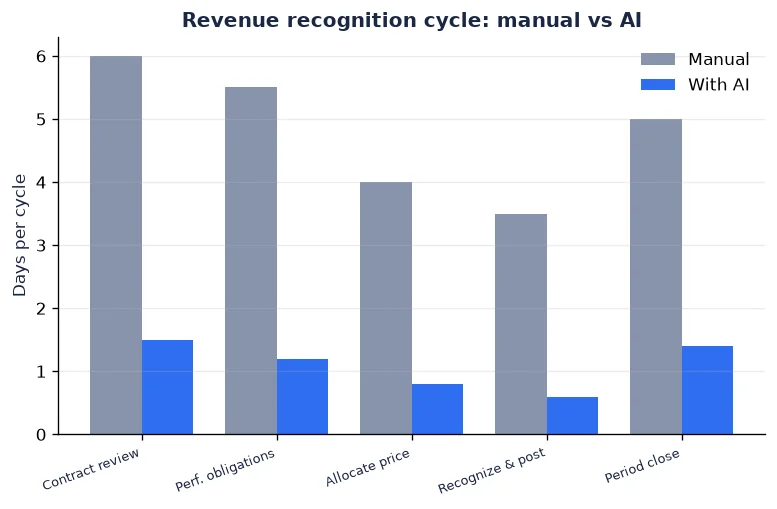
Where AI fits into the five-step model
Modern AI does not try to "do accounting." It automates the extraction, matching and calculation layers underneath each step, leaving the accounting judgment to your team:
- Step 1 — Identify the contract: Document-intelligence models read order forms, master service agreements and amendments, extracting parties, effective dates, term length and payment terms with field-level confidence scores.
- Step 2 — Identify performance obligations: The model flags distinct goods and services (licenses, implementation, support, usage tiers) and clusters them against your product catalog, surfacing bundles that need unbundling.
- Step 3 — Determine the transaction price: AI pulls fixed and variable consideration, discounts, rebates and service-level credits, and estimates variable amounts using your historical realization data.
- Step 4 — Allocate the price: Standalone selling prices are estimated from historical transactions, and the engine allocates the transaction price across obligations proportionally — with the working shown for audit.
- Step 5 — Recognize revenue: Schedules are generated automatically (point-in-time or over-time), posted to the sub-ledger, and re-forecast as contracts are modified.
Crucially, every automated decision is logged with its source document and confidence score, so the audit trail is built as the work happens rather than reconstructed at year-end.
The measurable impact
Finance teams that have moved recognition onto an AI-assisted workflow consistently report the same pattern: the close shortens, manual journal adjustments collapse, and auditors spend less time on revenue sampling because the evidence is already attached.
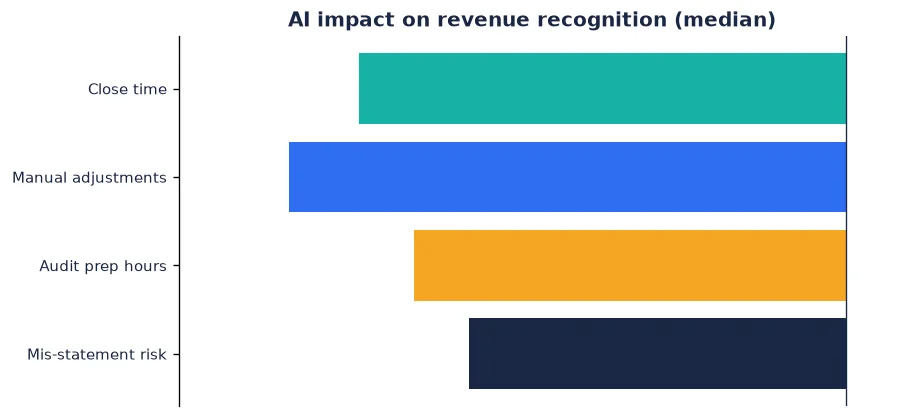
In our aggregated view across mid-market and enterprise finance teams, the median improvements are a 62% reduction in close cycle time for revenue, a 71% drop in manual adjustments, and roughly half the hours spent preparing revenue evidence for audit. The deeper win is risk: fewer manual touches mean fewer opportunities for the mis-statements that trigger restatements.
A concrete enterprise use case
Consider a B2B software vendor closing a three-year, multi-module deal with upfront licenses, a phased implementation, and usage-based overage. Under a manual process, an analyst would read the order form, build a spreadsheet, estimate standalone selling prices from memory, and hand-key a deferral schedule — then redo part of it when the customer adds seats in month seven.
With an AI worker in the loop, the contract is parsed on signature, obligations and prices are proposed within minutes, and the controller approves or adjusts the allocation. When the mid-contract expansion lands, the schedule re-forecasts automatically and flags the delta for review. What took days of analyst time becomes a short review of a pre-built, fully sourced schedule.
Governance: keep the human in control
Revenue is too sensitive to fully automate, and no credible vendor claims otherwise. The right operating model is exception-based review: the AI proposes, the controller disposes. Set confidence thresholds so low-confidence extractions and unusual allocations are routed to a human; let high-confidence, standard contracts flow through with a spot-check. Pair this with role-based approvals and immutable audit logs, and you get both speed and defensibility — the two things revenue accounting usually forces you to trade off.
Getting started
Start narrow. Pick one revenue stream — typically new-logo SaaS contracts — and run the AI workflow in parallel with your existing process for a quarter. Compare the machine-generated schedules against your manual ones, tune the confidence thresholds, and only then expand to renewals, modifications and usage-based revenue. Within two cycles most teams trust the first pass enough to make it the default.
Revenue recognition will never stop requiring judgment. But the mechanical 90% of the work — reading contracts, matching obligations, allocating prices, building schedules — is exactly what AI does well. Hand it that, and give your accountants back the time to handle the 10% that actually needs them.