Human-in-the-Loop AI Agents: The Oversight Playbook for 2026
By Pam — 2026-10-07
A practical four-tier framework for human oversight of enterprise AI agents: approvals, guardrails, audit trails, and a 30-day path to production.
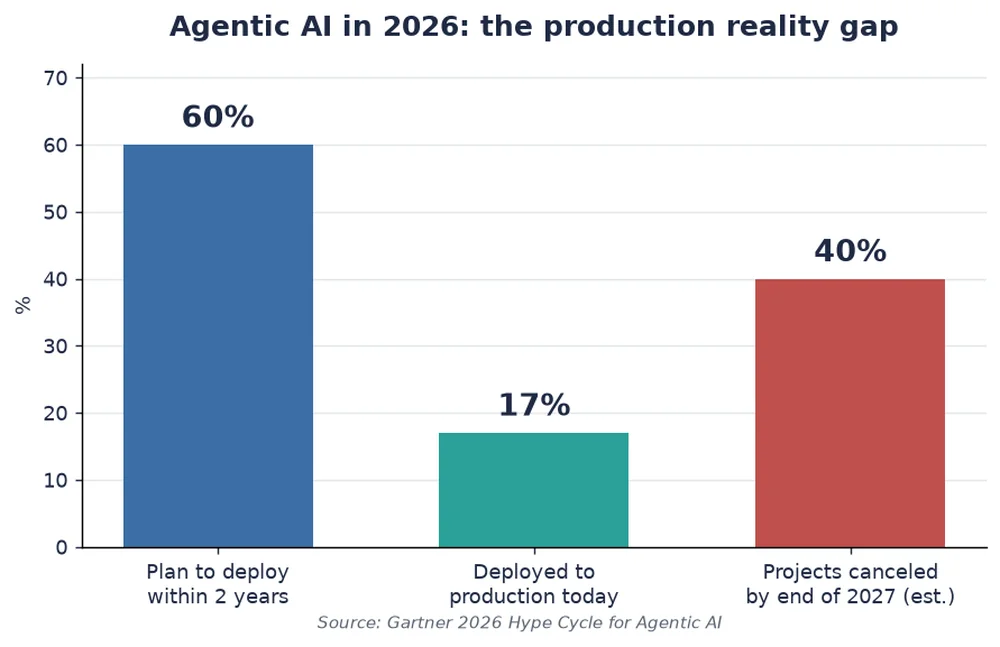
Agentic AI had a spectacular 2026. Agents stopped answering questions and started doing the work: closing renewals, triaging tickets, reconciling invoices, pushing code. And then enterprises hit the wall every powerful technology hits. Gartner predicts that over 40% of agentic AI projects will be canceled by the end of 2027 over cost overruns, unclear business value and inadequate risk controls. The gap between the demo and the deployment is where most budgets die.
The teams crossing that gap share one habit: they design human oversight into the agent from day one, instead of bolting it on after the first incident. This is the human-in-the-loop playbook for 2026.
The reality gap: why autonomous agents stall in production
An agent that drafts an email is a convenience. An agent that sends it, issues the refund, or changes a production config is a liability if it is wrong. The failure mode is rarely the model being dumb. It is the model being confident and wrong at a step no human saw. A Perplexity–Harvard field study of agent use found that more than half of activity in its dataset was genuine cognitive work, which is exactly why unchecked mistakes can compound so quickly.
The lesson from the cancellation forecast is not “use less AI”. It is “put a human at the right checkpoint”. Oversight is not the opposite of automation; it is what makes automation shippable. For the wider deployment picture, read our guide to agentic AI enterprise workflows.
Four tiers of human oversight
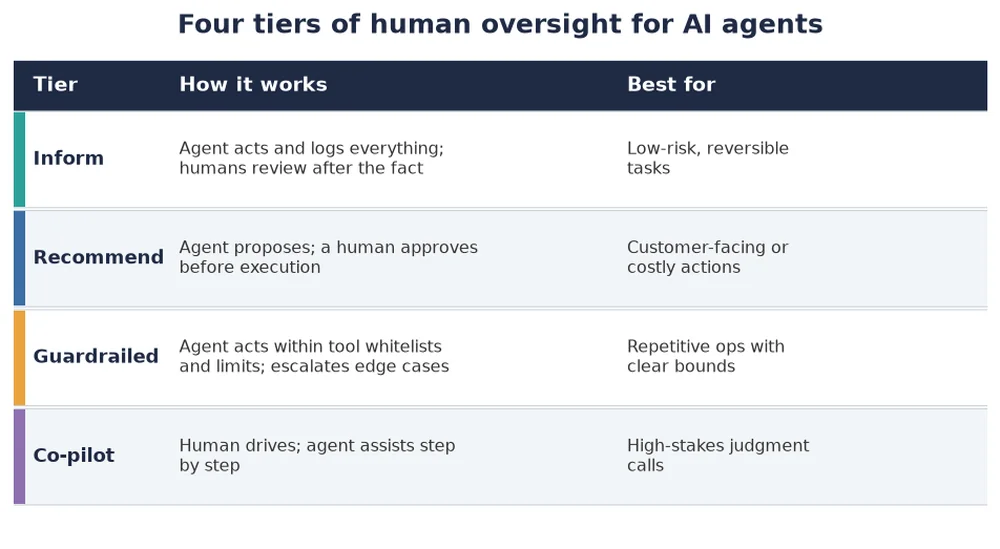
Human-in-the-loop is not one setting. It is a dial you turn per task, based on how reversible and how costly a wrong action is. Our AI agent guardrails guide explains how to enforce the boundaries.
1. Inform
The agent acts and logs everything; humans review after the fact. Right for low-risk, reversible work: tagging tickets, drafting internal summaries, enriching CRM records.
2. Recommend
The agent proposes, a human approves before anything executes. The default for customer-facing or costly actions: outbound messages, refunds, contract edits.
3. Guardrailed
The agent acts autonomously, but only inside tool whitelists, spend limits and policy checks, and escalates edge cases to a person. Right for repetitive operations with clear bounds.
4. Co-pilot
The human drives and the agent assists step by step. Reserved for high-stakes judgment calls where accountability must stay human.
Designing the checkpoint, not just the agent
Good oversight is cheap to comply with and expensive to bypass. Three design rules make it work:
- Make the approval ask a decision, not a document. Show the human the proposed action, the evidence, and the one-click approve/modify/reject, not a 40-line trace to decode.
- Escalate by exception, not by default. If a human has to approve everything, you have rebuilt manual work with extra steps. Route only the uncertain or high-impact cases to people.
- Log for replay. Every action, input and decision should be reconstructable. When something breaks, you want an audit trail, not a mystery.
This is also how you stay ahead of regulation: the EU AI Act's human-oversight provisions expect designated intervention points for higher-risk systems. BCG’s responsible AI practice treats governance as part of the operating model. For production failure modes, see our AI agent reliability analysis.
How Delos Workers build oversight in
Delos AI Workers are designed around the Recommend and Guardrailed tiers by default. A Worker prepares the full action, surfaces it for a one-tap approval on the channel you already use, and only executes once you sign off, with every step logged. You turn the dial toward more autonomy as a Worker earns trust on a given task, and back toward review the moment stakes rise. That is the practical difference between a flashy pilot and an agent you actually let touch production.
A 30-day path to trustworthy agents
Start narrow. Pick one workflow where a wrong action is costly but recoverable, and deploy at the Recommend tier: the agent does 100% of the preparation, a human approves 100% of the executions. Measure approval rates. When a task type clears 95%+ approvals for weeks, graduate it to Guardrailed with tight limits. Keep the Inform log running the whole time so you can prove what happened. Within a month you have agents that are fast where they have earned it and supervised where they have not, which is the only version of agentic AI that survives contact with production.
The enterprises that win in 2026 are not the ones with the most autonomous agents. They are the ones who put the human in exactly the right loop.