Shift Handover Is Where Plants Lose Hours: Let AI Agents Write the Report
By Delos Intelligence — 2026-10-25
Most plants still hand over shifts with a clipboard and a chat. Here is how AI agents draft the report, surface open issues and leave the sign-off to a human.
At 6:00 a.m., the night shift leaves. The day shift arrives to a machine that is "running a bit odd", a quality hold nobody wrote down, and a maintenance ticket that lives in someone's head. Shift handover is a small ritual with an outsized cost: this is where context gets lost, and lost context turns into repeat downtime.
It is also one of the most concrete places to put an AI agent to work. Deloitte's 2026 Manufacturing Industry Outlook names autonomously generated shift handover reports and work instructions as a way to maximise production uptime. This guide shows what that looks like in practice, and where to keep a human in the loop.
Why shift handover is a hidden source of downtime
A handover has to carry four things: what happened, what is still open, what is risky, and what the next shift must do first. On paper or in a chat thread, each of those depends on one tired person remembering everything at the end of a long shift.
The cost of getting it wrong is real. Siemens' downtime study, as cited by Digest.Pro, estimates that unplanned downtime costs the world's 500 largest companies about $1.4 trillion a year. Not all of that comes from a bad handover, but every repeated stop caused by a missed note is avoidable.
What an AI agent actually does at shift change
Forget the chatbot. A handover agent reads the sources your plant already produces, drafts the report, and asks a person to confirm it.
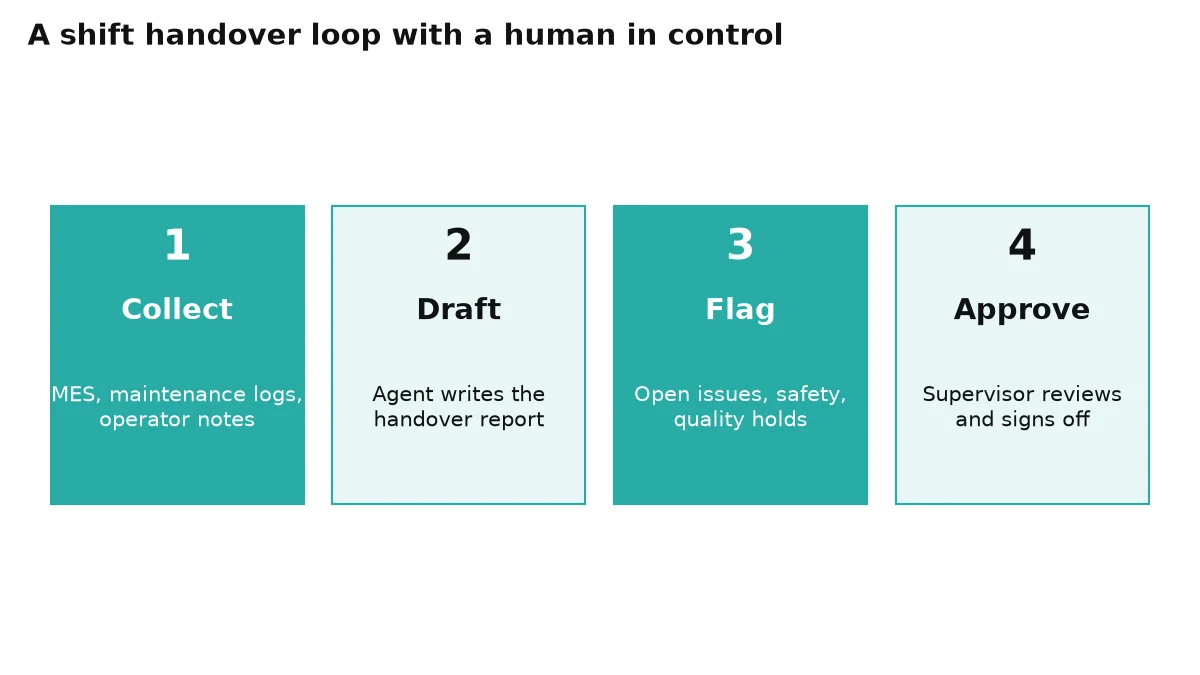
1. It collects
The agent pulls machine events and stoppages from the MES, open and closed tickets from the maintenance system, quality holds, and the free-text notes operators already type. Nothing new for the team to fill in.
2. It drafts
It writes a short, structured report: output versus target, stoppages with probable causes, deviations, and what changed on each line. Same format every shift, so readers know where to look.
3. It flags
Open issues, safety observations and quality holds go to the top, not buried in paragraph six. If the same alarm has appeared three shifts in a row, the agent says so.
4. It hands the decision back
The outgoing supervisor reviews, corrects and signs. The agent never changes a schedule or releases a lot on its own.
Where plants are today: piloting a lot, scaling little
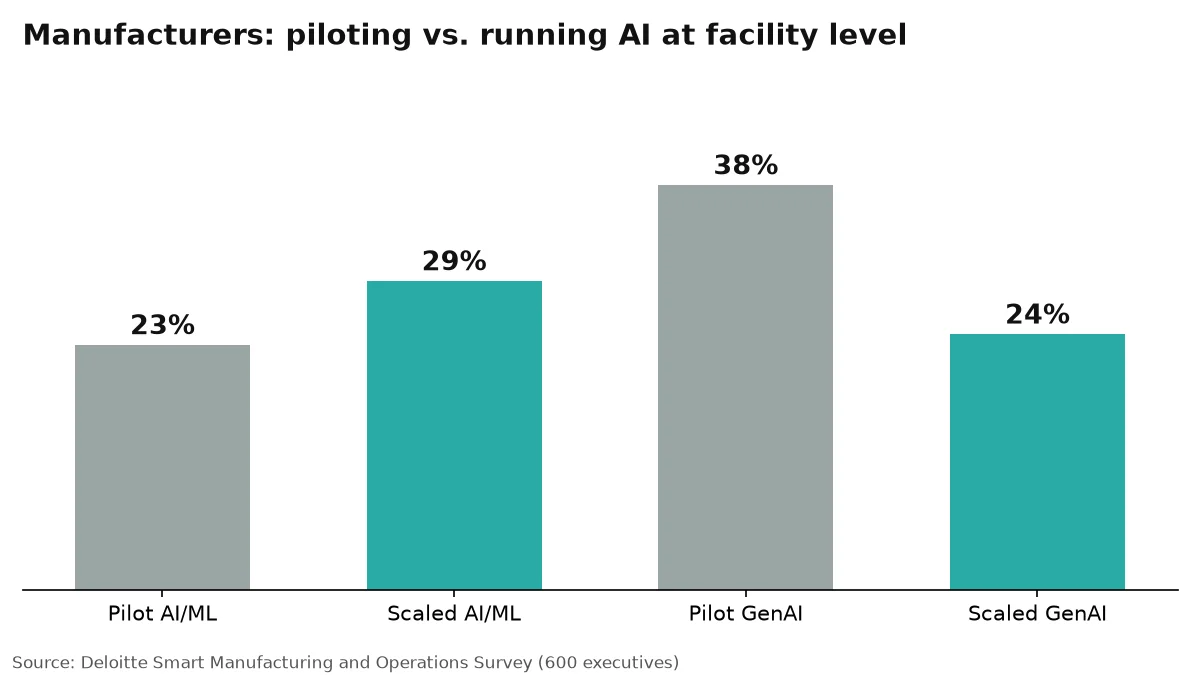
Deloitte's Smart Manufacturing and Operations Survey of 600 manufacturing executives shows the gap clearly. At facility or network level, 29% of manufacturers use AI or machine learning and 24% use generative AI, while 23% and 38% are still piloting them.
A Swiss Deloitte survey, AI in Manufacturing 2026, points the same way: 84% of manufacturers already see measurable value from AI, but only about 20% of use cases are scaled. Handover is a good candidate to cross that gap because the inputs exist, the output is easy to check, and one line is enough to start.
A four-step loop with a human in control
The pattern is the same in every plant that gets it working: collect, draft, flag, approve. The last step is not a formality. It is what makes the report trustworthy.
What the plants that scale do differently
Deloitte's 2026 outlook is blunt about prerequisites: integrated data and a modern architecture come before agents, not after. In practice, that means three habits.
- They start with one line and one shift pattern. Two weeks of parallel running, agent report next to the human one, is enough to see what is missing.
- They fix the data first. If machine states are mislabelled in the MES, the agent will faithfully repeat the mistake.
- They define what the agent may never do. Read access to MES and maintenance, write access only to the draft report. See our guide on letting agents handle routine exceptions for the same principle in logistics.
For a look at what agentic AI on a real shop floor looks like, this Bosch video from its Bamberg site is a good primer.
How to start next week: a 30-day plan
- Week 1: pick one line, list the five things a good handover must contain, and collect three weeks of real handover notes.
- Week 2: connect read-only access to the MES and maintenance tickets; generate draft reports without sharing them.
- Week 3: run in parallel; supervisors mark every missing or wrong item.
- Week 4: switch the draft to the primary report, keep sign-off mandatory, and track repeat stoppages and time spent writing reports.
Measure what matters
Skip vanity metrics. Track three numbers: minutes spent writing the handover per shift, repeat stoppages within 24 hours of a handover, and the share of open issues that were acted on in the first hour of the next shift. If those move, you have a case to extend to the next line. Access control matters too: read our piece on least privilege for AI agents before connecting anything to production systems.
Conclusion
Handover will not make headlines, and that is the point. It is a bounded, measurable, human-supervised workflow where an agent saves time every shift and prevents the stoppages nobody wrote down. Start with one line, keep the sign-off, and let the numbers decide.