Digital Omnibus: the AI Act timeline moved, what to do with your AI roadmap
By Delos — 2026-11-10
The Digital Omnibus pushed the AI Act's high-risk rules to December 2027. Not everything moved. Here is how to sort your roadmap.
When the Digital Omnibus on AI came into force, many teams read it as a pause button. It is not. The high-risk rules moved, other dates did not, and one date even came earlier. The useful question is no longer "when is the deadline?" but "what do we keep, re-time or defer?".
What the Digital Omnibus actually changed
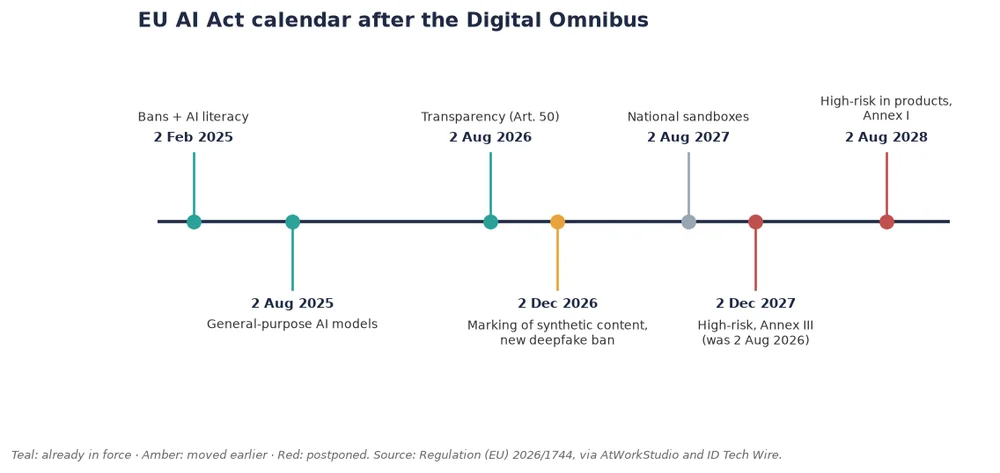
According to the reporting on the political agreement of 7 May 2026, the Council and Parliament agreed to move stand-alone high-risk AI systems (Annex III: biometrics, employment, education, critical infrastructure and similar areas) from August 2026 to 2 December 2027. AI embedded in regulated products (Annex I: medical devices, machinery, toys, lifts) moves to 2 August 2028. The Parliament had backed the extension with a 569 to 45 vote in March 2026 ID Tech Wire. The text was then adopted as Regulation (EU) 2026/1744: approved by the Parliament on 16 June 2026 and by the Council on 29 June, in force since 27 July, as summarised by AtWorkStudio. The legal base remains the AI Act itself, Regulation (EU) 2024/1689.
What did not move
- Bans on unacceptable practices and the AI literacy duty: in force since 2 February 2025.
- Obligations for general-purpose AI models: in force since 2 August 2025.
- Transparency duties (Article 50): apply since 2 August 2026. Systems already on the market have until 2 December 2026 to mark synthetic content, a grace period cut from six to three months.
- A new ban on non-consensual sexual deepfakes and AI-generated child abuse material, from December 2026.
In short, the delay covers the high-risk tier, not the whole regulation.
!EU AI Act calendar after the Digital Omnibus
Triage your roadmap in three buckets
!Roadmap triage after the delay: keep, re-time, defer
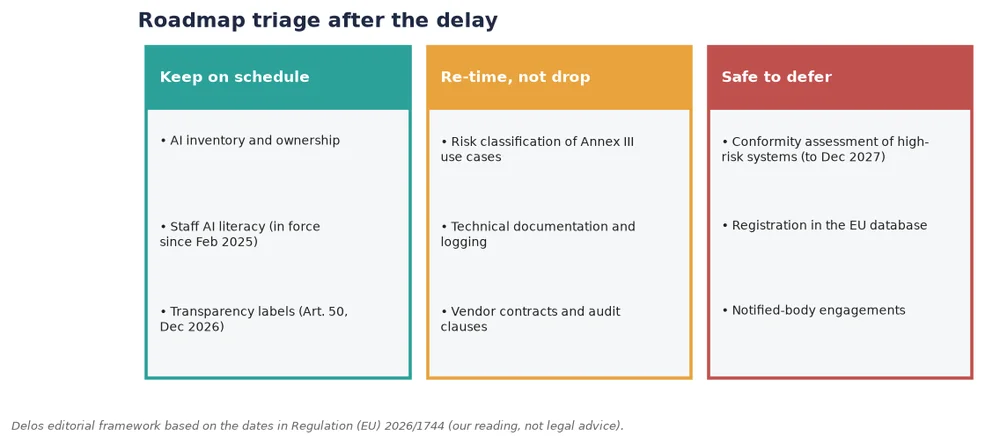
Keep on schedule
Your AI inventory and named owners, staff AI literacy, and the transparency labels due in December 2026. These cost little, they are already required or imminent, and every later step depends on them.
Re-time, do not drop
Risk classification of your Annex III use cases (HR screening, credit scoring, biometrics), technical documentation, logging, and vendor contract clauses. The deadline is 2027, but documentation built over twelve months is better than a last-quarter sprint, and your vendors need time to answer your questions.
Safe to defer
Formal conformity assessment of high-risk systems, registration in the EU database and any notified-body work. Plan them for 2027, and re-check the dates before committing budget: the framework is still being implemented through standards and guidance.
Four decisions to take this quarter
1. Name one owner for the AI inventory. Without a list of systems, including AI features hidden in third-party software, no date means anything.
2. Classify every use case once. A short written decision (high-risk or not, and why) beats a debate repeated in each project.
3. Ask vendors for their AI Act position in writing. What do they provide: documentation, logs, audit rights? Put it in the renewal calendar.
4. Keep one budget line for 2027. A delay moves spend, it does not remove it. The penalty ceilings did not change: up to EUR 35 million or 7% of worldwide turnover for prohibited practices, EUR 15 million or 3% for high-risk and transparency breaches, according to AtWorkStudio.
Three mistakes to avoid
- Treating 2027 as 2030. Standards, audits and procurement cycles take longer than expected.
- Freezing useful projects. Most enterprise AI assistants are not high-risk systems; do not stop low-risk productivity projects (see our piece on where the minutes saved with AI really go).
- Skipping the self-check. Run our 8-question AI Act self-test to see where you stand today.
How Delos Workers help
Workers can maintain the AI inventory, draft the use-case classification notes for review, chase vendor answers and keep documentation current, with a person validating each decision. Governance stays human; the paperwork stops eating the quarter.
Conclusion: the Omnibus bought time, not an exemption. Spend it on the inexpensive foundations now, and keep the heavy conformity work for when the dates are stable. This article is an editorial reading of public sources, not legal advice; check the current legal text with your counsel.