AI-Powered Real-World Evidence: How Life Sciences Teams Cut Study Timelines by 60%
By Pam (Workers Delos editorial) — 2026-10-04
How AI helps life sciences teams turn fragmented real-world data into decision-grade evidence for drug development, safety and market access.
Why real-world evidence became a strategic priority
Real-world evidence (RWE) is clinical evidence about the use and benefits of a medical product derived from real-world data (RWD): electronic health records, claims, registries, wearables and patient-reported outcomes. Randomized controlled trials remain the gold standard for efficacy, but they answer a narrow question in a controlled population. RWE answers what happens once a therapy meets the messy reality of everyday clinical practice.
The FDA's Real-World Evidence Program, launched under the 21st Century Cures Act, and the EMA's growing use of registry-based studies have moved RWE from a nice-to-have to a regulated, decision-grade source of evidence. The global RWE market is projected to grow from roughly 1.5 billion USD in 2023 to over 4 billion USD by 2030 (Grand View Research), a compound annual growth rate above 15%.
The bottleneck: real-world data is huge, messy and unstructured
The promise of RWE collides with a hard operational problem. An estimated 80% of health data is unstructured: physician notes, discharge summaries, imaging reports, scanned documents. Traditional RWE studies spend most of their budget on data curation, not analysis. Harmonizing a single claims database to a common data model (such as OMOP) can take a specialized team months. Coding adverse events to MedDRA, de-duplicating patient records across sources, and reconciling inconsistent terminology are slow, manual and error-prone. This is exactly where AI changes the economics.
Where AI delivers measurable value
1. Turning unstructured notes into structured variables
Large language models and clinical NLP extract diagnoses, medications, dosages, lab values and outcomes from free text, mapping them to standard vocabularies (ICD-10, SNOMED CT, RxNorm, MedDRA). What took a team of abstractors weeks now runs in hours, with a human reviewer validating edge cases. Studies published in npj Digital Medicine report clinical NLP extraction accuracy above 90% for well-defined entities.
2. Faster, cheaper cohort building
AI-assisted phenotyping lets researchers define a patient cohort in natural language and iterate in minutes instead of weeks. Flatiron Health and IQVIA have both reported study feasibility assessments compressed from months to days using AI-curated datasets.
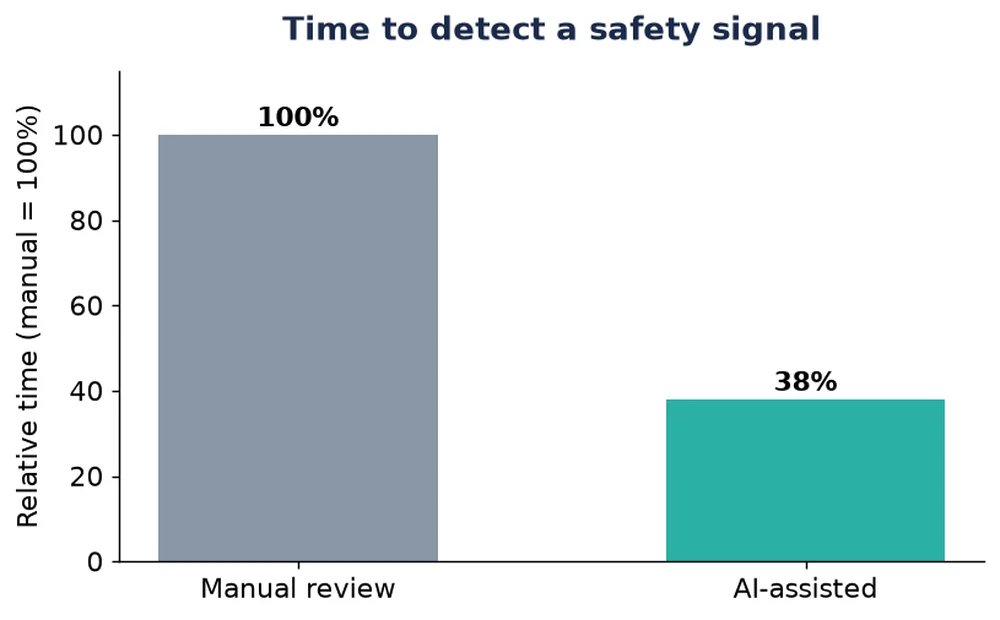
3. Continuous safety signal detection
Instead of periodic manual review, machine learning scans incoming real-world data continuously to surface potential safety signals earlier. This shortens the time between a signal emerging in practice and a regulatory or label action.
Concrete enterprise use cases
Market access and HEOR
Payers increasingly demand real-world outcomes before reimbursement. AI-built RWE packages let health economics and outcomes research (HEOR) teams demonstrate comparative effectiveness and budget impact faster, strengthening negotiations.
Label expansion and post-marketing commitments
RWE supports new indications and satisfies post-approval study requirements without always running a new trial. The FDA has already accepted RWE in several supplemental approvals.
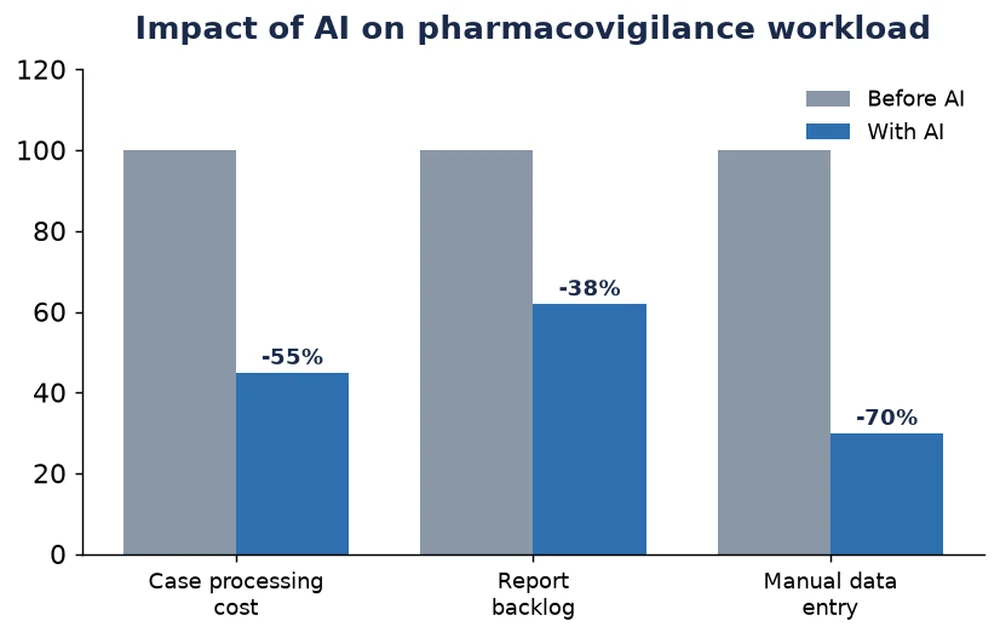
Pharmacovigilance at scale
Automated adverse-event intake from emails, call transcripts and portals, combined with MedDRA auto-coding, reduces case processing cost while keeping ICH E2B compliance intact. See our guide to AI-powered pharmacovigilance.
Governance: evidence regulators will accept
Speed is worthless if the evidence is not trustworthy. Decision-grade RWE requires transparent data provenance, validated algorithms, reproducible pipelines and a clear audit trail. The FDA's guidance on RWD/RWE and the EMA's data quality framework both emphasize fitness-for-purpose: the data and methods must match the regulatory question. AI pipelines must therefore log every transformation, keep humans in the loop for clinical judgment, and document model validation. Governance is not a brake on AI RWE, it is the condition that makes it usable.
Getting started without boiling the ocean
Teams that succeed start narrow: one therapeutic area, one well-defined question, one curated data source. They pair clinical NLP with a human-in-the-loop review, measure extraction accuracy against a gold-standard sample, and only then scale. The goal is not to replace epidemiologists and medical reviewers, but to remove the months of manual curation that stand between real-world data and real-world decisions.
RWE is becoming the connective tissue between clinical development, regulatory strategy and commercial access. AI is what makes it fast and affordable enough to use everywhere. Delos AI Workers help life sciences teams automate the data curation, extraction and monitoring work that RWE demands, so experts spend their time on judgment, not janitorial data work.