AI-Powered Contract Analysis: How Enterprises Cut Contract Review Time by 75% and Catch 88% of Risk Clauses
By Pam — 2026-09-09
How AI contract analysis tools help enterprises cut review time by 75%, identify 95% of clauses, and catch 88% of risk flags at a quarter of the cost.
The Hidden Cost of Manual Contract Review
Enterprise legal teams manage thousands of agreements across procurement, sales, partnerships, employment, technology, and regulated operations. Manual review remains expensive and inconsistent: a complex contract can consume eight hours of attorney time, yet reviewers may identify only 60% of material clauses and 45% of risk flags.
The cost extends beyond legal labor. Missed auto-renewals lock enterprises into unwanted commitments. Uncapped liability, weak data protection terms, and unfavorable termination rights create financial exposure. Obligations buried in signed agreements are often disconnected from operational systems, causing missed credits, service-level penalties, and compliance deadlines.
AI-powered contract analysis changes the operating model. Natural language processing extracts clauses, compares language against standards, scores risk, and generates concise summaries. Human lawyers retain judgment over negotiation and approval, while AI handles the high-volume work that slows review.
How AI Contract Analysis Works
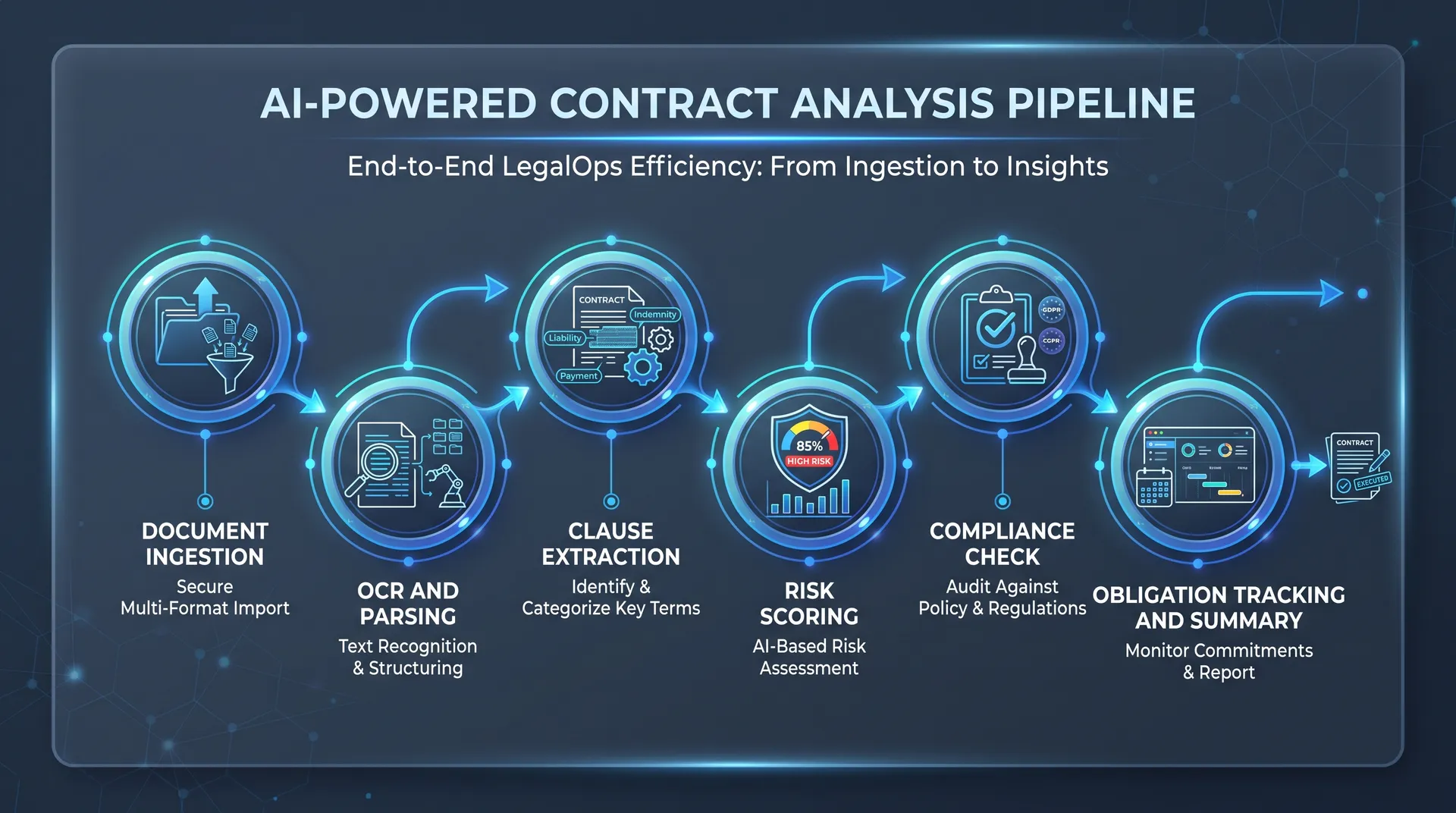
Stage 1: Document Ingestion and Parsing
The platform ingests Word files, searchable PDFs, scanned agreements, amendments, schedules, and email attachments. OCR converts scans to machine-readable text. Document models preserve page structure, tables, definitions, and cross-references so extraction remains traceable to the source.
Stage 2: Clause Extraction
AI identifies payment terms, liability caps, indemnities, termination rights, governing law, intellectual property, confidentiality, data protection, service levels, and renewal provisions. It maps each clause into a structured taxonomy while retaining the original wording and page reference.
Stage 3: Risk Scoring and Deviation Analysis
Extracted clauses are compared with approved templates, fallback positions, risk policies, and historical outcomes. The system flags missing clauses and deviations such as uncapped liability, excessive notice periods, broad indemnities, or data-processing terms that conflict with GDPR requirements.
Stage 4: Compliance Checks
The platform evaluates contracts against applicable regulations and internal controls. It can flag absent data-processing agreements, incomplete security obligations, restricted-party concerns, and industry-specific requirements.
Stage 5: Obligation Tracking
Signed contracts are converted into structured obligations: who owes what, when it is due, and which evidence proves performance. These obligations can be synchronized with procurement, CRM, ERP, and project-management systems.
Stage 6: Summary Generation
Stakeholders receive a concise brief containing the commercial terms, material risks, required actions, and recommended negotiation points. The summary links every statement to the source clause.
!AI contract analysis pipeline
Manual Review vs AI-Powered Review
| Metric | Manual Review | AI-Powered Review |
|---|---|---|
| Review time per contract | 8 hours | 2 hours |
| Clauses identified | 60% | 95% |
| Risk flags caught | 45% | 88% |
| Cost per review | $2,400 | $600 |
!Contract review performance comparison
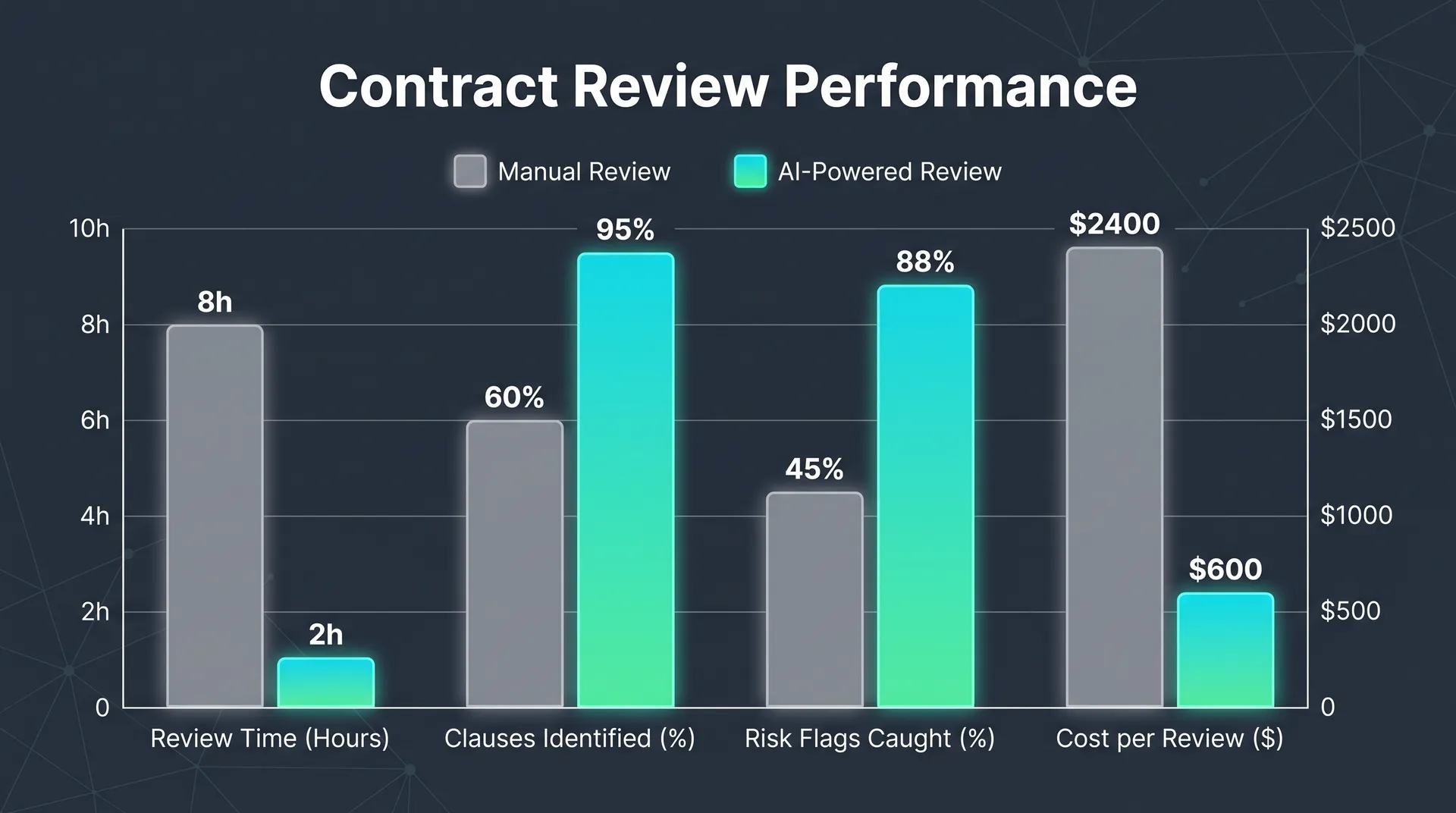
The 75% reduction in review time allows legal teams to process larger volumes without reducing rigor. Standard agreements can move quickly, while senior lawyers concentrate on material deviations and strategic negotiations.
Enterprise Use Cases
Procurement
Procurement teams review supplier terms, compare pricing and service levels, detect unfavorable renewals, and identify consolidation opportunities. AI enables consistent review across thousands of vendor agreements.
Legal Operations
Legal operations teams standardize intake, triage contracts by risk, measure cycle time, and improve playbooks using data from previous negotiations. The system creates an auditable record of review decisions.
M&A Due Diligence
Deal teams ingest data-room contracts, identify change-of-control provisions, customer concentration, IP restrictions, litigation exposure, and termination rights. AI accelerates document review while improving portfolio coverage.
Vendor Management
Post-signature analysis supports obligation monitoring, service-level enforcement, certificate tracking, and renewal planning. This reduces value leakage after contracts are executed.
A Four-Phase Implementation Roadmap
Phase 1: Define the Clause Taxonomy
Document the clauses, fallback positions, and risk thresholds that matter. Start with one high-volume agreement type such as NDAs, procurement contracts, or customer MSAs.
Phase 2: Pilot in Shadow Mode
Run AI analysis alongside current legal review. Measure extraction accuracy, risk recall, false positives, review time, and attorney agreement with recommendations.
Phase 3: Integrate with CLM and Workflows
Connect the analysis engine to contract intake, templates, e-signature, and repository systems. Route low-risk contracts through streamlined workflows and escalate deviations automatically.
Phase 4: Expand and Optimize
Add more contract types, jurisdictions, and business units. Use reviewer feedback to improve the taxonomy, playbooks, and model performance.
Governance, Security, and Human Oversight
Contracts contain commercially sensitive and personal data. Enterprises should enforce encryption, data residency, role-based access, retention controls, and complete audit trails. Models must be tested for extraction accuracy across languages and contract formats.
Human review remains essential for high-value agreements, unusual language, and decisions that materially affect rights or obligations. AI should accelerate review and improve consistency—not replace legal accountability.
The ROI Case
An enterprise reviewing 1,000 contracts annually can reduce review cost from approximately $2.4 million to $600,000, producing $1.8 million in annual savings. Faster review also shortens sales and procurement cycles, while stronger risk detection prevents expensive disputes and missed obligations. Typical payback occurs within six to nine months.
The Bottom Line
AI-powered contract analysis converts contract review from a manual bottleneck into a structured intelligence workflow. Enterprises gain faster cycle times, broader clause coverage, consistent risk scoring, and reliable post-signature obligation tracking. The winners will pair AI speed with experienced legal judgment and strong governance.
This article was written with AI assistance. In accordance with EU AI Act Article 50 transparency obligations, readers are informed that AI tools were used in the creation of this content.