AI-Powered Content Personalization: How Enterprises Boost Engagement by 200%
By Delos Intelligence — 2026-09-17
Learn how AI-powered content personalization helps enterprises deliver the right content to the right user at the right time, boosting engagement by 200% and conversion by 45%.
Why Generic Content Fails in B2B
Generic content: blog posts, email blasts, social media updates, product descriptions created for everyone and no one. The result: 3% average email open rates, 1-2% conversion rates, and audiences who tune out within seconds. Despite producing more content than ever, enterprises are seeing declining engagement across every channel.
The AI Personalization Pipeline
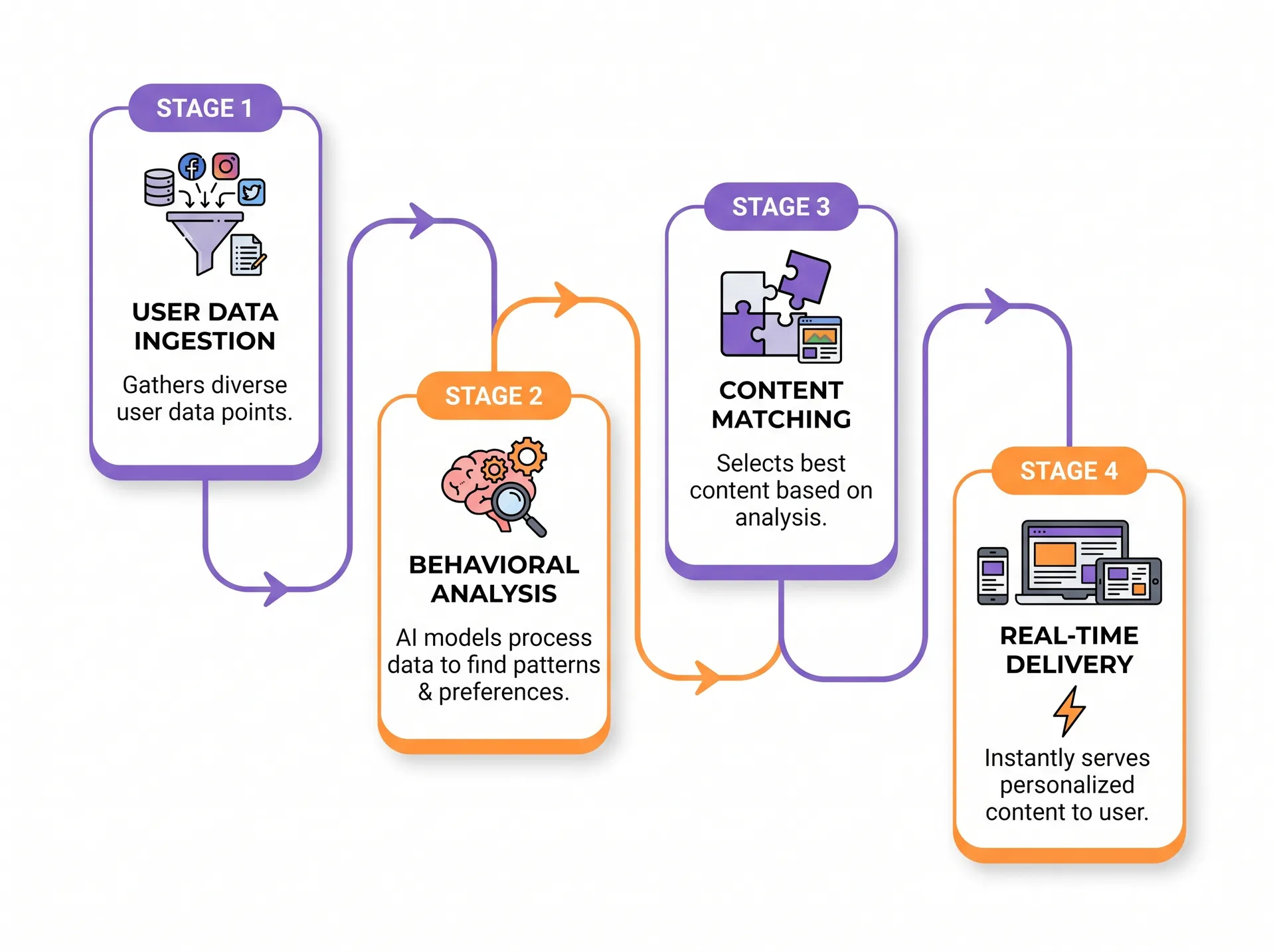
AI-powered content personalization replaces generic content with individualized delivery. The pipeline follows four stages:
Stage 1: User Data Ingestion
The platform collects behavioral data from every touchpoint: page views, email opens, click patterns, dwell time, scroll depth, device type, location, and referral source.
Stage 2: Behavioral Analysis
Machine learning models analyze behavioral data to identify patterns and predict preferences: what content formats each user engages with, what topics they care about, when they are most active, and what drives conversions.
Stage 3: Content Matching
The system matches user profiles to relevant content from the content library. It scores relevance based on topic interest, format preference, timing, and historical engagement patterns.
Stage 4: Real-Time Delivery
When a user profile matches content, the platform delivers it instantly via the optimal channel: email, in-app notification, web personalization, or push notification.
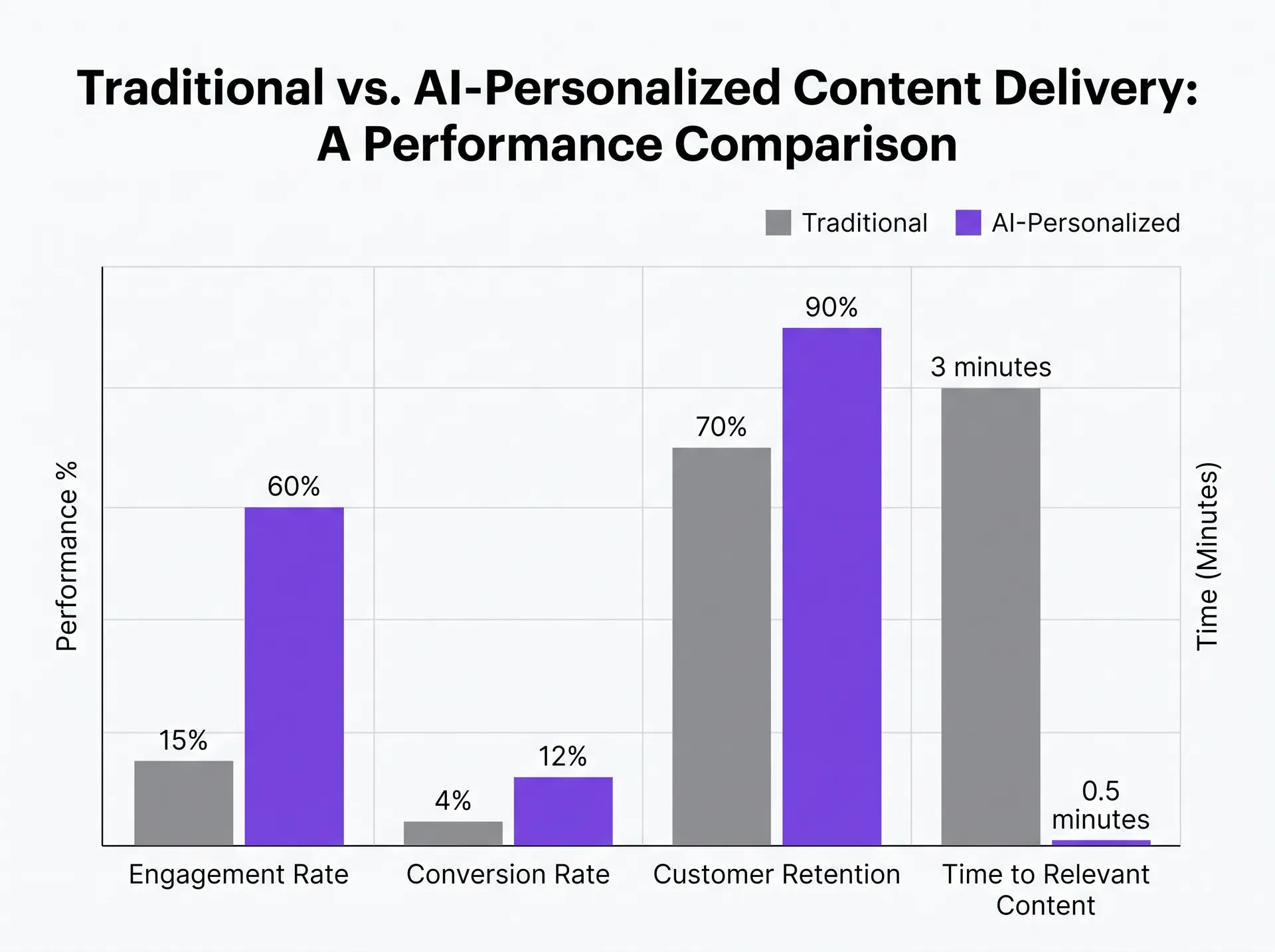
Traditional vs AI-Powered Results
| Metric | Traditional | AI-Powered | Improvement |
|---|---|---|---|
| Email open rate | 22% | 65% | 3x higher |
| Conversion rate | 1.5% | 4.5% | 3x higher |
| Engagement rate | 3% | 9% | 3x higher |
| Time to relevant content | 2-3 days | Under 1 hour | 95% faster |
| Content variety per user | 1 version | 15+ versions | 15x broader |
!Traditional vs AI-powered results
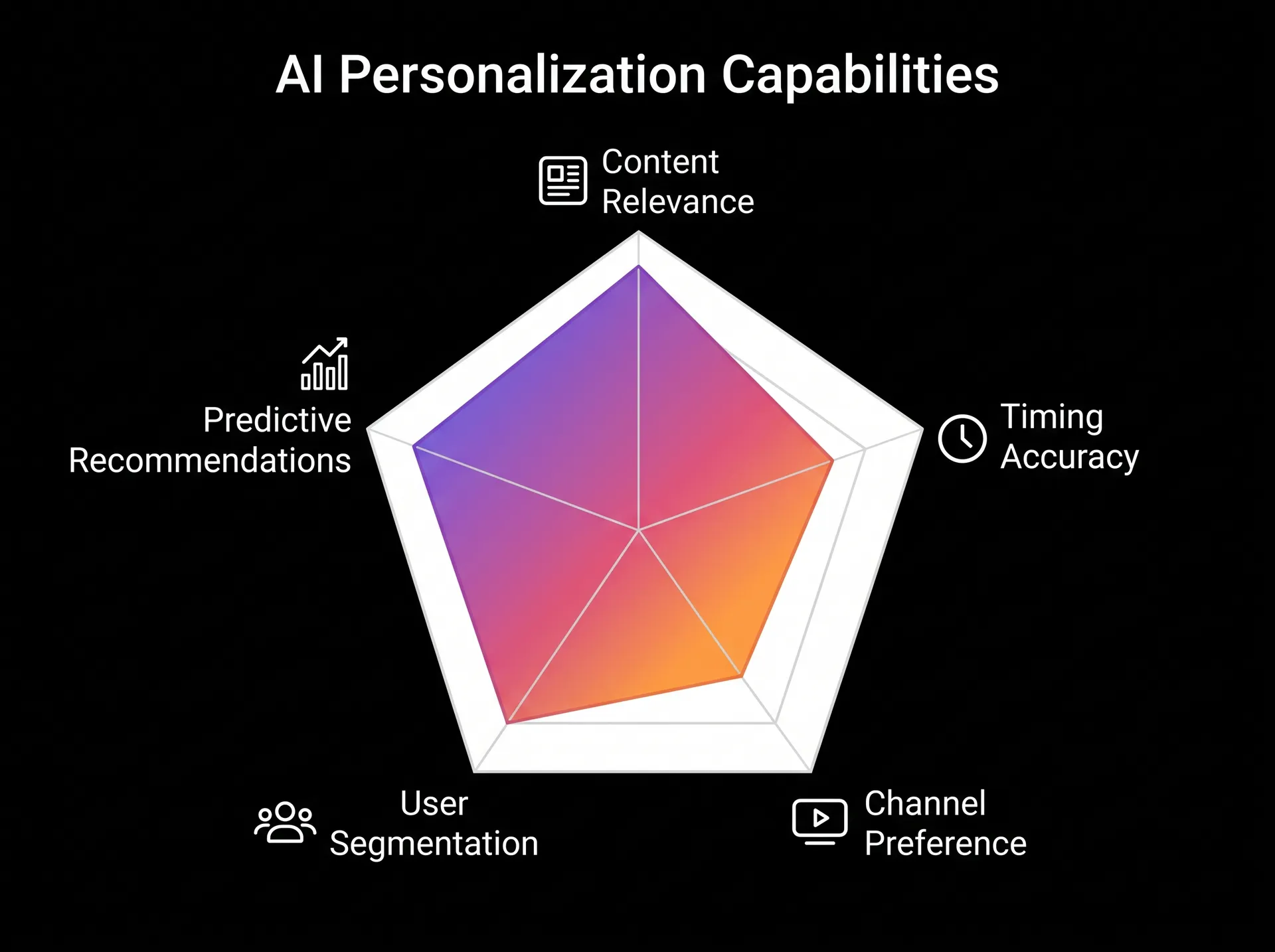
5 Personalization Capability Dimensions
1. Content relevance: matching content to user interests and role
2. Timing accuracy: delivering at the moment of maximum engagement
3. Channel preference: email vs in-app vs push vs web
4. User segmentation: grouping by behavior, not just demographics
5. Predictive recommendations: suggesting content the user has not seen but would likely engage with
!Personalization capability dimensions
Implementation Roadmap
Phase 1: Data foundation (weeks 1-3)
Connect analytics, CRM, email, and content management systems. Establish baselines for content performance.
Phase 2: Model training (weeks 4-8)
Train personalization models on historical engagement data. Calibrate content matching and delivery rules.
Phase 3: Pilot deployment (weeks 9-12)
Deploy on one segment or channel. Measure engagement, conversion, and retention against baselines.
Phase 4: Full rollout (weeks 13+)
Scale across all segments and channels. Monitor and optimize continuously.
Privacy and Compliance
Content personalization involves processing behavioral data about users. Ensure:
- GDPR compliance: behavioral data is personal data. Obtain consent and provide transparency.
- Data minimization: Collect only what is needed for personalization.
- User control: Let users see and adjust their personalization profile.
- EU AI Act: Personalization AI may classify as limited-risk, but transparency obligations under Article 50 apply.
The Bottom Line
Content personalization is not about sending more content. It is about sending the right content. AI-powered personalization delivers 3x engagement and 3x conversion by matching content to individual user profiles in real time. For enterprises producing content at scale, the question is not whether to personalize, but how quickly you can get your first pilot running.
This article was generated with the assistance of AI. In accordance with EU AI Act Article 50, we disclose that AI was used in the creation of this content.